Showing posts with label Pasta. Show all posts

Friday, 6 May 2022

Pasta with Rutabaga Greens, Anchovies, Garlic & Chile

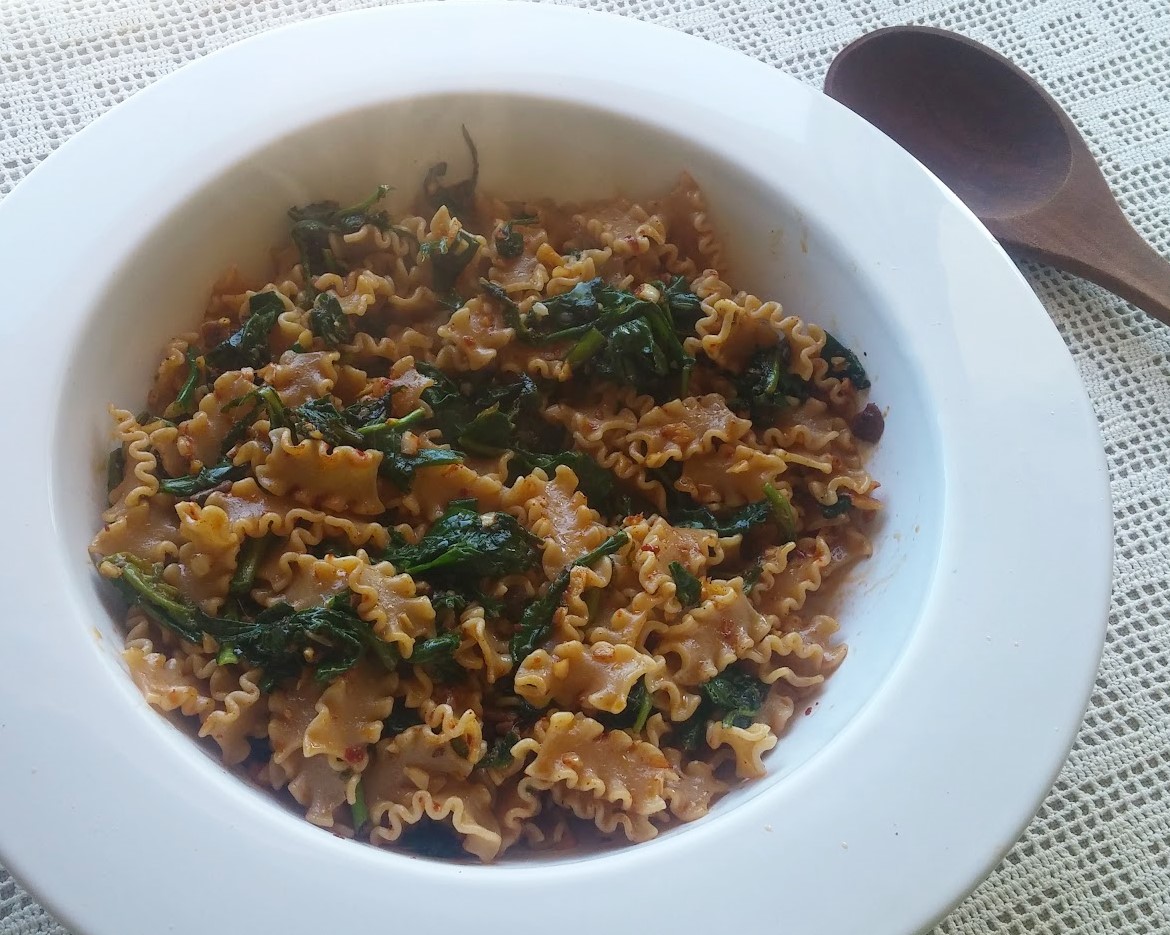
Here is a lively take on one of my favourite ways to prepare pasta: the pasta and some vegetable are cooked together then dressed with something richer and perhaps fried. In this case not fried, so much as infused into a generous but not too greasy amount of olive oil. (If your anchovies come with a certain amount of oil, by all means start with that when you measure the oil.) All the flavours are very strong, but in spite of that they get along with each other excellently. I used whole wheat pasta - I mostly do these day, on the rarish occasion I eat pasta at all - which can be a bit robust for more delicate sauces but which mingles well with all these equally robust ingredients. Use whatever pasta you like, though. 
 
Rutabaga greens are, as I've said before, the best (non)turnip greens, but turnip greens could be used, or Swiss chard, kale, or collards in their season. Rapini or broccoletto too, would be good, meaning this is a dish that can be made any time there are good, astringent greens around. Spinach? I think it's a little too refined to be ideal for this hearty dish, but it would work well enough if that's what you can get. Apply it with a little heavier hand, maybe. 

I'm saying 20 minutes, which is about the time for the water to come to a boil and then cook the pasta and greens, but if your greens are at all obstreperous about needing picking over, allow a little longer.
 
2 to 4 servings
20 minutes prep time
Pasta with Rutabaga Greens, Anchovies, Garlic & Chile

300 grams (10 ounces) rutabaga greens
6 to 10 cloves of garlic
1/4 to 1/2 teaspoon chile flakes
freshly ground black pepper to taste
25 grams (1 ounce; 1/2 small tin) anchovies
225 grams (1/2 pound) pasta
1/4 cup olive oil
 
Put a large pot of salted water on to boil for the pasta.

Wash and trim the greens, and chop them. Peel and mince the garlic, and put them in a small bowl with the chile flakes and pepper. Drain and mince the anchovies. 

When the water boils, add the pasta and set the timer for 1 minute longer than the recommended cooking time. When the pasta has 6 minutes left to cook, add the green, mixing them in well. 

Meanwhile, heat the olive oil over medium-low heat in a smallish skillet. When it is hot, mix in the garlic with the spices, and the anchovies. Allow them to sizzle gently in the oil until very fragrant, then remove from the heat and set aside. 

When the pasta and greens are cooked, drain them well and return them to the pot. Toss them with the hot seasoned oil and toss well to combine. Serve at once.


Last year at this time I made Cipollata.

Friday, 15 October 2021

Macaroni & Blue Cheese

I went and bought some blue cheese on a whim (by which I mean it was on sale) and then I needed something to do with it. A look around the cupboards rounded up the usual suspects and a seasonal cauliflower, so macaroni and cheese it was. It's fairly different from the usual macaroni and cheese, but if you like blue cheese it's very good stuff. I'd have thrown some sautéed mushrooms in if I had had any mushrooms, but I didn't. You could. 

Also, I dare not refer to this as mac and cheese, as my mother screams with horror at the degeneracy of modern manners and morals every time she sees macaroni and cheese disrespected that way. It isn't even macaroni and cheese, really; I used rotini as it seems so hard to find good old elbow macaroni these days. Any small, stubby pasta will work just fine.
 
3 to 6 servings
1 hour 20 minutes - 30 minutes prep time
 

Cook the Macaroni & Cauliflower:
4 cups small cauliflower florets
225 grams to 250 grams (1/2 pound) macaroni or similar pasta
 
Wash, trim, and prepare the cauliflower. Put a large pot of salted water on to boil. Cook the pasta with the cauliflower for half the recommended time for the pasta; usually 5 or 6 minutes. (If for some reason the pasta cooking time is not 5 or 6 minutes, that's still how long to cook the cauliflower.) Drain well.

Make the Sauce:
200 grams (1/2 pound) cream cheese
3/4 cup milk
2 teaspoons barley or other flour
125 grams (1/4 pound) blue cheese
2 cloves of garlic
NO to 1/8 teaspoon salt
freshly ground black pepper to taste
1/4 to 1/2 teaspoon Aleppo pepper
 
Mix the milk slowly into the cream cheese to make a smooth sauce. Mix in the flour, then crumble the blue cheese and mix it in. Peel and mince the garlic and mix it into the sauce with the remaining seasonings. Salt will depend on how salty your particular blue cheese is.

Make the Topping & Finish:
1/3 cup finely grated Parmesan cheese
1/3 cup fine bread crumbs
2 tablespoons unsalted butter

Preheat the oven to 375°F. Lightly oil a shallow 2 quart baking dish (8" x 10" lasagne pan). 

Mix the Parmesan and the bread crumbs, and rub in the butter until they are evenly moistened. 

Mix the drained pasta and cauliflower into the sauce. Spread it all evenly into the prepared pan. Sprinkle the top evenly with the Parmesan bread crumbs. Bake for 40 to 45 minutes, until golden brown and bubbly at the edges. Let rest 5 minutes before serving. 


Last year at this time I made Koresh Karafs - Persian Celery Stew.

Wednesday, 24 March 2021

Baked Penne or Ziti

This seems to be a very popular American take on pasta baked in the oven, although it's not something that was ever made in my family. It has a lot of resemblances to lasagne, but it's simpler, both in the amount of effort required to assemble it, and in the flavours of the finished product. I have to admit I thought it was quite pleasant, but maybe a tad dull. But things that are comfort foods often are a little plain, I think; they're comfort foods because they are childhood foods.

Most instructions for this recipe have you cooking the pasta completely before baking. Even at cooking for half the time before baking, I found the pasta got a little bit too soft. I wrote up the instructions suggesting to cook them for even less time, but now I'm wondering if I make this again if I shouldn't add just a bit more sauce and put the pasta in raw. 

And yes, there's a lot of tomato sauce already and I've broken it down as I have because it goes into the casserole in stages.
 
4 servings
1 hour 15 minutes - 40 minutes prep time
 
Baked Penne
 
Pre-Cook the Pasta & Get Started:
1 medium onion
3 or 4 cloves of garlic
1 tablespoon olive oil
1/4 teaspoon salt
freshly ground black pepper to taste
1 1/2 teaspoons fennel seeds, crushed
1 1/2 teaspoons rubbed oregano
1/4 to 1/2 teaspoon Aleppo or similar pepper
340 grams (12 ounces) penne OR ziti
 
Put a pot of water on to boil (salted as usual) for the pasta. Peel and chop the onion finely. Peel and mince the garlic. Heat the oil in a skillet and cook the onion over medium heat until softened and translucent. Add the garlic and cook for another minute. Stir regularly. When the onion and garlic are done, transfer them to a mixing bowl. Add the seasonings to them.
 
When the water boils, add the pasta and cook for HALF (or even less) of the time listed on the package; generally this will be for 5 or 6 minutes, but 3 or 4 may be even better. Drain the pasta, and if you are not ready to proceed, rinse it in cold water and drain well again.
 
Assemble the Casserole & Bake It:
150 grams (5 ounces) mozzarella cheese
2/3 cup grated Parmesan cheese 
1/2 cup tomato sauce 
1 1/2 cups tomato sauce 
125 grams ricotta cheese
1 cup tomato sauce

Preheat the oven to 375°F. Grate or dice the mozzarella and grate the Parmesan.
 
Put 1/2 cup of tomato sauce into an 8" x 10" (2 quart) baking (lasagne) pan, and spread it evenly over the bottom. Spread half the prepared pasta over it. Mix 1 1/2 cups of sauce and 1/3 of the ricotta cheese into the onions and spices. Top the pasta in the pan with half of this mixture. 

Dot half the remaining ricotta over the casserole, and sprinkle half the mozzarella over it. Top with the remaining pasta, the remaining mixed sauce, and the remaining ricotta and mozzarella. 
 
Press the top of the casserole gently with the back of spoon to be sure it's reasonably level, then drizzle the remaining cup of plain tomato sauce over the casserole. Sprinkle the Parmesan evenly over it. 

Bake at 375°F for 35 to 40 minutes, until the top is lightly browned, then let rest for 10 minutes before serving. 


Last year at this time I made Turkish Red Lentil Kofte.


Friday, 26 February 2021

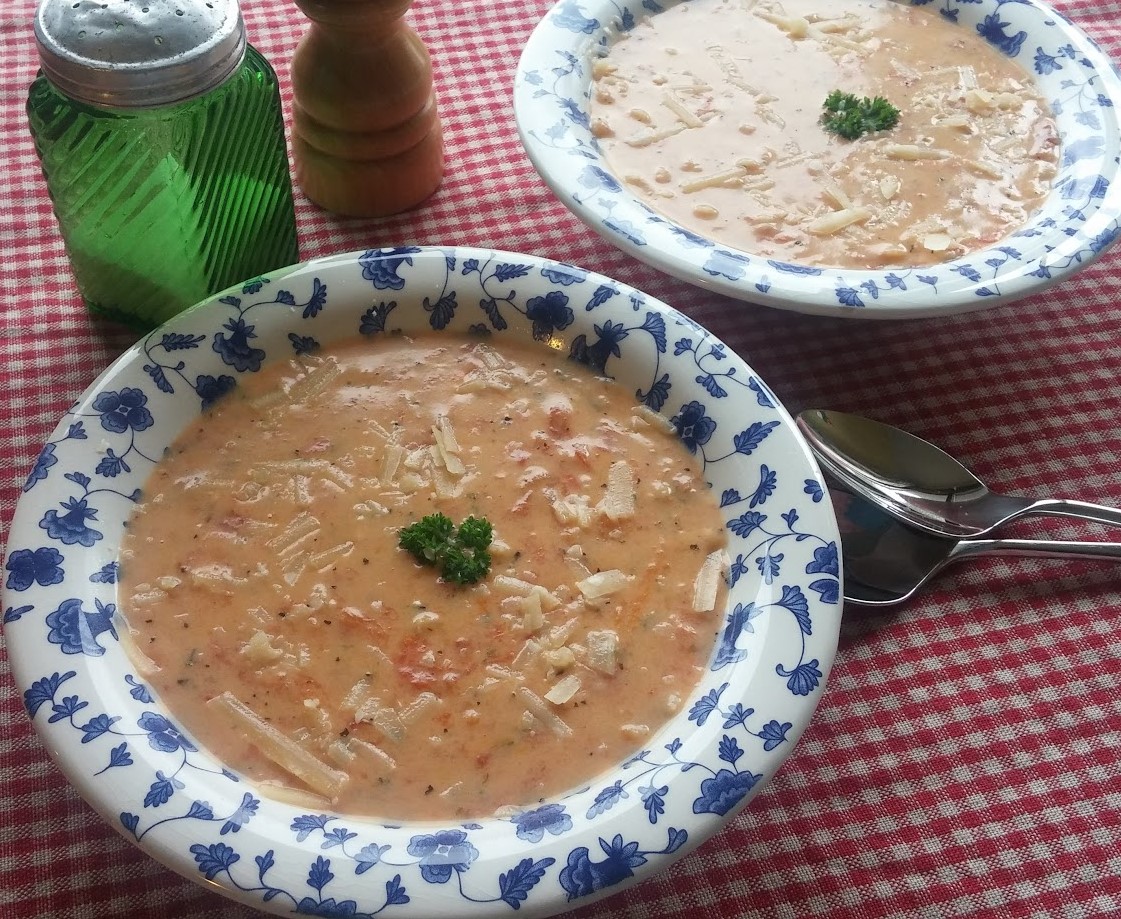
Tomato, Macaroni, & Cheese Soup

This is too simple and homely a dish to justify taking 2 pots to make, but there it is. It does. I have to rate it as worth it, because it's the fabulous marriage of 2 popular comfort foods. 
 
As usual, we ate it all. It's soup, but it's really also the main event. All it needs is a bit of salad on the side to be a complete meal.
 
2 to 4 servings
20 minutes prep time

Tomato Macaroni & Cheese Soup

In Pot #1:
2 1/2 cups crushed tomatoes
1/2 cup water
1/4 teaspoon salt
1 by leaf
1 cup small soup-sized pasta (e.g. macaroni)

Put everything but the pasta into a medium-sized saucepan and bring them to a boil. Add the pasta, stir well, and boil for 2 minutes short of the recommended cooking time. Stir occasionally.

Meanwhile...

In Pot #2:
2 tablespoons unsalted butter
2 tablespoons flour
1 teaspoon mixed Italian herbs OR
1/2 teaspoon rubbed basil AND
1/4 teaspoon rubbed oregano AND
1/8 teaspoon rubbed rosemary leaves
freshly ground black pepper to taste
2 cups milk
125 grams (1/4 pound) old Cheddar cheese
2 tablespoons grated Parmesan cheese

In a heavy-bottomed 2 litre (qt) soup pot, melt the butter with the flour and seasoning. Mix well and cook to a pale paste. Stir in the milk, a little at a time, to form a smooth sauce, adding larger amounts each time until it is all in. Whisk until thickened; it should take just a few minutes.

Dice or grate the Cheddar and add it to the white sauce you have just made. Stir until completely melted. At about this time, the pasta in the crushed tomatoes should be cooked. Stir it all slowly into the cheese sauce. Do not let it simmer or boil again, but it should be hot through and the pasta should be tender. Serve at once, sprinkled with a little Parmesan. 


Last year at this time I made Barley Mujadara.

Friday, 19 February 2021

Sweet Potato Gnocchi with Peas & Paprika Cream Sauce

Gnocchi and Spaetzle continue to be my new pasta best friends. Sweet potatoes give these ones a delicate flavour that goes well with delicate sauces. A little grated Parmesan passed when you serve them does not go amiss.
 
Since this makes 4 servings, I froze half the dough. The next time, I thawed it out overnight, sprinkled on a bit more potato starch, and formed and cooked the gnocchi as usual. It worked fine.  

4 servings
45 minutes prep time
NOT including baking the sweet potato
 
Sweet Potato Gnocchi with Peas & Paprika Cream Sauce

Make the Gnocchi:
900 grams (2 pounds; 2 large) sweet potatoes
1/2 teaspoon salt
freshly ground nutmeg
1 large egg
1 3/4 cups barley flour
1/2 cup potato starch
 
Wash, trim, and bake the sweet potatoes at 375°F for 1 to 1 1/4 hours, until tender. Let cool. This can be done up to a day ahead. 
 
Peel and mash the sweet potato very smoothly. Put it in a mixing bowl and mix in the salt, nutmeg, and egg. Add the barley flour a portion at a time and work it in until you have a fairly soft and sticky but smooth dough. 

Sprinkle about 2 tablespoons of potato starch onto a clean surface (I used a bit of parchment paper) and coat 1/4 of the dough in it. Roll it out into a long snaky cylinder. Use a fork to cut off bite-sized pieces, which are then rolled into an oval and pressed with the tines of the fork. Set aside on a plate which has been lightly dusted with starch, and repeat with the remaining dough. Try not to stack them, as they will stick to each other. This can be done up to a day ahead too; cover them with a tea towel in an airtight container in the fridge.
 
Cook the Gnocchi & Make the Sauce:
2 cups thawed frozen peas
2 medium shallots
2 cloves of garlic
1 1/2 teaspoons sweet Hungarian paprika
1/4 teaspoon salt
freshly ground black pepper to taste
1 tablespoons barley flour
2 tablespoons unsalted butter
1 tablespoon sherry
1 cup 10% cream
 
Put a large pot of lightly salted (not nearly as much as for dry pasta) water on to boil. Have the gnocchi and the peas standing by. 

Peel and mince the shallots and the garlic. Put the garlic in a small bowl with the paprika, salt, pepper, and flour. 
 
Heat the butter in a large skillet over medium heat. When it is melted and sizzling, add the shallots and cook for about 5 minutes, stirring occasionally. Keep the temperature at a gentle but steady simmer. 
 
Meanwhile, when the water comes to a boil put in the gnocchi and peas, and give them a very gentle stir. Boil them until they float. (I mean the gnocchi, but the peas will too.) Drain well when done. 
 
But meanwhile again, add the spices and flour to the shallots and mix in well; let cook for about a minute. Add the sherry and mix in well, then slowly stir in the cream. Mix well, stirring frequently, until it thickens - it should take just a few minutes and it should not boil. Add the drained gnocchi and peas and gently fold into the sauce. Transfer to a serving dish or dishes, and serve. I saved a few of the peas at the bottom of the strainer to sprinkle over the top, for the colour. 


Last year at this time I made Creamy Rutabaga & Leeks.

Friday, 8 May 2020

Spinach-Spelt Spaetzle or Gnocchi

The amount of fresh spinach you need to have to end up with a fairly piddling amount of cooked spinach is amazing. I did use frozen spinach here, because there is still a fair bit in our freezer from last year, but I know very well that each packet of frozen spinach takes about 8 medium-packed cups of washed and trimmed spinach, having washed and trimmed it by the bushel. And also, while we have spinach in the garden and there are SOME leaves large enough to use, it needs to do a fair bit of growing yet. Goodness, this has been a slooooow spring and I am finding it harder to take than usual; wonder why?

I made this a couple of times to make sure I had the ideal quantity of flour; but the trouble is the exact quantity will depend on how moist your spinach is. A dough stiff enough to want to form a ball will give firmer spaetzle, but it will also be a lot harder to push through the spaetzle maker. The second time I made them I used the higher amount of flour, and could only get 2/3 of the dough through the spaetzle maker before my arm gave out. I made the rest of the dough into gnocchi after dinner and fried them up for breakfast. If you want gnocchi, that's the way to do it. For spaetzle, it's better to keep the dough softer. 

With some vegetables and cheese in moderate quantities this will be a complete meal for two. If you are serving it as a more definite side dish, with a piece of fish, poultry, or other meat, it will certainly go further.

Preparing the spinach is by far the most tedious and time-consuming part of making this dish; the actual cooking takes minutes once the water comes to a boil. Do not make the batter too far in advance of the cooking time, as it will get stiff and even harder to work.

2 to 6 servings
30 minutes to prepare spinach
15 minutes to make spaetzle

Spinach Spaetzle

170 grams (6 ounces) cooked spinach
1/3 cup water
1 large egg
1/2 teaspoon salt
freshly ground black pepper to taste
a few scrapes of nutmeg
1 1/2 to 1 3/4 cups whole spelt flour

Wash, trim and pick over, drain, and steam the spinach. You will need about 8 cups fresh to start, and you will end up, once it has been squeezed fairly dry and chopped, about 1/2 cup. You can certainly start with frozen spinach which has been thawed, or you could prepare your spinach in advance; keep it refrigerated until needed.

At any rate, once your spinach is cooked, squeeze as much liquid out of it as you can, chop, and measure it. Put it in blender (preferred) or food processor. Add the water, salt, pepper, and nutmeg, and process it until it is as smooth as you can get it. Scrape down the sides as needed. When it is a very smooth purée, scrape it into a mixing bowl.

I broke the egg into the blender, and whizzed it on low for about 30 seconds to help get all the spinach out and into the mixing bowl; it worked reasonably well in conjunction with a good silicone spatula. At any rate, mix the egg into the spinach. Then mix in the flour to make a smooth, pliable, if somewhat sticky dough. It should be on the stiff side of pliable, so add a bit more flour if necessary. Keep in mind if you are not cooking it right away, it will continue to stiffen slightly as it sits.

Bring a large pot of lightly salted water to a boil. Press the batter into the boiling water using a spaetzle maker or a strainer with moderately large holes. That silicone spatula is likely to still be very handy here. Give them a gentle stir once the batter is all in, and when the little noodles float and seem firm - a matter of only a couple minutes, unless those holes were very large - drain them well.

Toss them with butter or good oil. Serve them with cheese, or vegetables such as peas tossed in with them, or with grilled or roasted meats.


Last year at this time I made Rolled Omelette with Spring Herbs & Cheese.

Friday, 1 May 2020

Wonton Soup, No Wontons

I was hearing the call of wonton soup for a while, but not the call of actually making wontons. What if I bought wonton wrappers and just cut them up as noodles, then made the filling into poached meatballs? Plan!

And then I went to the grocery store and right next the wonton wrappers they had "wonton noodles". I didn't even have to cut them up!  Somebody's way ahead of me! (Not exactly unheard of, I have to admit.) So I made my wontonless wonton soup, and it was delicious and exactly what I wanted, and we lived happily ever after. Well, until the next day, at least*.

2 to 6 servings
45 minutes prep time

Wonton Soup, No Wontons

Make the Meatballs:
2 green onions
1 tablespoon finely grated fresh ginger
2 teaspoons toasted sesame oil
1 tablespoon soy sauce
1 tablespoon barley flour
1/2 teaspoon salt
freshly ground black pepper to taste
1 small egg
250 grams lean ground pork
about 2 tablespoons barley flour

Wash, trim, and mince the onions finely. Put them in a mixing bowl. Peel and grate the ginger finely, and add it to the bowl. Add all the remaining ingredients except the pork, and mix until there are no lumps of flour, then mix in the pork by hand, very thoroughly.

Form the mixture into 24 small meatballs, dropping them onto a plate sprinkled with the remaining flour and rolling them to coat them in it.

Make the Soup:
6 cups chicken stock, salted to taste (may use soy sauce)
6 to 8 slices fresh ginger
2 cups finely shredded Savoy or green cabbage
1 medium carrot
2 or 3 green onions
finely chopped cilantro to taste
200 grams (7 ounces) wonton noodles, loosened

Put the chicken stock on to come up to a boil, in a soup pot. Start a pot of lightly-salted water boiling, big enough to hold the noodles. Scrub and slice the ginger and add it to the chicken stock while it heats. 

Wash, trim, and chop the cabbage. Peel and grate the carrot. Wash, trim, and very finely chop the green onions. Put the cabbage, carrot, and two-thirds of the green onion aside together; leave out the darkest green parts of the green onions. Wash, dry, and chop the cilantro and set it aside with the remaining green onion tops.

When the soup comes up to a boil, add the meatballs and the ginger. Stir them very gently once to be sure they are not sticking, then let them cook for about 3 minutes. At that point, add the noodles to the pot of boiling water, stir them well, and cook them for 1 minute.

Meanwhile, add the cabbage, carrot and green onion pile to the soup; mix in gently but well. Cover the soup and bring it up to the boil.

Drain the noodles and add them to the soup, stirring them in gently. Let the whole soup come back up to the boil, then serve it, with the remaining green onion tops and cilantro sprinkled over the top.


*Yes, I'm getting a little punchy. How about you?


Last year at this time I made Roasted Mushroom, Bacon, Green Onion, & Buckwheat Salad.

Monday, 9 March 2020

Rutabaga Gnocchi

I have now made these with both spelt and barley flour, and they both work well so feel free to use whichever you prefer. The spelt flour will certainly be easier to find. Our impression is that the spelt ones had a stronger and more robust flavour than the barley ones did, so that may be a factor in your decision as well. I found the texture of the dough when using barley flour improved with sitting for 10 minutes before being formed, so you should allow for that if you go that route. You can see one of the barley flour gnocchi sitting in the middle of the plate (paler and slightly grooved). It was a pretty subtle distinction.

This is a nice variation on the theme of gnocchi, but I found the flavour of the rutabaga less pronounced than I expected. You may or may not consider that a good thing. 

72 (6 dozen pieces); 4 to 8 servings
1 hour to boil and mash the rutabaga
20 minutes to make and cook the gnocchi

Rutabaga Gnocchi

2 cups mashed cooked rutabaga
about 2 1/2 cups whole spelt OR barley flour
1/2 teaspoon salt
a few gratings of nutmeg
1 large egg
1/2 cup potato starch OR more flour as used

Peel the rutabaga and cut it into cubes. You will need a scant 4 cups of cubes to achieve 2 cups of mashed cooked rutabaga. Put the cubes into a pot and cover them generously with water. Bring them to a boil and boil them for 40 to 45 minutes, until tender. Drain them very well and mash thoroughly. Let them cool for a few minutes (or completely) before proceeding.

Put a large pot of salted water on to boil to cook the gnocchi - not as much salt as for cooking pasta, but a sprinkle. If you are using barley flour to make these, however, hold off until the dough has been mixed and has sat for 10 minutes.

Measure 2 cups of flour and add it to the mashed rutabaga (back in the pot, or in a mixing bowl). Add the salt and nutmeg, and mix well. Break in the egg, whisk it up, then mix it in thoroughly. At this point, add a little more flour, mixing well between each addition, until you have a sticky but cohesive dough. I added about another 1/2 cup in total to achieve this.

Divide the dough into 4 or 6 even parts, and roll each part into a long, even roll about 1" in diameter. Cut each roll into 16 or 12 even pieces, roll each piece into a flattish rectangle and put them on a plate on which the potato starch or remaining flour has been sprinkled. Shake to coat them, then shake off any excess starch or flour.

When the water boils and the gnocchi are made, add them to the pot. Boil until they all are floating high in the water; unless you have made them much larger than I did, that will be about 5 minutes at most. Skim them out or drain them, and dress them with the sauce of your choice. Serve at once.


Last year at this time I made Scottish Oatcakes

Monday, 20 January 2020

Potato-Buckwheat Gnocchi

This is aaaaalmost a traditional northern Italian recipe, but I left out the white flour and used all buckwheat flour, where the traditional version uses about half and half buckwheat and white wheat flours. No doubt this is a little more rustic, but it fits my diet and is also gluten-free.

Normally one would make this right after cooking the potatoes, only letting them cool enough to handle, but since my goal is to convert the starch in the potatoes to resistant starch, I cooked them the night before, cooled them, and made the gnocchi the next day. This worked perfectly well; you can do it either way. I served mine with our homemade frozen pesto, because we have a lot of it, but I'm not sure it's the ideal treatment for these. Something similar to Pizzoccheri alla Valtellinese would probably be better, but omit the potato as it's already in the gnocchi. I think this Mushroom, Celery, & Leek Sauce would also go very well. 

I served this as 4 main-course portions (froze 2 for later use) and found them a little skimpy but adequate. We do tend to have hearty appetites, so keep that in mind. Six to 8 portions would really only work as part of a multi-course meal. I have to say they did not recook well while frozen; next time I will be sure to thaw them first.

3 to 6 servings; 64 gnocchi
30 minutes to 1 hour to cook the potatoes
30 minutes to mix and form the Gnocchi
20 minutes to cook the Gnocchi

Potato-Buckwheat Gnocchi with Pesto

Cook the Potatoes:
500 grams (1 1/4 pounds) starchy white potatoes

You will need 4 to 6 potatoes, medium to medium large in size, but cooking them evenly will be easier if they are of similar configuration. Bring a pot of water sufficient to cover them well to a boil, and boil them for about 20 minutes, until quite tender. DO NOT peel them first, and remove them from the pot to drain, dry, and cool promptly. This will help keep the potato flesh quite dry, which is the object here.

Perhaps a better technique is to bake the potatoes at 375°F for approximately 1 hour, until tender. Remove them from the oven and let them cool.

You can proceed as soon as the potatoes are cool enough to handle, but if you wish them to do very little to raise your blood sugar, they should be cooled completely and chilled overnight first.

Make the Gnocchi:
2/3 cup dark buckwheat flour, about
1/2 teaspoon salt
1 large egg
a little potato starch OR more buckwheat flour to roll

Peel the potatoes and grate them on the finest holes of your box grater, or pass them through a ricer/food mill into a mixing bowl.

Sprinkle the flour and salt over the potatoes, and work them in, breaking up any clumps of potato until you have a fine, evenly grainy mixture.

Break in the egg, break up the yolk and mix the egg then work it into the potatoes. This is a good dough to mix with your (clean!) hands, until it reaches the texture of plasticene. You may need to adjust the amount of flour slightly. Form the dough into a ball, and let it rest for 10 to 15 minutes.

Cut the dough into quarters, and roll one quarter into a fat but straight sided tube in your hands. Roll it out with your hands on a lightly-dusted board until you have an long, even, thin roll, about 12" to 16" long. Cut it into 16 even pieces, and roll each piece with a fork until tubular and embossed with the pattern of the tines. Place them in a single layer on a large plate as you work.

Repeat with the remaining 3 quarters of the dough.

To Cook; put a large pot of boiling water on to boil. Add a little salt, but less than you would for dry pasta as the gnocchi have already been lightly salted. When the water is boiling briskly, add the gnocchi in a steady stream. Do not really stir them, but if they look like sticking to the bottom of the pot, loosen them gently. Cook them for about 4 to 5 minutes. They will float to the top in about 2 minutes, but in my experience they need just a tad longer to cook through to the middle (and next time I will make sure they are a little flatter - don't make them into perfect cylinders).

Serve them with the sauce or other treatment of your choice. Brown butter and sage is classic, as is pesto. Nothing wrong with tomato sauce, or bake them with cheese, breadcrumbs, and herbs.


Last year at this time I made Leek & Dried Tomato Salad.

Friday, 3 January 2020

Stir-Fried Glass Noodles with Vegetables

Hi. I'm Ferdzy, and I am a pasta addict.

Like most addicts, I recognize I have a problem, but I'm trying to find ways to mitigate my problem without having to give up my favoured substance. Unlike most addicts, I think I can actually do this. I mean, that's what most addicts think, but in this case I not only think I'm right, I... think I'm right.

So; okay. 

But the thing is, it's not "pasta" or "noodles" that are the problem, it's "things that raise my blood sugar". That is most traditional pasta and noodles, but it's not all of them. I've mentioned before that if you can turn the starch in foods into resistant starch, it will not spike your blood sugar like those other starches do.

I've always loved noodles made with bean or sweet potato starch, and it turns out these contain resistant starches! Meaning that they can be consumed, in reasonable quantities, by me and anyone else looking to watch their blood sugar. They are also extremely tasty (well, no they're pretty bland, actually, but they soak up tasty flavours like little sponges) and a lot of fun to eat (that's true - it's the texture, and the translucency that make them so good).

I'm going to be eating these semi-regularly. I'm also getting thoroughly obsessed with making spaetzle, but that's another (series of) blog post(s). As for traditional wheat or rice based noodles, I guess I'm just going to have to become a Christmas-and-Easter Pastafarian, to mix some metaphors.

3 or 4 servings
30 minutes prep time

Stir-Fried Glass Noodles with Vegetables

Soak the Noodles & Make the Sauce:
2 bundles (100 grams; 4 ounces) glass noodles (cellophane noodles or saifun)
1 tablespoon finely minced, peeled fresh ginger
2 or 3 cloves finely minced, peeled garlic
1 teaspoon toasted sesame oil
1 teaspoon fish sauce
1 teaspoon chile garlic sauce
1 to 2 tablespoons soy sauce
1 tablespoon apple cider OR rice vinegar

Put the noodles into a bowl and cover with tepid tap water. Soak them for 10 minutes, then drain them well and snip them right through twice, about 1/4 of the way in from each end.

Peel and mince the ginger and garlic, and put them in a small bowl. Add the remaining ingredients and mix well.

Make the Stir-Fry:
4 cups finely shredded green or Savoy cabbage
1 medium carrot, peeled and grated
1 medium onion, peeled and slivered
6 to 8 small button mushrooms
2 tablespoons mild vegetable oil

Wash, trim, and shred the cabbage. Peel and grate the carrot. Peel the onion, cut it in half, then into then slivers. Clean and slice the mushrooms.

Heat the oil in a large skillet over high heat. Add the carrot, onion, and mushrooms and cook for 2 to 3 minutes, until about halfway cooked. Add the cabbage and mix in well. Cook for another minute or so, stirring to combine, until the cabbage is about half wilted. Then mix in the drained and cut noodles. Mix in well.

Drizzle the sauce over the pan of noodles and vegetables, and mix it in. Continue cooking and mixing/turning the contents of the pan until everything is done to your liking and well-combined. Turn out onto a serving dish and serve at once.


Last year at this time I made Turkish Leek Cake.

Friday, 20 December 2019

Rye Spaetzle with Caraway

This was the final dish of a menu consisting of Broiled Muscovy Duck Breast, Braised Belgian Endive, and the spaetzle. It looks a little plain - it's noodles, basically - but I have to say this is the dish that is going to stick in my memory, and which I intend to make again regularly. I am late to discovering how fast and easily spaetzle can be made, and I regret it. All those wasted years! But now I know. It helped, I think, to have a colander with fairly large holes that work well for forming the little dumplings, but I have to admit I have purchased a spaetzle maker for the next batch. This is an unusual one, which doubles as a perforated pot lid.

The rye flour worked perfectly. The caraway seeds, in my opinion were what really made these special, and the tang of the buttermilk added to the joy.

Mr. Ferdzy must have really liked them too. I was planning various things to do with the leftovers - sautéed with vegetables and sprinkled with cheese; fried with bacon, put in vegetable soup as noodles - but the quantity of leftovers is just pitiful. I guess I could throw them in some soup but it hardly seems worth the effort. They may disappear as someone's midnight snack anyway.

And as is traditional around now, it's time to step away from the computer and go spend time with the family. I hope all my readers have happy holidays, and may we all have an excellent New Year.

4 to 6 servings
15 minutes prep time plus some wait time

Rye Spaetzle with Caraway

2 cups whole rye flour
1 teaspoon caraway seeds, OPTIONAL
1/4 teaspoon salt
3 large chicken eggs OR 2 large duck eggs
about 1 1/4 cup buttermilk

Mix the flour, caraway seeds, and salt in a mixing bowl. Break in the eggs, and whisk about 1 cup of the buttermilk in with them, then stir it all together to form a smooth batter. Let it rest for 30 minutes to an hour if you can, before you cook the spaetzle, although it is not absolutely required.

Put a large pot of salted water on to boil. Check the consistency of the batter - it should be like a thick pancake batter. I needed to add another 1/4 cup of buttermilk, but be prepared for it to vary slightly. When the water boils - which should be about 5 minutes before you are ready to serve dinner, because these little jobbies cook amazingly fast - transfer the batter to a colander (or spaetzle maker, if you have one) and press the batter through the colander using a spatula. Obviously, you want to hold the colander over the boiling water while the batter goes into it. Your third arm will come in extremely handy here - in this case attached to Mr. Ferdzy. Seriously, I am at a bit of a loss to see how this can be done by one person alone. I mean it could be, if you didn't mind a quarter of the batter all over the place, but I do.

Anyway, once all the batter is in, in little squiggles, or at least as much of it as you are going to get in, let it cook in the rapidly boiling water until they all float. This will be just about enough time to quickly wash the colander so you can use it to drain them - 3 or 4 minutes is all they will take. Serve 'em hot, with a pat of butter if nothing else, but creamy cheeses, gravy drenched meats, or saucy vegetables will all be appropriate ladled over them.


Last year at this time I made Curried Parsnips Roasted with Apples & Shallots and also Oslo Kringle.

Monday, 9 December 2019

Leek & Oyster Mushroom Lasagne

I think I'm on a bit of a lasagne kick. There is a lot of filling in proportion to the pasta which is a good thing on several levels, as far as I am concerned. And oh, look! It's leeks and mushrooms; two of my favourite things. (And pasta. And creamy cheese. I mean. This is a winner.) Admittedly it's also a bit luxurious, but after all, there are a number of holidays coming up, for which this would be very suitable.

8 servings
2 hours - 45 minutes prep time

Leek & Oyster Mushroom Lasagne

Prepare the Vegetables:
3 large leeks
450 grams (1 pound) oyster mushrooms
4 to 6 cloves of garlic
4 tablespoons butter
1 teaspoon salt
2 teaspoons rubbed thyme OR savory

Trim and wash the leeks, and cut in half lengthwise. Cut into slices, rinse, and drain well. Trim the oyster mushrooms - they should need very little; they may be just a little woody around the roots. Peel and mince the garlic.

Put half the butter in a large skillet and heat it over medium heat until melted and bubbling. Add the drained leeks and cook, stirring regularly, until they are softened and reduced in volume but do not let them brown. Add the garlic, mix in and cook for another minute, then transfer to a bowl.

Melt the remaining butter in the skillet and add the mushrooms. They can get a little hotter and  brown a little, to which end stir them regularly but let them sit long enough to brown before turning them. Sprinkle them with the salt and seasoning. When they have softened and browned, but are not thoroughly cooked, add them to the leeks and mix them in.

Make the White Sauce:
3 tablespoons butter
4 tablespoons soft unbleached flour
1/2 teaspoon salt
freshly ground black pepper to taste
3 cups whole milk OR light cream

Melt the butter in a large saucepan over medium-high heat. Add the flour and seasonings and mix them in well. When there is no visible flour and everything is well amalgamated start whisking in the milk, a little at a time. Add more as the sauce thickens. When it is all in and the mixture is smooth and has thickened remove it from the heat.

Assemble & Bake the Lasagne:
650 grams (1 1/2 pounds) ricotta cheese
250 grams (1/2 pound) mozzarella cheese, grated
about 12 lasagne noodles
1 cup finely grated Parmesan cheese

Preheat the oven to 375°F.  Grate the mozzarella and Parmesan cheeses.

Spoon about 1/4 of the white sauce into a  9" x 13" shallow baking (lasagne) pan. Lay 4 lasagne noodles (or in fact, enough to cover the bottom of the pan in a continuous single layer) over it. Spread them with 1/4 of the ricotta cheese then 1/3 of the vegetables. Sprinkle with 1/2 of the grated mozzarella.

Repeat twice with another layer of noodles, white sauce, ricotta, vegetables, and mozzarella in that order. Finish off by spreading the final 1/4 of the white sauce and ricotta cheese over the top of the lasagne. Sprinkle the Parmesan evenly over the top. Cover the lasagne loosely with aluminum foil and bake for 20 minutes at 375°F. Remove the foil and bake for a further 40 to 50 minutes until it is well browned and bubbling. Let it rest for 10 minutes before serving.


Last year at this time I made Leek & Celeriac Soup

Friday, 4 October 2019

Pasta with Sausage, Pepper, & Onion Rosé Sauce

I love the combination of fried peppers and onions - served over steak or chops, with beans and sausage, or as here, with pasta and sausage.

The sausage can be whatever kind you like, although I don't think I would go for anything sweet. The seasonings I suggest give it a hot Italian vibe, which you should likely not do if your sausage is already hot Italian.

I was greatly dismayed when I added the tomato sauce to the cream sauce, because it promptly broke (curdled, that is to say) even though I was being very careful to keep the heat low. I guess it was acidic enough it didn't matter. Fortunately, as it thickened up it pulled itself back together and was smooth enough to be fine by the time I was ladling it over the pasta. So don't worry if yours does that too. It will be okay in the end. 

4 to 6 servings
45 minutes prep time

Pasta with Sausage, Pepper, & Onion Rosé Sauce

2 medium green peppers
2 medium red peppers
2 medium onions
2 or 3 cloves of garlic
500 grams (1 pound) raw pork sausage
1 teaspoon coarsely ground fennel seed (optional)
1/2 teaspoon red chile flakes (optional)
salt & freshly ground black pepper to taste
3 tablespoons flour
2 cups 10% cream
2 cups tomato sauce
330 to 500 grams (10 ounces to 1 pound) stubby pasta

Wash, core, and cut into small strips the green and red peppers. Peel the onions and cut them into slivers. Peel and mince the garlic.

Cut the sausage into small bite-sized pieces.

Heat a large skillet over medium heat. Cook the sausage, with a little water to cover the bottom of the pan if required to keep it from sticking as it gets started, until browned all over and mostly cooked. Add the seasonings towards the end, taking very much into account how much and with what the sausage is already seasoned.

Put a large pot of salted water on to boil for the pasta. 

Remove the sausage to a bowl with a slotted spoon, leaving the drippings in the pan to cook the peppers and onions. If there is not enough fat you can add a little more bacon fat or oil to make it sufficient. If there is too much, remove the excess but I suggest the longer term solution would be to change your source of sausage.

Cook the onions and pepper over medium heat until softened and greatly reduced in volume. They can brown a little but don't let that happen too quickly. When they have but a minute or so to cook before you would call them done, add the garlic and mix in well.

This is probably the time to add the pasta to the boiling water, assuming it requires 10 to 12 minutes to cook.

Sprinkle the flour over the vegetables and mix in well until it is evenly distributed and no white powder is showing. Pour in the cream and mix very well. As soon as it begins to thicken, mix in the tomato sauce. Add the sausage back into the sauce. Continue simmering gently and stirring regularly until the pasta is ready. Drain the pasta and put it in individual dishes or a serving dish, and apply the sauce to it as you will.


Last year at this time I made Turkish Eggplant & Potato Kofte.

Wednesday, 7 August 2019

Spaghetti Nerano

I serve pasta with zucchini all the time, but only recently did I start looking to see if there are any traditional Italian takes on the concept. You would think so. And what do you know! Here's one.

I found this tasty, but a little greasy. I say "but", but it isn't as if those two concepts are in any way contradictory. Still, next time I would blot that fried zucchini a little better and really wipe out the pan before I put in the butter. 

2 to 3 servings
30 minutes prep time

Capellini Nerano

1/2 cup loosely packed basil leaves
125 grams (1/4 pound) provolone cheese, grated
60 grams (2 ounces) Parmesan cheese, grated
500 grams (1 pound; 2 or 3 medium) zucchini
mild vegetable oil to fry the zucchini
225 grams (1/2 pound) spaghetti or other pasta
2 tablespoons unsalted butter
salt & freshly ground black pepper to taste
another 2 tablespoons shredded basil leaves

Wash and pick over the basil leaves, and cut them in shreds - don't forget to set aside a bit to garnish. Grate the cheeses. Set these all aside until needed.

Wash, trim, and slice the zucchini a little less than 1/4" thick. Put on a large pot of salted water to boil to cook the pasta.

Heat enough oil to coat the bottom generously in a large skillet over medium-high heat. Add zucchini slices in a single layer and cook them until lightly browned on each side. Remove them to a plate lined with paper towel as they are done, adding more slices to the pan to cook as you go. When the zucchini is all done, remove the pan from the heat. Wipe or drain out any excess oil from the pan. Blot the cooked zucchini fairly well. Add the butter to the pan and let it melt, but don't return it to the heat yet.

Meanwhile, when the water boils cook the pasta for the time listed on the package. Just before draining it, ladle out about 1/2 cup to use as part of the sauce and retain it. Add the drained pasta to the large skillet and return it to a burner over medium heat. Stir it well into the butter, along with the reserved pasta cooking water. Sprinkle the cheeses over and mix them in well. Add the fried zucchini and season with salt and pepper to taste. Mix in the shredded basil last, until it is just wilted.

Serve the pasta at once with the last bit of shredded basil leaves sprinkled over it.

Monday, 22 July 2019

Pasta with Swiss Chard & Feta Cheese

This is a kind of hybrid dish, with the flavour profile of spanakopita, but more or less the method of spaghetti carbonara. We enjoyed it very much, especially since I have decided that pasta is now only an occasional treat. As such, it's a little fussier then most of the pasta recipes I make, but only in that the herbs and vegetables take a certain amount of time to chop. I decided to get the herbs dealt with before I even turned on the stove, and I think that was a good plan.

I used capellini which meant that I put the Swiss chard stems and leaves into the boiling water before I added the capellini, as it cooks in only 2 minutes. Most types of pasta will take longer though, and should go in first.

2 or 3 servings
30 minutes prep time

Capellini with Swiss Chard & Feta Cheese

Prepare the Vegetables:
2 tablespoons finely minced fresh dill
2 tablespoons finely minced fresh mint
1/4 cup finely chopped fresh parsley
3 or 4 green onions or 1/3 cup finely chopped chives
225 grams (1/2 pound) Swiss chard

Wash, trim, and mince the herbs and set them aside together in a small bowl.

Put a large pot of salted water on to boil for the pasta.

Wash, trim and shred the Swiss chard finely, setting the stems and leaves aside in separate piles.

Prepare & Finish the Pasta:
2 large eggs
1 tablespoon mild vegetable oil
generous quantities of freshly ground black pepper
225 grams (1/2 pound) spaghetti
2/3 cup finely crumbled feta cheese
1/3 cup finely grated Parmesan cheese

Whisk the eggs with the oil and pepper in a slightly generously sized bowl and keep to one side.

When the water boils, cook the pasta until tender according to package instructions plus one minute. About 4 minutes before the pasta is done, add the chopped Swiss chard stems to the pot. About 2 minutes before it is done, add the Swiss chard leaves. Stir in well after each addition.

When the pasta is cooked, remove 1/2 cup of the cooking water to the eggs and whisk it into them. Drain the pasta well and return to the pot, over medium heat. Mix in the herbs at once, followed by the whisked eggs etc. Stir until the eggs cook enough to form a creamy sauce. Mix in the two cheeses and serve at once. You could keep some of the Parmesan out and sprinkle it over the top, if you like.


Last year at this time I made Apricot Panna Cotta.

Friday, 28 June 2019

Ham & Snap Pea Pasta Salad with Honey Mustard Dressing

I do love a good pasta salad in the summer. Anytime, really, but the next month or so is the time for snap and snow peas. Quick and simple? So much the better.

2 to 4 servings
30 minutes prep time

Ham & Snap Pea Pasta Salad with Honey Mustard Dressing

Make the Dressing:
1 tablespoon honey
2 teaspoons Dijon mustard
1/2 teaspoon sweet Hungarian paprika
salt & freshly ground black pepper to taste
1/3 cup mayonnaise (light is fine)

In a small bowl, mix the honey, mustard, paprika, salt, and pepper. Mix in the mayonnaise.

Make the Salad:
166 grams (10 ounces) stubby pasta
2 cups snap peas (or snow peas)
250 grams (1/2 pound) chopped cooked ham
1 small onion, sweet would be nice
1 stalk celery
1/4 cup chopped parsley

Put a pot of salted water on to boil, and cook the pasta according to instructions, plus one minute. Meanwhile, wash the peas and string them. Drop them into the pasta water to cook for the last 4 or 5 minutes. Drain, rinse in cold water until cool, then drain well.

Chop the ham, the onion, the celery, and the parsley. Toss them into the pasta and peas with the dressing. If you like, you can chop the onion before cooking the pasta, sprinkle it with salt, and let it drain while the pasta cooks to make the flavour milder and the onion more digestible.


Last year at this time I made Green Garlic & Pea Bruschetta with Chevre

Friday, 15 March 2019

Nacho Macaroni & Cheese

Was this the last but the best of this weeks theme dishes? The photo certainly doesn't look glamorous (a faithful representation of the dish, in other words) but what it lacked in beauty, it made up in deliciousness. Mr. Ferdzy loved it, no surprise, and I had no complaints either, I assure you.

You will see I call for no salt, other than salting the cooking water for the macaroni. In particular, the corn chips are unsalted. And yet, what with the beans and the salsa and the cheese and, oh, everything that already contains salt in this dish, it was plenty salty. Do not add more, and be sure about getting unsalted corn chips.

4 servings

Nacho Macaroni & Cheese

Make the Seasoning:
1 teaspoon cumin seeds, ground
1/4 to 1/2 teaspoon red chile powder
2 teaspoons sweet Hungarian paprika
1 teaspoon rubbed oregano

Grind the cumin seeds and mix all the spices together. Set aside.

Make the Macaroni & Cheese:
225 grams (1/2 pound) elbow macaroni
2 tablespoons unsalted butter
2 tablespoons flour
1 cup milk
180 grams (6 ounces) medium Cheddar cheese
1 to 1 1/2 cups refried beans, or cooked mashed beans
1 cup cooked chopped (pulled) pork, chicken, or beef
2 cups prepared red or green salsa
1 1/2 cups crushed unsalted corn chips
minced pickled Jalapeños, sliced olives, etc; to taste

Put a pot of salted water on to boil for the macaroni. When it boils cook the macaroni for half the time suggested on the package. Drain well.

Preheat the oven to 350°F. 

While the macaroni drains, return the pot to the stove. Melt the butter and flour. Add the seasoning mix and cook, stirring, over medium heat until well blended and no dry powders remain. Slowly mix in the milk to form a smooth sauce.

Grate the cheese and mix it in. Mix in the macaroni, the beans and the meat. Mix in the salsa, gently and not too thoroughly (leave it streaky). Scrape the mixture into a shallow 2 litre (quart) baking dish and spread it out evenly. Crush the corn chips and sprinkle them evenly over the casserole. 

Bake at 350°F for 1 hour. Garnish with minced pickled Jalapeños, sliced olives, or other nacho toppings according to taste and availability.


Last year at this time I made Red Cabbage Slaw in Cucumber Boats

Monday, 11 March 2019

Pasta Taco Style

We have a very precise theme for this week - it's easy, trashy, cross-dressing Tex-Mex-ish comfort food! March needs all the help it can get, after all, and these are a lot of fun and very tasty.

Here to start us off with a bang is pasta with taco inspired toppings. Mr. Ferdzy's 2 favourite things! I thought it was pretty darn good too. Use whatever your favourite taco toppings are to finish your bowl of pasta.

4 servings
30 minutes prep time

Pasta served with a taco inspired sauce, and taco-style toppings

Prepare the Toppings:
1 cup grated Cheddar or jack cheese
1 medium avocado, peeled and diced
2 tablespoons finely diced pickled Jalapeños
1/2 cup sour cream
olives, finely chopped cilantro, grated carrot, shredded lettuce, etc.

All of these are optional and flexible; use the ones you have and which you regard as indispensable on a taco. Prepare them to be scattered over the pasta once it is served, and put them out in small bowls with the appropriate serving spoons.

Make the Seasoning:
2 teaspoons cumin seed, ground
1 teaspoon sweet or smoked Hungarian paprika
1/4 to 1 teaspoon hot red chile powder
1 teaspoon rubbed oregano
1/4 teaspoon ground black pepper
1/2 teaspoon salt
2 or 3 cloves of garlic

Grind the cumin seed and mix it in a small bowl with the remainder of the spices. Peel and mince the garlic and add it to the bowl.

Make the Sauce: 
300 grams (10 ounces) lean ground beef
1 or 2 teaspoons mild vegetable oil, if needed
2 1/2 cups prepared salsa
1 cup water

Heat a large skillet over medium-high heat. Crumble in the ground beef - use a little oil it you think it will otherwise stick - and cook, stirring frequently and breaking it up - until most of the pink is gone. Add the little bowl of spices, mix in well, and let cook for another couple of minutes.

Add the salsa and water, and mix in well. Reduce the heat to a simmer, and simmer steadily, stirring occasionally, until the pasta is ready.

Cook the Pasta:
300 to 450grams (10 ounces to 1 pound) stubby pasta

Put a large pot of salted water on to boil. Add the amount of pasta you believe will be eaten, and cook it until just tender, according to the package instructions. Drain well and toss with sauce. Serve at once, allowing people to apply the toppings of their choice.


Last year at this time I made Carrot & Tomato Soup with Garlic Croutons

Monday, 18 February 2019

Spaetzle - Quick Austrian Egg Noodles (Dumplings)

General experience in the kitchen does help. I can recall trying to make these many years ago and ending up with a big inedible mess. Now I gave them another go, and thought, "Wow! These are really quite easy! And faster than I expected!"

Tasty, too; although I think I need to try them with several different flours. The one I used was a whole spelt flour, and I think I would prefer something that gives firmer, chewier results. It was fine though. Most recipes seem to call for all-purpose flour, but this a form of pasta and I would think a durum semolina would be ideal. Some people do call for a mixture of all-purpose flour and semolina. Some recipes call for beating the dough for quite a long time, which suggests that they expect you to use a fairly high protein flour like the durum semolina, although they rarely say so.

The two of us ate this over two meals, but they were meals where I dressed the spaetzle with a little cheese, sauce, and some vegetables and that was the meal. If you are serving them as a side dish with meat, they will go quite a bit further. It is traditional to serve them with meat dishes, but they can also go into soup as well as being served the way we had them.

Is anybody out there an experienced spaetzle maker? Do you have tips or tricks to suggest, and what kind of flour do you use? (And if you are wondering, I did use 3 eggs even though the recipe calls for 4. That's because I have been getting some lovely duck eggs and they are definitely larger than chicken eggs.)

makes 4 to 8 servings
45 minutes prep time

Materials for making Spaetzle

I used a large-holed strainer and a silicone spatula to form the spaetzle. It took some effort to press the batter though the holes, but readily done enough. I did divide the batter in half and worked with one half at a time. For smaller households, half a recipe may be all you wish to make.

Spaetzle - Quick Austrian Egg Noodles or Dumplings

2 cups flour, see notes above
2 teaspoons salt
freshly ground black pepper OR nutmeg to taste, optional
4 large eggs
1/3 cup water or milk

Put a large pot of salted water on to boil.

Measure the flour and salt, and put them in a medium-sized mixing bowl. Season with a little pepper or nutmeg if it seems appropriate.

Break the eggs onto the flour. Whisk them together, trying not to get much flour into them until blended. Pour in the water or milk and now whisk everything to a smooth batter. It should be soft enough to change shape as it sits, neither too liquid nor too firm. You can adjust the liquid or flour quantities slightly if necessary. Whisk it briskly for several minutes, then let the batter rest for about 15 minutes.

When the water boils transfer the batter to a large-holed strainer. Use a broad, flexible spatula or similar to press the batter through the strainer in strands over the boiling water. Don't worry about cutting them off; as they get heavy enough they will break off and fall into the water. You may need to scrape the last bits off and flick them into the water.

Once all the batter is in, boil for 3 to 8 minutes, until the spaetzle float to the top and are firm and chewy in texture. Test several; because they go in over a few minutes you want to make sure that all of them are done. I'm suggesting a big range of time because I suspect it will depend on the thickness of your batter, the size of the holes it gets pressed through, and which flour you use.


Last year at this time I made Za'atar Roasted Sweet Potatoes.

Wednesday, 13 February 2019

Haluski

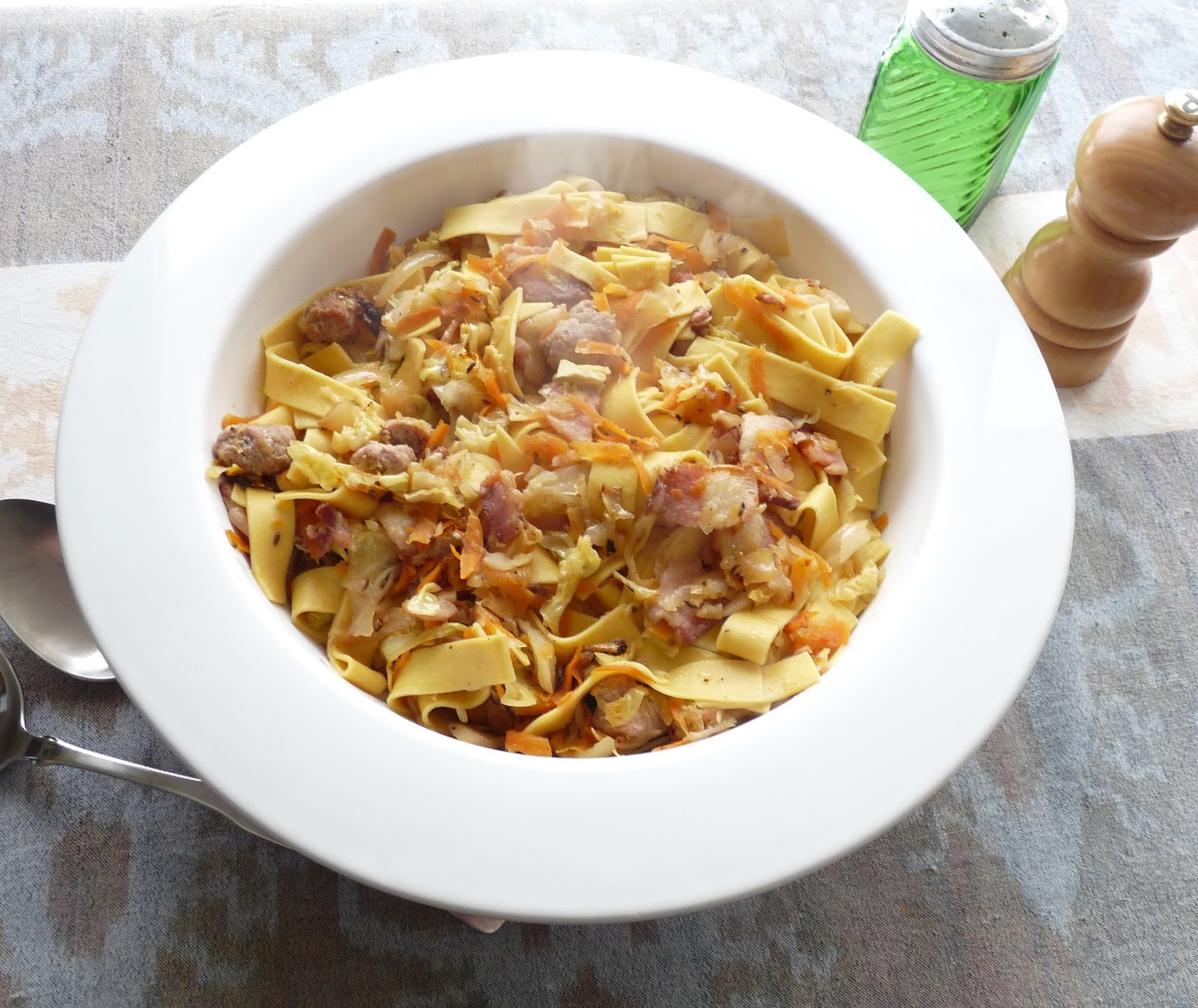
Well, yes, it sounds exotic, but it's the usual winter trinity of cabbage, carrots, and onions mixed with noodles and pork products. So not very exotic, really, but extremely tasty. Quick, too, as pasta dishes generally are. Fry up your what-nots, boil your noodles, mix'em together; you are done. Like dinner.

I say it in the recipe but I want to emphasize it some more: watch the salt. I've had bacon, sausage, and sauerkraut that didn't have that much salt in them. On the other hand it is quite common to get versions of all of those that are absolutely loaded with it. The odds are good that you will not need to add any salt, and if you are unfortunate in your buying decisions this could in fact end up too salty. In short, this is a recipe where you need to be mindful of the salt even as you do the shopping. Leftover braised (pulled) pork would make a good substitute for the sausage, and if you cooked it yourself it would hopefully not be too salty.

4 servings
40 minutes prep time

Haluski - Egg Noodles with Cabbage and Pork

Prepare the Vegetables:
1 medium onion
1 medium carrot
4 cups chopped green or Savoy cabbage
2 or 3 cloves of garlic, optional. 
2 cups sauerkraut OR 2 more cups chopped cabbage

Peel the onion and cut it into slivers. Peel and grate the carrot. Wash, trim, and chop the cabbage - it doesn't have to be too fine. Peel and mince the garlic if you would like it; also keep in mind whether the sausage already has some or not. Drain the sauerkraut.

Put a pot of salted water on to boil to cook the noodles.

Cook the Noodles, Meat, & Vegetables:
125 grams (1/4 pound) bacon
375 grams (13 ounces) pork sausage
1 to 2 teaspoons caraway seeds
freshly ground black pepper to taste
salt, with caution
375 grams (13 ounces) egg noodles

Cut the bacon into bite-sized pieces, ditto the sausage. Begin frying the bacon in a large skilletover medium-high heat, and add the sausage once the bacon has rendered a little fat. Cook them together for 3 to 5 minutes, stirring regularly, until they have changed colour all over and are sizzling well even when stirred.

Start putting the vegetables into the pan by handfuls, starting with the onions, then the carrots and cabbage. Stir well between each addition. Season with the caraway seeds and pepper. You can add some salt but keep in mind that bacon, sausage, and sauerkraut may all be quite high is salt - you should have some idea of their state before you add any more.

Once the vegetables are all in, cook for another 10 minutes or so stirring regularly to ensure everything cooks evenly. Add the sauerkraut towards the end of the cooking time, mixing it in to ensure it gets good and hot, although it doesn't really need to cook as such. This is about the time for garlic to go in as well, if it is to be used. Turn the heat down if it looks like things are getting too far ahead of the noodles.

When the water boils cook the egg noodles according to package instructions. Drain well. Mix into the pan of meat and vegetables until well distributed. Transfer to a serving dish and serve at once.


Last year at this time I made Rye & Potato Bread.