Showing posts with label Fiddleheads. Show all posts

Friday, 25 May 2018

Crustless Fiddlehead or Asparagus Quiche

I had a more traditional quiche in mind, but when push came to shove there were yogurt, sour cream, and cream cheese in the fridge all clamoring to be used up.  It didn't seem right to go out and buy more dairy products. Actually, the light  tartness of the yogurt, sour cream, and cream cheese went really well with the vegetables, which are delicate spring greens after all. I used a mixture of fiddleheads and asparagus, but it could be all one or the other. I'd throw in a good handful of finely chopped spinach if I had it too.

4 to 6 servings
1 hour 20 minutes - 20 minutes prep time - plus cooling time

Crustless Fiddlehead or Asparagus Quiche


2 cups fiddleheads OR chopped asparagus OR combo
1/2 cup finely chopped green onions OR shallot greens
1 cup yogurt
1/2 cup sour cream
4 large eggs
1/2 teaspoon salt
freshly ground black pepper to taste
1 teaspoon rubbed basil, savory OR thyme
250 grams (1/2 pound) cream cheese
1 teaspoon butter

If using fiddleheads, wash them well and trim off any brown bits (the stem ends will need trimming). Put a pot of water on to boil; drop them in and boil for 4 or 5 minutes. Rinse in cold water and drain well.

If using asparagus, wash and trim, then cut into half-inch pieces. Boil them as above but for only 2 minutes. If you are using a mixture of the two, drop them in when the fiddleheads have 2 minutes to go. Rinse to cool and drain well.

Preheat the oven to 375°F

Wash, trim, and finely chop the green onions or shallot greens. 

In a mixing bowl, mix the yogurt, sour cream, and green onions. Beat in the eggs. Mix in the salt, pepper, and other seasoning. Crumble or glop in by spoonfuls (depending on the texture) the cream cheese, and mix it in but leave it fairly lumpy.

Use the butter to grease a 10" pie plate. Put most to all of the prepared vegetables in and spread them about - any you don't put in are for use in garnishing the top of the quiche. Pour the yogurt mixture over the vegetables and stir very gently to mix. Arrange the reserved vegetables over the top, pressing them gently down to be level with the surface.

Bake at 375°F for 1 hour. Let cool some before serving; it can be served warm or at room temperature. If made in advance, take it from the fridge 20 minutes before eating to take the chill off.


Last year at this time I made Asparagus with Onions & Mushrooms.

Wednesday, 16 May 2018

Fiddlehead & Potato Salad

I think I have missed the wild leek season. I went into our back forest to check on our transplants, and they are doing well but not expanding. Give them another couple of decades, I guess.

We don't have any fiddleheads growing in our woods but I did find some in a local shop. They make a good addition to a potato salad.

4 to 6 servings
30 minutes prep time

Fiddlehead & Potato Salad

Make the Dressing:
1/2 cup mayonnaise (light is fine)
1/3 cup thick yogurt OR sour cream
2 tablespoons apple cider vinegar OR dill pickle brine
2 teaspoons Dijon mustard
1/4 cup finely chopped chives
salt & freshly ground black pepper to taste

Start the potatoes just before you start the dressing.

Mix the mayonnaise, yogurt, vinegar or brine in a mixing bowl. Wash and pick over the chives, and chop them finely. Add them, with salt and pepper to taste. Stir well. Keep in the refrigerator until ready to add the salad. 

Make the Salad:
750 grams (1 1/2 pounds) potatoes
1 large carrot
1 1/2 cups fiddleheads
1/2 cup diced peeled celeriac OR 1 stalk celery

Wash and trim or peel the potatoes. Cut them into small bite-sized chunks. Wash and peel the carrots, and cut them just slightly smaller. Put both in a pot with water to cover, and bring to a boil. Boil for 10 to 15 minutes until the potatoes are just tender. Drain, and rinse under cold water until cooled. Drain again well.

Wash the fiddlehead by rubbing them gently between your hands in cold water then rinsing them well. Trim off any browned spot. Bring a pot of water to a boil and drop them in. Boil for 5 minutes. Meanwhile, bring a small kettle of water to a boil. Drain the fiddleheads then return them to the heat and immediately pour over enough boiling water from the kettle to cover them. Boil another 4 to 5 minutes until tender. Rinse in cold water to cool and drain well.

Wash, trim, and chop the celery fairly finely.

Mix the potatoes and carrots, most of the fiddleheads - reserve a few for garnish - and the celery into the bowl of dressing and toss well. Transfer to a serving bowl and garnish with the extra fiddleheads.

Thursday, 13 May 2010

Frog Soup

No frogs were harmed in the making of this soup. However "Frog soup!" is what my Mom said as I put a bowl in front of her and now I guess I can't call it anything else. In fact the green comes from ramps and fiddleheads and the little froggy heads peeping up from the soupy swamp are also fiddleheads.

Alas this is pretty much the last of the ramps for the year, at least around here. Fiddleheads should be around a little longer, but they too are moving along. Sorry as I am to see them go I will not be sad to see the weather get a little warmer. And soon, strawberries! Okay, then.

This was a nice soup but I have to admit it took too damn many pots. Not sure how to get the number down.

If you want to make it in advance and reheat it, no problem. You'll just have to also drop the reserved fiddleheads for garnishing into boiling water for a minute or two to reheat them.

3 to 4 servings
30 minutes prep time

Frog Soup with Ramps and Fiddleheads
2 large potatoes
4 cups chicken stock
1 cup cleaned and trimmed raw fiddleheads
2 bunches ramps (24 to 32)
1 tablespoon unsalted butter
2 tablespoons flour
salt & pepper to taste

Scrub the potatoes, trimming off any bad spots, and cut them into chunks. Put them in a pot with the chicken stock, and bring to a boil. Boil until the potatoes are tender.

Put the cleaned, trimmed fiddleheads into another pot with water to just cover, and bring to a boil. Boil for about 4 minutes, then drain and replace the water. Boil them for another 4 minutes.

Meanwhile, cut the white parts off from the ramps, and trim and wash them. Chop the green tops of the ramps, and set them aside for the moment.Chop the white parts finely, and sauté them in the butter until lightly browned. Add the flour, and season with salt and pepper - the amount of salt will depend on how much is in the chicken stock. I used a teaspoon, but my stock was unsalted.

When the flour is pretty much cooked onto the ramps, put them into the pot with the potatoes as they cook. Add the chopped ramp tops as well.

Drain the fiddleheads, and put 1/3 to 1/2 of them into the soup, and keep the remaing 1/2 to 2/3 aside to garnish the finished soup.

Put the soup into a blender or food-processor and blend until smooth, but do not overdo it, or the potatoes may become gummy. Reheat the soup if necessary, and serve garnished with the remaining fiddleheads.


Last year at this time I made Irish Soda Bread.

Friday, 7 May 2010

A Visit to Nor-Cliff Farms

When we headed down to the Niagara Peninsula last Tuesday the other place we went, besides Grimo Nut Nursery was to Nor-Cliff Farms. Nor-Cliff is not your average farm.


Here's one of their "fields". Yes, it's basically the edge of a bog; the Wainfleet bog to be precise. The locals were amused when "folks from the city" bought this farm, but in fact they knew what they were doing - their crop is fiddleheads. Fiddleheads, for those unfamiliar with them, are a traditional foraged spring-time treat in eastern Canada. They are the tightly curled frond buds of the Osterich fern (matteuccia struthiopteris), which grows in damp, somewhat shaded places. They were gratefully gathered by first nations tribes and then by settlers to eastern Canada as one of the first green vegetables of spring, and they are still very popular especially in New Brunswick and Quebec.


Another view of the "farmland". I was given a tour by Nina DiLorenzo, one of the partners who own NorCliff Farms, who told me that they farm 40 acres of fiddleheads here. (Nick Secord, the main partner was in Quebec for the harvest.) This is a newish venture, started in 2007, and only a small part of NorCliff farms operations. Most of their fiddleheads are wild harvested in New Brunswick, Quebec and Ontario, from land they lease and own, and they have a freezing plant in Asbestos, Quebec. This is their first attempt at actually growing fiddleheads deliberately, although NorCliff Farms has been harvesting and selling fiddleheads since 1974.


The fiddleheads shown above and below are at the right stage to be picked. They start as tight, hard brown nubbins in a circle around the crown of the plant, and as they rise they begin to loosen and unfurl. They should be picked when they have risen a little, but are still quite tightly furled and are a bright fresh green. Because they start so early in the spring, frost damage must be watched for and avoided. Once the leaves begin to unfold, the fronds are too mature to eat. The fiddleheads are not cut off, but carefully broken off to minimize oxidization.


More fiddleheads ready to pick. Only about a third of the fiddleheads should be picked from the plant, in order to keep the plant healthy. Nina recounted how they hired people to plant the young ferns by the bag, with instructions that they should be planted out in rows, as with most crops. They later discovered, to their dismay, that many of them had been shoved into the ground in large clumps. It all worked out though; it turns out that fiddleheads are gregarious and much prefer to grow that way. The tight clumps of ferns will also keep other plants from encroaching much on their territory.


These ostrich ferns were in the garden of the house and were well past the stage for picking. You can get some idea of what large and attractive ferns they will be during the summer season, and you can see some of the dried fronds from last year as well.


Above is a package of Nor-Cliff Farms frozen fiddleheads, so they are available all year. However, from mid April to early June is the prime time for fresh fiddleheads. They are picked in widely seperate places depending on the point in the season. I got a glimpse of the logistical problems involved in ensuring a smooth supply of fiddleheads the day I was there, as Nina scrambled to find a replacement truck to pick up the harvested fiddleheads for one which had cancelled. It must all be a little ad-hoc as the harvest moves around so much. Still, you will find fresh fiddleheads in many Canadian grocery stores at this time of year, as you could since 1974 when Nick Secord got started, somewhat by accident. He wanted to go fishing on a rather exclusive river; his friend, who owned a local Dominion store could get him there. In exchange, he wanted fiddleheads for his grocery store. Nick started supplying Dominion, and the rest is history. I used to shop at Dominion, and it's amusing to think that I was buying Nick and Nina's fiddleheads years ago.

So, once you have some fiddleheads, what should you do with them? You should definitely cook them. They have a delicate yet distinctive flavour and are excellent served simply steamed of boiled for 8-10 minutes, and topped with a dab of butter. If you boil them, it's best to change the water after a few minutes. The water they cook in will turn brown; that's normal and caused by their iron content, but the cooked fiddleheads should be tender and still bright green. Be sure to remove any of the papery brown membrane that may cling to the fiddleheads before cooking. Also, the stems may have darkened (oxidized) at the broken ends and should just be trimmed to remove this. Keep them stored in icy cold water in the fridge. They will keep for up to 2 weeks this way, if freshly picked. Don't forget to check under "fiddleheads" in the side index for recipes. There's only two there at the moment, but more should show up this spring.

Fiddleheads were once regarded as an excellent spring tonic, and they should be still; they contain twice the antioxidants of blueberries, as much vitamin C as spinach, and are an excellent source of omega-3 fatty acids. Like most vegetables, they are low in sodium and high in fibre. This information comes from recent research by the Atlantic Food & Horticulture Research Centre in Nova Scotia, where more research into fiddleheads nutritional profile are underway.

Thursday, 6 May 2010

Pizza with Asparagus, Fiddleheads, Mushrooms & Ramps

I've been craving pizza lately, so I drafted Mr. Ferdzy and we made 6 batches of the dough recipe below. We froze most of the dough as I figure it's actually fairly quick to put together a pizza once you have the dough ready - you just have to remember to take it out at least a day ahead of time - and they will make good meals on days we do a lot of gardening.

This one was Spring on a slice, and we just loved it, and ate the whole thing between us in one sitting. Yeah, pigs. Oink. The ramps were just perfect, but it all went together beautifully. You could use all asparagus or all fiddleheads for the greens if you like; just double the one not being eliminated. Morels would be the trendy mushroom to use, but my lifetime record for foraging/finding them for sale is 1*/0, so I just used button mushrooms, and they were fine.

4 to 6 servings
Dough: 15 to 20 minutes prep, 2 hours to rise
To Finish: 30 to 40 minutes prep, 20 minutes to bake and rest
Allow 2 1/2 hours to complete
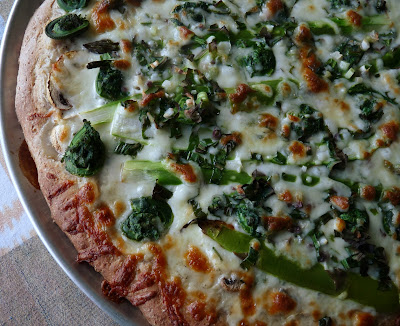
Pizza with Asparagus Fiddleheads Mushrooms and Ramps
Make the Dough:
1 cup warm filtered water
2 teaspoons fast acting yeast
1 1/3 cups hard white wheat or spelt flour
1 cup whole wheat flour (I used Red Fife)
1/3 cup gluten flour
1 teaspoon sugar
1 teaspoon salt
1 tablespoon olive or sunflower seed oil
a little more whole wheat flour if needed

The water should be just warm, not hot. Sprinkle the yeast over it and let the yeast dissolve and foam for 5 or 10 minutes as you prepare the other ingredients.

Mix the remaining ingredients, except the oil, in a mixing bowl. When the yeast is ready, remove about 1/3 of the flour mixture to clean counter or board. Mix the yeast, water and oil into the remaining flour. Turn the mixture out onto the floured board and knead for 4 to 6 minutes, until all the flour is incorporated and the dough is smooth and elastic. You may need to sprinkle a little more flour over the dough and counter as you knead if the dough is too sticky.

Put the dough into a clean, oiled bowl and cover it with a clean tea-towel. Let the dough rise for about 1 hour in a warm place. It can also be put in a clean plastic bag and kept in the fridge for up to 48 hours if desired.

Lightly oil a 16" perforated pizza pan. Press the dough out to a flat disc on a 16" perforated pie plate. It should pretty much cover the plate evenly. Start from the middle, and work your way out, keeping it even and trying to flatten it, rather than stretch it. Let it rise for about an hour again.

Finish the Pizza:
2 tablespoons butter
3 tablespoons flour
1/4 teaspoon salt
1/4 teaspoon freshly ground black pepper
1 teaspoon rubbed oregano
1 cup light cream (I used 5%)

4 to 6 asparagus spears
1 cup fresh fiddleheads
1 small bunch (10 to 14) ramps
6 to 8 button or other mushrooms
250 to 375 grams (1/2 to 3/4 pound) mozzerella cheese

Put the butter, flour, salt and seasonings in a small pot and cook together until thick and pasty over medium heat. Reduce the heat, and stir in the cream a little at a time, to make a smooth lump-free sauce. Continue cooking, stirring constantly, until the sauce thickens. Set it aside and cool it slightly as you prepare the other toppings.

Wash and trim the asparagus, and cut each spear in half lengthwise. Wash the fiddleheads, removing any of the brown papery membrane which may cling to them. Trim off any darkened stem ends. Blanch them for 2 minutes, then rinse in cold water to stop them cooking any further, and drain well.

Wash and trim the ramps, and chop them finely. Clean and trim the mushrooms, and slice them. Grate the cheese.

Preheat the oven to 475°F.

Spread the sauce evenly over the pizza, and arrange the mushroom pieces evenly over it. Sprinkle about 2/3 of the cheese evenly over the pizza, then arrange the asparagus pieces and fiddleheads over it. Sprinkle over the chopped ramps, and the remaining cheese.

Bake for 15 minutes until the cheese is browned in spots. Let rest for 5 minutes before cutting and serving.


Last year at this time I made Blue Cheese Salad Dressing.


*Not one pound. That's one. One mushroom. Yeah, not impressive.

Tuesday, 2 June 2009

Basque Style Barley with Cheese & Spring Vegetables

I was of two minds whether to post this recipe or not. It's based on a dish we ate in Spain, at the Guggenheim museum in Bilbao. Like many great museums, it has a restaurant with the quality (and prices) to match the artwork and it was our most expensive meal of the trip. This was a dish of Spanish rice swimming in a rich cheese sauce, garnished with vegetables. Alas, I failed to note what cheese it was, although all through Basque country we were eating some wonderful firm cheeses made with a mixture of sheep, goat and cows milks. I resolved to try making it at home, since it was really a very simple dish. They used asparagus (green, for the first and only time of the trip - Spaniards think asparagus ought to be white) and artichokes for their vegetables.

This was served as the "primero" of a typical Spanish meal, consisting of a primero, a segundo, and a postre, or dessert. It is so very rich that I recommend it as an appetizer in small portions, although you could surround it with good leafy, astringent salads as a main course.

Mine was such a pale shadow of the original I was embarrassed. On the other hand, I decided it does have potential. My big problem was I was in a bit of a rush when shopping and had to settle for a decent but fairly standard commercial cheese, which I shall not embarrass by naming. This is a dish which is ALL about the cheese, and it just didn't have what it took. So my question, dear readers, is what Ontario artisanal cheese would you recommend for this? I'm looking for something intensely rich in flavour with a wonderful melty texture. I hear there are people out there making Gouda cheeses on a small scale, and I rather think one of those would be excellent, if I only knew where to get my hot little hands on some. Any other ideas?

I also have to admit the Spanish rice was better than the barley. Barley was fine, and if the cheese had been better I'd have been happier about it. But if you can get some good Spanish rice, by all means; this would be a good place to use it although I really can't give you any advice on how to cook it. It cooks more like an arborio rice than most rices and my first couple attempts at cooking it for a non-paella or risotto type dish were not particularly successful. Perhaps the old English style of cooking rice, where it is boiled in plenty of salted water then drained, like pasta. Or perhaps I just don't know the correct proportion of liquid to use. I would be happy to receive advice on this topic as well.

6 to 8 servings
30 minutes prep time, not including cooking the barley

Basque Style Barley with Cheese and Spring Vegetables
3/4 cup raw barley or Spanish rice
1/4 teaspoon salt
200 - 250 grams (1/2 pound) excellent melty cheese
2 tablespoons unsalted butter
3 tablespoons flour
1 1/2 cups milk
salt to taste

250 grams (1/2 pound) asparagus
125 grams (1/4 pound) fiddleheads
125 grams (1/4 pound) button mushrooms
2 teaspoons unsalted butter

Cook the barley (or rice) with the salt until tender. I used the rice cooker for my barley; but I'm not at all sure it would work for the rice (see above.) This can be done in advance, and probably should be, just to keep life simple.

Cut up the cheese into smallish pieces. Make the cheese sauce by cooking the flour and butter together in a heavy-bottomed saucepan until well amalgamated. Reduce the heat to medium-low and slowly, bit by bit, mix in the milk to make a smooth sauce. Once it's in, reduce the heat a bit more and add the cheese. Continue stirring frequently until the cheese is melted. Taste and adjust the salt if necessary. Leave uncovered on the back of the stove while you finish the vegetables - hopefully not too long.

Meanwhile, have your vegetables prepared in advance. The asparagus should be cleaned and trimmed, and cut in half. The fiddleheads should be very well washed to remove any grit and bits of papery husk which may adhere to them. Soaking in cold salted water is probably not a bad idea. Clean the mushrooms and slice them in half.

Put the fiddleheads in a pot with water to cover. Boil them for 5-8 minutes, then drain and generously re-cover them with water. Bring them back to the boil, and add the asparagus; continue boiling for another 5 minutes until the asparagus is tender. Drain well.

Also meanwhile, heat the remaining 2 teaspoons of butter in a skillet, and sauté the mushroom halves until golden brown. Three arms will be useful here, and three burners and pots absolutely required. Sorry.

Dish up the barley into individual serving dishes, and garnish each with their share of the vegetables, pressing them in slightly. Serve at once.

This will not reheat particularly well, especially if you use barley. The starches from the grain will make the sauce gummy as it sits.


Last year at this time I made Stewed Rhubarb Compote with Apples or Strawberries.