Friday, 30 October 2020

Year End Garden Report


This photo is from Wednesday, which looked like the last nice day to stroll around with a camera. The garden looks neat and ready for winter, which it mostly is. I'm sure we could find another 2 weeks worth of work, supposing the snow holds off that long.  Still have the annual cleaning of the garage to do too ughhhhh. We agree we are very ready to finish gardening for the season.

This was last week, just before we took down the last of the bean trellises. The Lima beans really didn't want to finish, but too bad; we were done with them. They are shelled and finishing drying in the food dryer as I type. We did get quite a good crop of them this year; much better than last year when we barely got enough for seed.

 
Mr. Ferdzy has worked on taking down the trellises as I pulled beets, rutabaga, and winter radishes.

Portions of the trellises plus two sheets of the 6 mil vapour barrier that we use as hoop-house covers got re-used to cover the spinach and lettuce that we hope will overwinter and get us started with some greens in early spring. 

You can see the new asparagus bed in the background, still turning colour. It's interesting; the old asparagus bed was a good week behind the new one in emerging, and it turned yellow at least a week before the new ones. Micro-climate differences clearly demonstrated; moving the asparagus was a very good idea. 

Our Brussels sprouts look much better than they are, but they are not too bad. We're going to have some (have already had some, in fact).

Three different varieties of beets, with significantly different foliage.

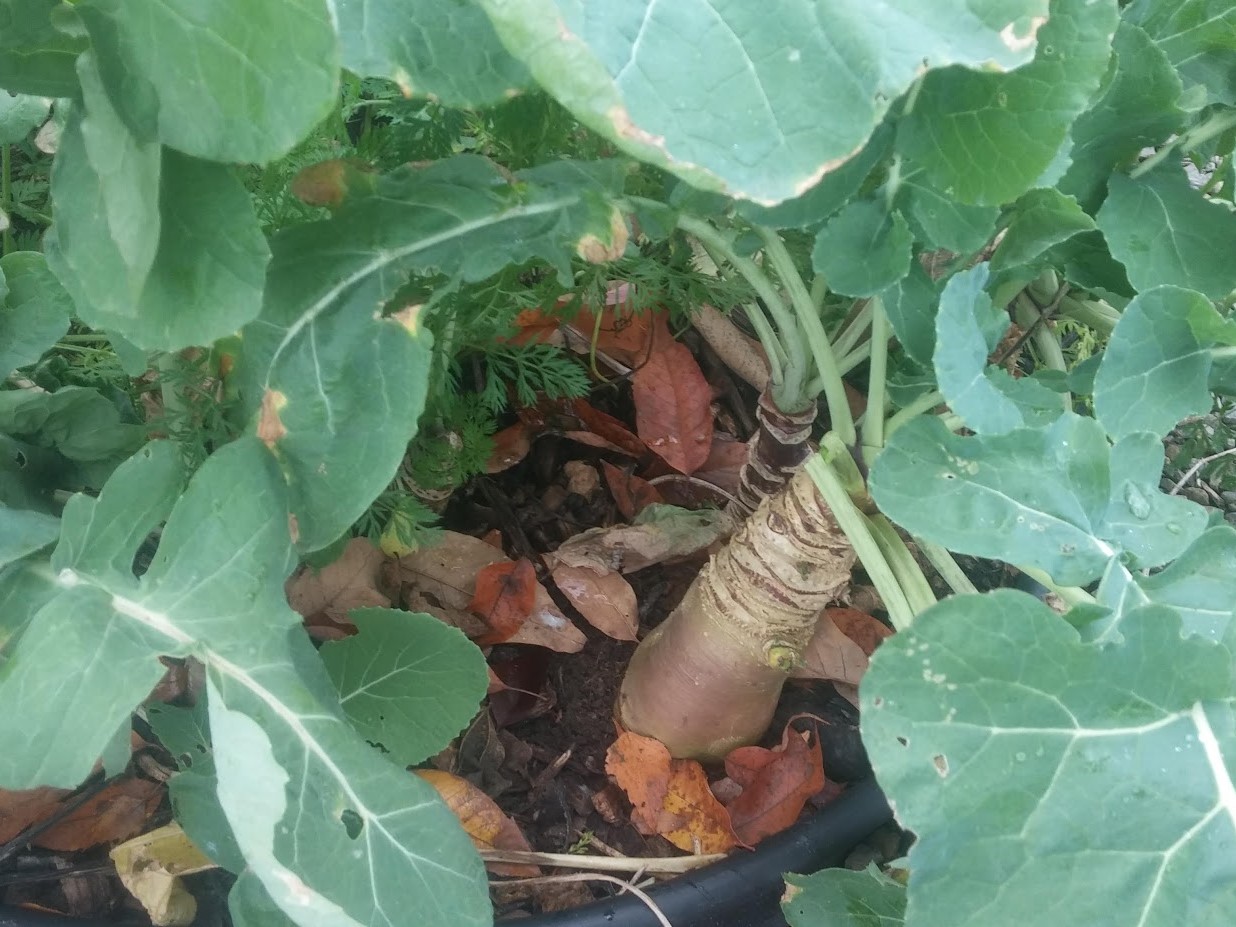
Our rutabagas are nowhere near as good as the foliage suggests; still we also have some that are big enough to eat and are already eating them, as well as having a sack of them stashed in the vegetable fridge. (Some people have a beer fridge - we have a vegetable fridge).

 
That's a fairly typical one - long and skinny compared to the ones you can buy... how do they do it, I wonder? Lots of fertilizer no doubt, and better soil generally. 

Carrots remain to be pulled for storage. We don't do that until the last possible moment before the ground freezes; until then we pick them more or less as we need them. It looks like a better year than most for them, partly because they liked the weather, and partly because we do get better at growing them.

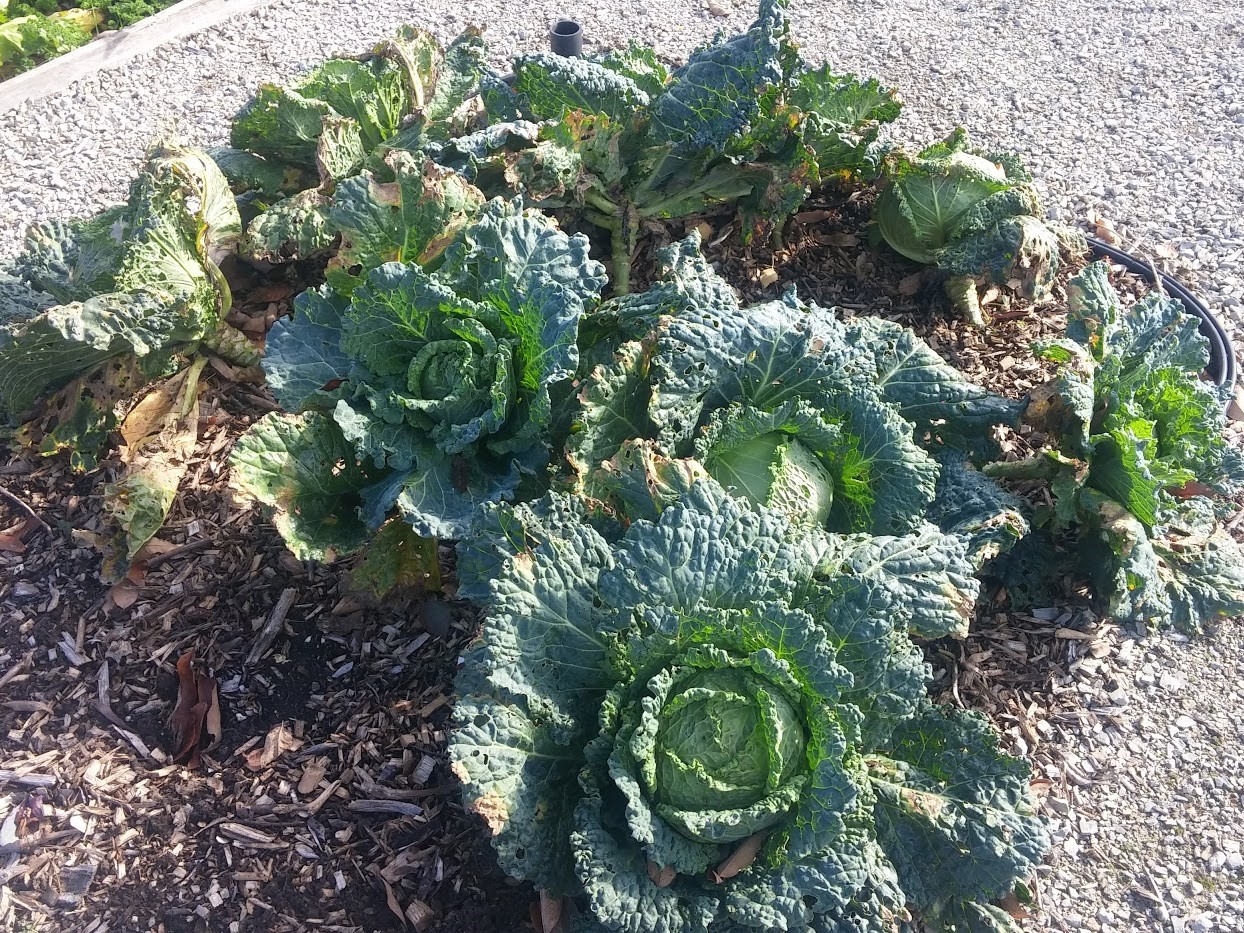
We have a few cabbages picked and in the fridge, but this particular kind is a cross between January King and Chieftain savoy. It will stand in the garden and can be picked even if frozen. We assumed this was normal, and left another variety out after first frost last year, only to discover they couldn't stand it, and rotted. Oops! 

Some of our cabbage looks pretty good, but we can see the effects of the swede midge which is now infesting our brassicas, and some of it looks pretty terrible. Our cross did fairly well, which is nice. 


And finally,we had a visit from this bird last week. I spotted it while washing the dishes after dinner, and it stayed there long enough for us to call Mom over and all watch it for several minutes before it flew away. I've been seeing a red-tailed hawk in the birch tree quite often this summer; I suppose this is the same one. Perhaps we have them nesting nearby. That's kind of fun! I don't think the resident crows particularly approve. Hawks will steal their eggs and babies. It's hard to feel too sorry for them, though, since they are not above nest-robbing themselves.

Wednesday, 28 October 2020

Celery Salad with Dates, Almonds, & Parmesan

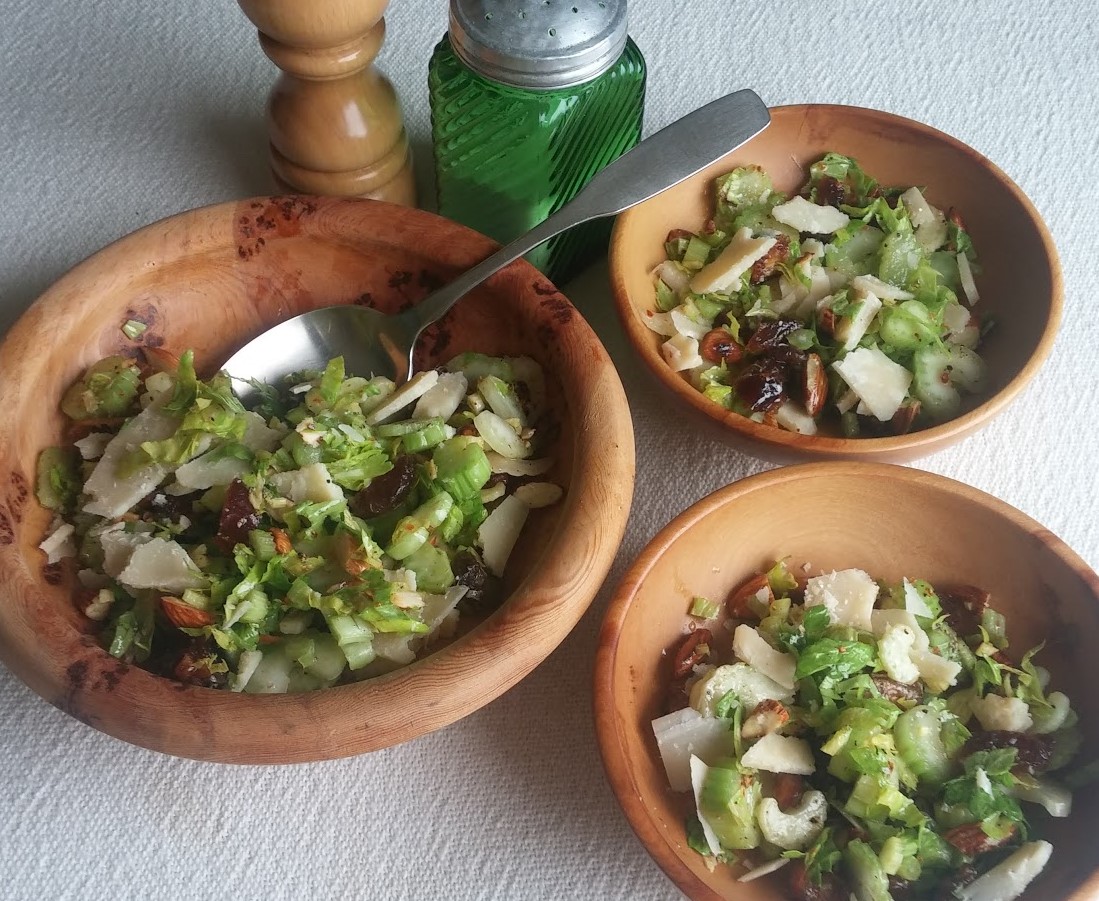
It isn't often that I make somebody else's recipe almost exactly as written, but I couldn't resist this one when I saw it at Bon Appetit. As I was making it I realized it's actually my favourite salad formula: fruit, nuts, cheese, and oh yeah, something green to hold it all together. This is a particularly nice iteration. I cut it in half since there were just the two of us, and had a slightly heavy heavy hand with the dates and the lemon juice. We thought this was delicious, even Mr. Ferdzy who does not particularly love dates. Had been hoping to steal a few back from him, but no such luck. 

They are a bit dismissive about celery at the Bon Appetit recipe. It's true that celery has ended up as an inevitable hanger-abouter in people's vegetable drawers, but it doesn't get a lot of love or respect, it seems. Too bad. Like cauliflower, it was once a very high-status vegetable in part because it was both seasonal and hard to grow, but modern agriculture has rendered it ubiquitous and familiarity seems to have bred contempt. As this salad shows, it can still really shine.
 
2 to 3 servings
20 minutes prep time
 
Celery Salad with Dates, Almonds, & Parmesan

1/4 cup almonds
3 to 4 stalks of celery, with leaves
4 large medjool dates
salt & freshly ground pepper to taste
1/8 teaspoon Aleppo pepper (to taste)
2 tablespoons lemon juice
2 tablespoons walnut OR hazelnut oil
30 grams (1 ounce) shaved Parmesan cheese

Chop the almonds coarsely, and toast them in a skillet over medium heat. Turn them out onto a plate to cool when lightly browned and fragrant. 

Wash, trim, and slice the celery thinly. Use the leaves. Put them in your salad bowl, then pit the dates, chop them, and add them along with the almonds. Season the salad with salt, pepper, and Aleppo pepper, and toss with the lemon juice and oil. 

Shave the Parmesan, and fold it gently into the salad. Serve at once.


Last year at this time I made Kohlrabi Soup.

Monday, 26 October 2020

Mincemeat Pudding with Custard

Is this Christmas pudding? Why, yes; it is. It is Christmas pudding.

I know it's the end of October, but if you want to make this particular recipe you will need to start by making mincemeat, and the time to make mincemeat is now.

As you may suppose, this pudding was actually made last year at Christmas time, and it was one of my earliest attempts at a very low-sugar dessert. The mincemeat was sweetened in a fairly typical way, as I had already made it before I got the news that I was pre-diabetic, and pre-diabetic or not, I am too cheap frugal to throw away perfectly good food, especially something like mincemeat that I had put a fair bit of work into. So I made it into pudding, and the only other sweetness came from the cooked carrots and a little in the custard sauce. The results were actually very good, I thought. If you want to do this yourself though, I suggest you taste the batter and add a little more sugar to taste once it is mixed.

I have to say, looking at this recipe makes it very clear that summer is well over (yes, brrrr), and we are rapidly hurtling into a new season...

6 to 9 servings
1 hour 15 minutes - 45 minutes prep time
NOT including the custard - 15 minutes prep time for that

Mincemeat Pudding with Custard

Prepare the Wet Ingredients:
1 cup boiled, mashed carrot
500 ml (2 cups) mincemeat
2 teaspoons ground cinnamon
1 teaspoon ground ginger
1/4 teaspoon freshly grated nutmeg
2 large eggs (OR 1 large egg and 2 large egg whites)
1/3 cup mild vegetable oil

Peel and slice 2 medium carrots and boil them in a little water until quite tender. Drain them, mash very thoroughly, and measure them into a mixing bowl. Mix in the mincemeat and the spices. Beat in the eggs and vegetable oil.

Mix in the Dry Ingredients & Finish:
1 cup whole spelt flour
1/2 cup finely ground almond meal (flour)
1/4 cup finely ground flax seeds
1 1/2 teaspoons baking powder
1/2 teaspoon salt
rum to taste (about 1/4 cup)

In a smaller bowl, measure and mix the dry ingredients.

Grease 3 or 4 500ml wide-mouth canning jars or a 2-quart pudding mold. Set up a steamer so that the jars or mold will be held above the boiling water, and start it boiling.

Mix the dry ingredients into the wet ingredients gently but thoroughly. Divide the batter evenly between the jars (3 jars will make 3 puddings of 2 or 3 servings each, 4 jars will make 4 jars of 2 servings each) or scrape it into the mold. Cover the tops of the jars or the pudding mold with a layer of parchment paper then a layer of aluminum foil, and keep it in place with string or elastic bands. Put the pudding(s) into the steamer and steam until firm; about 25 to 30 minutes for the jars or 1 hour for the large pudding.

I made 3 jars of pudding and I found they rose beyond the top of the jars. As soon as they were removed, though, they began to cool and shrink back down at once. I removed and discarded the paper and foil, and poured a little rum over each, then capped them with sterilized lids. I put them back in the steamer for another 10 minutes. They all sealed very well, and we ate the final pudding 3 months later. I did keep it in the fridge for that time, although the cold cellar would have been fine too, I'm sure.

Make the Custard:
1 tablespoon arrowroot
2 to 4 tablespoons sugar
a pinch of salt
2 large eggs (OR 1 large egg and 2 large egg yolks)
1 1/2 cups whole milk or light cream
1 tablespoon rum

Mix the starch, sugar, and salt in the top of a double boiler and whisk in the eggs. Slowly whisk in the eggs until everything is smoothly combined.

Heat the double boiler to a simmer and cook, whisking regularly, until the custard thickens. Remove it from the heat and whisk in the rum. Allow to cool and serve, warm or cooled, on the pudding. 


Last year at this time I made Roasted Chile-Garlic Tofu & Broccoli.

Friday, 23 October 2020

Lemon-Mayonnaise Broiled Trout

When I cook fish I almost always broil it. Most fish is thin enough to be broiled - trout fillets certainly are - and done properly it will leave your fish moist and flaky. It's also done in 10 minutes or less, which I have to admit is almost always the actual deciding factor in my decision to cook this way.

This easy sauce is tasty enough to enhance lovely fresh trout and delicate enough to do it without trying to steal the limelight, and it doesn't add a lot of time to proceedings. You'll also have about half a lemon left over once it's done, so cut it in wedges and pass it with the trout.

2 to 4 servings
20 minutes prep time

Lemon-Mayonnaise Broiled Trout

Make the Sauce:
1 clove of garlic
1/4 teaspoon salt
freshly ground black pepper to taste
the finely grated zest of 1/2 lemon
1/2 to 1 teaspoon rubbed thyme OR savory
1 tablespoon potato starch
2 tablespoons lemon juice
1/4 cup mayonnaise

Peel and mince/mash the garlic with the salt and pepper. Put it in a small bowl with the lemon zest, herb, and potato starch. Mix, then mix in the lemon juice and then the mayonnaise. 

Cook the Fish:
2 250 gram (1/2 pound) trout fillets
about 3 tablespoons mild vegetable oil
    OR melted butter

Preheat the broiler.

Use a standard double-layered broiler pan. Put about 1/4" of water in the lower pan. Brush the upper perforated piece with oil or melted butter, using a pastry brush. Lay the trout fillets, skin side down, on the pan so as to get them best centred under the grill. Pat them dry with paper towel then brush them with a little oil or melted butter.

Spread the sauce evenly over them. Put the pan directly under the broiler and broil for 6 to 8 minutes, until done. Let rest for 5 minutes before serving.

Wednesday, 21 October 2020

Table Queen (& Gill's Golden Pippin) Acorn Squashes


In the photo above, there are 2 Table Queen and 2 Gill's Golden Pippin acorn squashes, the Table Queen being dark green and the Golden Pippin being, uh, golden. Acorn squash are distinctive, generally vaguely acorn shaped (if you use your imagination) but with distinctive fluting. They are fairly small, running from just one or two servings each, up to about 4 servings per squash. In general, the Table Queen run larger than the Gill's Golden Pippin; the one at the top is an unusually big example. I've written about Golden Pippin before.

Acorn squash are members of the cucurbita pepo group, meaning that they are related to most of the zucchini and summer squashes, and will cross with them. In my experience the resulting crosses are rarely good; they get tough and seedy too fast as summer squash, and lack good flavour and keeping qualities as winter squash. Acorn squash are about the only form of cucurbita pepo that are eaten as storage squash, and they are not particularly long lasting. They will be good from now through the end of the year, but by January they really should be gone or rapidly disappearing, as they are noticeably not as good as they were. 

Table Queen was apparently introduced to widespread commerce in 1913 by the Iowa Seed Company (according to Baker Creek) and became immensely popular. All through my youth and really, up to today, this was the basis for commercially produced acorn squash, if not in fact the exact variety. I confess that when I started gardening I regarded Table Queen with some disdain as a common and not very interesting acorn squash, but it really isn't true, and a good home-grown one is delicious.

There is a Table King, in both bush and vine varieties, which I presume are the result of breeding and selection for more productivity, disease resistance and compactness, but my impression is that they are not hugely different. A Golden Table Queen won the All American Selection in 1939, but it seems to have disappeared. There is also a bush version of Table Queen, but mine was the classic vining version. Vines can get to 20 feet long under ideal conditions, and they are pretty amenable to being piled up on themselves, but trellising is really a good idea. Squash that have been kept off the ground develop better shapes and are less likely to develop mould problems ore be attacked by insects or other pests. I am finding that this year the Table Queen have a very tough skin, and are harder to cut than the Golden Pippin.

The Arikara first nation of North Dakota were skilled and productive gardeners, trading their excess produce over a wide area, and their vegetables have been a prolific source of genetic material for North American vegetables to this day, particularly for corn, squash, and beans. Table Queen was likely developed from one of their squash, and may not even be all that much changed from what they grew. It is certainly a very well adapted squash all over North America, from Texas to eastern Canada, from Florida to British Columbia. It has good resistance to vine-borers, squash bugs and cucumber beetles, the three plagues of squash. It ripens in 80 to 85 days from germination, which will give plenty of time from a late May to June 1st planting date. Under ideal conditions and with good soil (so not me) you can apparently get up to 8 squash per vine.

To some degree Table Queen has been replaced by similar but hybridized versions, but the original is still an excellent plant with great productivity and resiliency, and is fairly widely available.

Monday, 19 October 2020

Costillas Guisadas con Patatas - Spanish Stewed Pork Ribs with Potatoes

It wasn't until I made Braised Pork Ribs with Squash that I discovered that ribs don't have to be slowly cooked in the oven all day. I mean, they are very delicious if that happens! But sometimes you want something faster, and stewing them works perfectly well and can be on the table in under an hour.

This is a very simple dish, with few ingredients, which is fairly typical of Spanish cooking. Half a kilo of ribs should be plenty enough, but that's what I used and I was a bit dismayed at just how very bony they were. As ever, the two of us ate it all, and it would have been better as part of the typical Spanish menu, with a "primero" of salad, and a "postre" of some sort. Maybe if you get better ribs it wouldn't be a problem, but this is what happens when you are not selecting your own groceries and just get what you are sent. Never mind! Very tasty and really, we are in no danger of starvation.

The peppers should be long Spanish or Italian type thick-walled fryers; bell peppers only if all else fails. I don't know why bell peppers persist in being so popular. They have a bitter aftertaste, and give plenty of people besides me indigestion. I used ham stock to make this, and so put in less salt than I am calling for - that amount assumes that you are using unsalted stock or water; adjust accordingly.

2 to 3 servings
50 minutes - 30 minutes prep time

Spanish Stewed Pork Ribs with Potatoes

500 to 750 grams (1 to 1/2 pounds) pork ribs
2 tablespoons mild vegetable oil
1 medium red pepper
1 medium green pepper
1 large onion
3 to 4 cloves of garlic
1 1/2 teaspoons sweet OR hot Spanish plain OR smoked paprika
1/2 teaspoon salt (or less, depending on stock)
2 cups ham or chicken stock, or water
500 grams (4 medium) potatoes

Cut the ribs into individual pieces. Heat the oil in a large, heavy-bottomed soup pot over medium heat, and brown the ribs on both sides.

While they brown wash, core, and cut the peppers into small dice. Peel and dice the onion.

When the ribs are browned on both sides, remove them to a plate. Put the peppers and onions into the pot and cook for 4 or 5 minutes, stirring regularly, until softened and reduced in volume - don't let them brown.

While the pepper and onions cook, peel and chop the garlic. When the peppers and onions are ready, add the garlic, paprika, and salt - if needed - and mix in well. Add the stock or water and let the ribs simmer for about 10 minutes.

While the ribs simmer, scrub or peel the potatoes and cut them into bite-sized chunks. Add them to the ribs, being sure that they are covered by the liquid. Add a little more liquid if needed; the ribs can be on top sticking out and that's fine. Put the lid partially over the pot and simmer steadily for a further 20 to 25 minutes, until the potatoes are cooked and the liquid is reduced to a thick sauce. Watch it carefully towards the end; you don't want it to get so thick it scorches. Again, a little more liquid can be added if needed.


Last year at this time I made Rye Apple Brown Betty.

Friday, 16 October 2020

Graham Muffins

I was trying for the flavour of graham crackers in a muffin, and I feel like I have succeeded, but I have to admit that without the texture of a graham cracker it reads pretty much as a bran muffin. With which there is nothing wrong! This is a very nice bran muffin, with a real fibre kick to it. It may seem like it calls for a lot of cinnamon but I find using ground flax really muffles the flavour of other things; I may try putting in even more next time. 

12 muffins
30 minutes - 10 minutes prep time

Graham Muffins

Mix the Dry Ingredients:
1 1/4 cups whole spelt flour
1 1/4 cups wheat bran
1/2 cup ground flax seed
2 teaspoons baking powder
1/2 teaspoon salt
1 1/2 teaspoons ground cinnamon

Measure the dry ingredients and mix them in a mixing bowl. Preheat the oven to 350°F, and put 9 muffin pan liners in a muffin pan. 

Mix the Wet Ingredients & Finish:
1/3 cup mild vegetable oil
3 tablespoons honey
3 tablespoons molasses
1 1/4 cups buttermilk
1 large egg

Measure the oil, and mix in the honey and molasses. It may help to heat it very slightly in the microwave to allow the sweeteners to dissolve, but don't overdo it.

Measure the buttermilk in a 2 cup measuring cup. Break in the egg, and stir it in.

Mix the wet ingredients into the dry ingredients until completely blended, but do not over-mix. Divide the batter evenly between the prepared muffin cups, and bake for 20 minutes until set and firm. Let cool to at least warm before serving.

Wednesday, 14 October 2020

Koresht Karafs - Persian Celery Stew

Like cauliflower, once upon a time celery was a glamorous and expensive vegetable. Then modern agriculturists figured out how to churn it out all year round. Its season here in Ontario is still relatively short, from late summer through to early winter, but its ubiquity means it rarely gets treated with much respect. Here it steps forward from it's role as supporting bit of crunchy umami, and steals the show. 

Most of the recipes I referred to for this said that the longer this cooks, the better. After even one attempt I can say I disagree. I cooked mine (the celery part) for somewhere between 40 and 45 minutes, and that bordered on too long for me. As far as I'm concerned,while the celery should absolutely not be crunchy, it should also not be mushy, and a few pieces were definitely heading in that direction. 

With that noted, this was surprisingly delicious. I was a bit dubious about the amounts of mint and parsley in addition to allll that celery, but it worked out beautifully. This is generally served with a Persian rice pilaf, although we had plain steamed rice. Yogurt is a nice accompaniment as well. 

Authentically, this is made with dried limes. I just laughed, and ordered fresh ones. People in more civilized locations who can get dried limes should use 2 to 4 of them, and they would go in as soon as the liquid is added to the celery. They are then squeezed and removed before serving.
 
4 servings
2 hours - 1 hour prep time NOT including cooling time
 
Iranian Celery Stew
 
Pre-cook the Meat:
500 grams stewing lamb OR beef
    OR bone-in chicken pieces
2 tablespoons mild vegetable oil
1/4 teaspoon salt
4 cups water 
 
Check and trim or cut the meat as necessary, and pat it dry with a paper towel. Heat the oil in a large heavy-bottomed soup pot, and brown the meat pieces all over. Season with the salt as they cook. Once they are browned, add the water and simmer until cooked and tender; about 20 minutes for chicken and up to an hour for beef or lamb. 

This can be done in advance, and allowing the beef or lamb to cool before continuing will make it more tender.
 
Prepare the Seasonings:
3-4 pods green cardamom 
1/2 teaspoon cumin seed
1/2 teaspoon black peppercorns
1/2 teaspoon salt
1 teaspoon ground turmeric
1/4 teaspoon ground cinnamon
1/4 teaspoon ground ginger
1/8 teaspoon ground cloves
4 to 5 cloves of garlic

Crush the cardamom to remove and discard the green papery husks, then grind them with the cumin, pepper, and salt. Put them in a small bowl with the remaining spices. Peel and mince the garlic, and add it to the spices.
 
Finish the Stew:
1 small head (6 to 10 stalks) celery
1 large onion
1 cup loosely packed mint leaves
1 cup loosely packed parsley
2 tablespoons mild vegetable oil
the juice of 1/2 large lime
lime wedges to serve
 
Separate all the celery stalks, wash them, and trim them. Cut off the leafy parts but keep them. Cut the stalks in halves or thirds lengthwise, then across into pieces about an inch to an inch and a half in length. Set them aside. Peel and chop the onion, and add it to the celery. 

Wash, dry, and pick over the mint and parsley. Discard any damaged leaves and tough stems, and chop them roughly, along with the saved celery leaves. Keep a few sprigs of the herbs aside to garnish the dish.
 
Heat the oil in a large, heavy bottomed soup pot, and add the celery pieces and onion. Cook for about 10 minutes over medium heat, until softened and wilted but not browned, stirring regularly. Add the herbs, and cook for another few minutes until well wilted. Add the spices and garlic, and mix in well for just a minute or two, until well combined and fragrant. Add the broth from cooking the meat pieces, and simmer the stew for 15 minutes. 

Now add the meat pieces back in and simmer for another 15 minutes. The meat should be hot through, and the celery should be tender but not soggy. Mix in the lime juice during the last few minutes of cooking. 

Serve the stew garnished with the reserved herbs, and pass the other half of the lime as wedges, for anyone who wants it a bit more tart.


Last year at this time I made Pork Tenderloin with Balsamic Plum Sauce.

Monday, 12 October 2020

Cauliflower & Pepper Sauté

This may be a very simple little vegetable sauté, but it is a particularly nice and seasonal combination and I'm amazed it has taken me this long to do it. An assortment of colourful peppers and onions do great things to give a little colour to otherwise pale cauliflower, and the flavours are terrific too.

4 servings
20 minutes prep time

Cauliflower & Pepper Sauté

4 cups small cauliflower florets
1 small mild red pepper
1 small mild yellow or orange pepper
1 or 2 green onions OR 1 red onion
a little piece of hot pepper, OPTIONAL
2 cloves of garlic
2 tablespoons mild vegetable oil
salt & freshly ground black pepper to taste


Put a pot of water on to boil, in which to cook the cauliflower. Wash, trim, and break the cauliflower up into small florets.

Wash, de-stem, and de-seed the peppers. Cut them into small bite-sized pieces. Wash, trim, and cut up the green onions or red onion into pieces of similar size and shape. If using a bit of hot chile, mince it fairly fine and be careful not to touch the seeds or the inside of the pepper generally. Peel and mince the garlic.

When the water boils, add the cauliflower florets and boil for 5 minutes.

Meanwhile, heat the oil in a large skillet over medium-high heat. Cook the mild peppers and red onion or white parts of the green onions for a few minutes, stirring regularly, until softened and reduced. Add the green onion parts, hot chile, and garlic just a minute or two before the cauliflower is done.

Drain the cauliflower and add it to the pan of peppers. Mix in well. Cook for another 5 to 10 minutes, stirring regularly, until the everything is well amalgamated and you can see little browned spots on the vegetables. Serve at once.


Last year at this time I made Acorn Squash with Wild Rice & Mushroom Stuffing

Friday, 9 October 2020

Garden Breeding Projects Annual Assessment

Here it is, close to the end of the garden season. (Agh, already!) It's time to assess how our breeding projects have worked out this year, both the planned and unplanned ones. To get started, here's our (cucurbita pepo x cucurbita argyrosperma) F2:
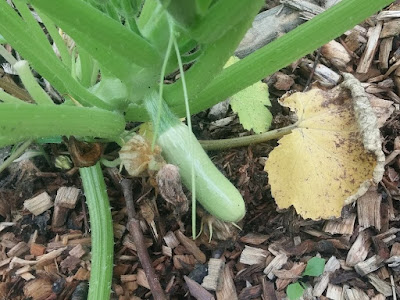
 

I thought I had posted about this last year, but I can't find that I did. This was an amazing cross that turned up in the garden last year from some seeds we had saved from Lebanese White Bush zucchini a few years earlier. We knew they would be crossed... we didn't know it would apparently be an interspecies cross with Tennessee Sweet Potato squash! The resulting squash were pretty horrid, frankly, but they were not bitter which has frequently been a problem on the seemingly very rare occasions when these two species (pepo and argyrosperma) cross. Argyrosperma is a squash grown mostly in the southern USA and Mexico, and freqently just for the seeds. We only grew it one year, and weren't too impressed. The flesh is bland, and the squash rapidly get a a very hard shell. If they are like the few of the cross that we tried as zucchini, they also develop their seeds very early. However, they are heat tolerant, drought tolerant, and bug and disease resistant. Getting some of those qualities into summer squash struck us as very desirable, and here we were with the means to work on that.

We planted 4 seeds, of which 3 germinated. One produced squash that appeared to have crossed again with an acorn squash; this was not a happy combination and got pulled pretty promptly. The other two plants appeared very similar, apart from the fact that one of them had a bush habit and the other was a bit more rambunctious, although I wouldn't call it a full-on vine. The fruit the produced was extremely similar, but that's a squash from the vining plant above and below. 


Here it is cut open. We found the stems attaching the fruit to the plant extremely tough, and the skin hardened fairly quickly too. This is no doubt the influence of the argyrosperma. That's a bit dismaying; if the plants are resistant to bugs and disease because they are physically hard that won't make for good eating. Still, these little squash were much better than last year in terms of tastiness and edibility. I won't say they were particularly great, but there is a big improvement.

We saved one fruit from each of the remaining plants. You can see how similar they are. Obviously, we intend to save seeds and continue next year. These are going to be very hard to cut open; they are still hard when ripe like the argyrosperma squash. I did manage it last year so I presume I can do it again.


We planted a bunch of potatoes from seeds in the spring, all of which got munched by flea beetles and leap hoppers, and generally didn't make it apart from a few stragglers that got left in a pot and which we have not examined yet. However, we replanted a number of seed potatoes from seed-grown plants. Here are three of the best four; one of them seems to have disappeared. I need to check the potato boxes to see if I can find a few to plant again next year. It was a dark purple skinned one, with a nice mauve and white interior. 

The others are all offspring of Pink Fir Apple. I wonder about that dark mauve skinned one; it looks like the other parent could be Purple Viking, which is known for producing some real lunkers. But maybe not; who knows what genetics are lurking beneath the surface in potatoes? The one at the top retains a hint of the waxiness of Pink Fir Apple, but the other two are quite light and fluffy in texture. They are all reasonably productive. These are the last remaining few selected from quite a few seed-grown potatoes. We discarded one I was quite interested in. It only grew about 6 or 8 inches high. It also produced about 6 very small potatoes per plant too, and that just wasn't going to cut it, unfortunately. Still! I'm pleased with the ones that remain.


Our watermelon project continues. I appear not to have posted an update last year; bad me! I feel like we've made a lot of progress, but we just aren't there yet. We planted only seeds from yellow-when-ripe watermelon this year, but we got some green skinned ones too. It's just a matter of time to sift them out, since the green skins are dominant, and once there are none, it will mean that gene is out. However, since we can't tell until the fruit ripens, they are still casting out their pollen. It sure slows us down on getting them out. 

Flavour-wise, we were a little disappointed in them this year. In spite of all the heat, they were good, but not great. Very sweet, but we thought a little on the mild side. So, we will have to see what we get next year. Right now they are moderately consistent; most of them are round to slightly oval, with either solid green turning to yellow rinds, or faintly striped green turning to yellow rinds, or "tiger" stripes in two tones of green turning to yellow and yellowish-green. And the ones that don't turn at all, of course.

As for beans, I thought it was kind of an exciting year. Our project of growing out the Blue Lake - Cherokee Trail of Tears for a more anthracnose-resistant Blue Lake type bean continues. Our anthracnose is as bad as ever, I would say, but the Blue Lake seemed especially unresistant this year. They are not really any worse than they have ever been; it's that our crosses that are growing out next to them really are more resistant and it's starting to show! 

I've sorted the crosses into 4 groups: the one I wanted the most was a pink-flowered, white-seeded, round (in cross-section) bean - there was exactly ONE. I have saved the seeds from that plant, up at the top right. Below it are the best from the much more common pink-flowered, black seeded, round bean. The beige seeds produce plants with purple pods; that's been the case since the cross first happened. I'd be more excited about them, because they are productive, tasty, and disease resistant, but for the fact that there are already quite a few purple-podded pole beans out there, and I don't know that mine are any improvement on them. Finally there are a lot of white-flowered, white-seeded plants and I saved seeds from the best of them. The seeds tend to be larger than those of the original Blue Lake, and the pods even more variable from round to really quite flat. There's also a lot of variability on the anthracnose resistance front, so we will be continuing to winnow out the disease-prone ones for a few years, I expect. But over all, they really are looking quite good.
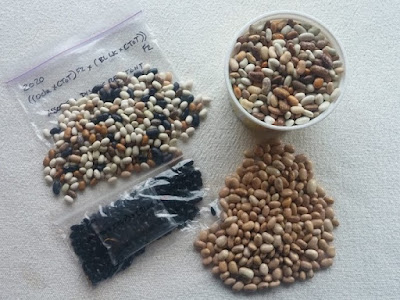

It's some other beans that have me really full of glee, though; two in particular. The two top sets are from a cross that turned up in the garden last year, and dried down to an amazing marbled mauve. It was in a patch that was a cross between Deseronto Potato and Blue Lake; I made the decision to discard that cross because it had turned out to be extremely lack-lustre but I kept the beans from the one plant. I determined that it was most likely ((Deseronto x Blue Lake) x (Anellino Yellow x Cherokee Trail of Tears)) OR ((Deseronto x Blue Lake) x (Blue Lake x Cherokee Trail of Tears)). Yes, I've mis-labelled that seed bag - must fix it.

On the top left are the seeds I'm keeping to try again, from a number of plants. These were the most disease resistant and reasonably productive ones, and they are mostly small and round like navy beans. I did keep one larger, flatter one just because it had such an unusual slate-blue colour. It looks black in the photo but it really is not. The ones in the tub were the rejects, which will be eaten this winter. 

There was one bean in this set that was truly amazing. That's the taupe seeds from it in the bottom right of the photo. All those seeds come from one plant. There would have been even more, except that the deer made a bee-line for it every time they broke into the garden and ate a bunch of it. I've never seen such a large, robust, branching bean plant. It was also quite disease-resistant. It has big, fat purple pods, and the seeds are a reasonably large size in addition to being numerous. Its sole flaw is that it was rather late to dry down, but we'll see how its offspring do - because you can be very sure those seeds are getting planted. 

The final bean in this set was another one that stood out as extremely productive. I wrote about spotting this one in the Octarora beans earlier this summer. The pile of seeds is about half the size of the other primo cross, but they are smaller generally and more dried down at this point. That's still an impressive amount of beans from one plant, and if the offspring are anywhere near as good as this plant was, they may actually replace the entire Blue Lake - Cherokee Trail of Tears project, even though it did so well this year, as being better. Amazing! A dark horse, so to speak. On which note, I'd like to ask how people feel about green beans with black seeds. They have not been admired in modern agriculture particularly, I know that, but they do seem to be what I am getting to some degree.

The final beans are the Lima beans. The photo is a bit of a mess, but the original seed I got for Alabama is in the packet at the top. I was trying to determine how much, if any, they have crossed with other Limas. I think the answer is; they have. Immediately below them are what I believe to be uncrossed Alabamas. They have just not darkened as much as the older ones, but they have the distinctive black eye. The ones immediately to their right, I believe to be a cross between Alabama and Potawatomi, otherwise seen in an un-crossed state in the lower left. These look like Alabama but with a pinker tint and brown to pinkish eye, and one of them had some darker mottling like Potawatomi which was what convinced me that these are a cross. 

Then there are a good number that are very pale when shelled, although they dry to a standard colour, and have no eye, or only a very faint one. I have concluded that these may be a cross between King of the Garden (those green seeds in the middle bottom) and Alabama. We planted a lot of seeds from a single plant of King of the Garden this spring, that last year was the only plant of any variety that did well, which was startling because King of the Garden is usually our latest and least productive Lima bean. It was a terrible year for Lima beans generally. However, we're just not getting very many King of the Garden beans this year, and I have to conclude that it is because it was an F1 hybrid, and the subsequent plants don't resemble it particularly. None of them are that spectacularly productive, nor do they have the green colour. However, if I'm right, I'll be interested to see how they develop next year, especially if we get any back-crosses.
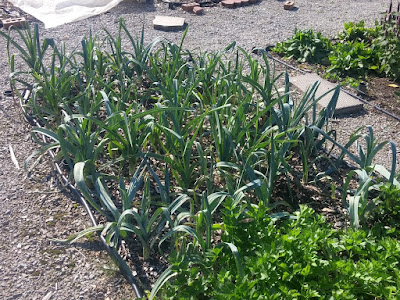
Finally, our selected line of extra-hardy leeks is doing well, apart from the leek moth which now appear to be a fixture. They still look quite variable but we have a good selection of medium to large sized leeks in the bed, so it looks like we are making progress in selecting them to size up a bit earlier. Unfortunately, I left about 8 to 10 leeks from last year to go to seed, and although I haven't cleaned it yet, it looks like there will be next to no seed. Not only is that pushing it on the number of leeks to let go to seed, they did very badly at blooming at overlapping times. However, there's lots of seed left from the year before, and this years, as said, are looking good. Onward to next year...

Wednesday, 7 October 2020

Spinach & Feta Stuffed Leeks

Leeks are so good stuffed, and spinach and feta are so good together and stuffed into leeks. With cheese, of course. So, so good. This is, I suppose, a kind of Spanakopita without the pastry, which is always a good idea for me. In this case I wasn't even thinking about that; just about how much I like leeks and how good they are stuffed.

I go into some detail about how to prepare the leeks, but once you have it down, making stuffed leeks is about the same level of difficulty as making a lasagne, and the dishes take a similar amount of time to do. You could do this into the winter with frozen spinach, which would have to be thawed in advance but would probably cut almost 15 minutes from the prep time.

4 to 6 servings
2 hours - 1 hour prep time


Prepare the Leeks & Spinach:
4 large leeks
1 tablespoon unsalted butter
300 grams (10 ounces; 1 1/2 cups) cooked drained spinach

Put a large pot of water on to boil. Wash and trim the roots and green from the leeks, and cut the remainder into 2 equal long pieces. Save any pale green parts that are usable for some other dish.

Boil the leek pieces for 7 to 8 minutes, then plunge them into cold water to cool. Leave the pot of water on the stove as you will use it again. Cut the leek pieces to the middle, longwise, and remove the centres from them - remove the leaves that are too narrow to roll nicely and leave all that are wider. Flatten the sliced leeks out, and use them to create 12 similar rectangles to be rolled.

Wash and pick over the spinach. Reheat your pot of water to boiling and cook it for 1 or 2 minutes, then drain it well. Squeeze to remove as much water as possible, then chop the spinach.

Heat the butter in a medium skillet over medium heat. Chop the leek leaves removed from the centres of the leeks and cook them gently in it until the butter is absorbed, just a few minutes. Mix this with the chopped spinach in a mixing bowl. This could be done in advance.

Stuff & Bake the Leeks:
2 tablespoons minced fresh OR 2 teaspoons dry dill weed
2 tablespoons minced fresh OR 2 teaspoons dry mint
freshly ground nutmeg, a few scrapes
freshly ground black pepper to taste
3 large eggs
225 grams (1/2 pound) feta cheese
2 tablespoons unsalted butter
100 grams (3 ounces) grated Cheddar cheese

Add the minced or dry herbs, pepper, and nutmeg to the chopped leeks and spinach. Break in the eggs and mix them in. Crumble in the feta and mix.

Preheat the oven to 350°F. Use the butter to grease a shallow baking pan into which the stuffed leeks will fit; about a 2 litre/quart dish. Divide the filling into 12 equal portions, and roll 1 portion up in each rectangle of blanched leek leaves. Arrange them in the baking tray in a single layer.

Bake the leeks for 15 minutes at 350°F. Meanwhile, grate the Cheddar. Sprinkle it evenly over the leeks then return them to the oven for another 30 to 40 minutes. Let rest 10 minutes before serving.

Monday, 5 October 2020

Melanzane alla Pizzaiolla

"Alla Pizzaiolla" means pizza-style, and that means tomato sauce and mozzarella. An awful lot of things are greatly improved by the addition of tomato sauce and mozzarella; eggplant is surely one of them. Throw in some basil, and some garlic... it has to be good. It's also pretty quick and simple to make. Some rice, quinoa, or even just some good bread and a salad will make this a complete meal. 

4 servings
1 hour prep time

Eggplant with Tomato and Mozzarella

500 grams (2 medium; 1 pound) eggplant
2 medium tomatoes
3-4 cloves of garlic
2-3 tablespoons olive oil
salt & freshly ground black pepper to taste
1/2 cup tomato sauce
1 tablespoon chopped fresh basil OR oregano
180 grams (6 ounces) mozzarella cheese
2 tablespoons finely grated Parmesan cheese

Wash, trim, and peel - if you like - the eggplant. Cut it into 1.5 cm thick diagonal slices, and sprinkle them with salt. Spread them out on a plate, and stack another plate on top, with a weight. Let them sit for 20 minutes or so.

Meanwhile, blanch and peel the tomatoes. Cut them into slices about 1 cm thick. Peel and mince the garlic.

Rinse off the eggplant and drain it well. Heat 2 tablespoons of olive oil in a large skillet that has a lid. Fry the eggplant on both sides until browned, then reduce the heat a little. Continue cooking and turning them, until quite soft and cooked through. Add a bit more oil if needed.

While those cook, wash and chop the basil or oregano, and slice and grate the cheeses. 

Add the garlic, and mix in well until sizzling and fragrant. Add the slices of tomatoes, shifting the eggplant around to allow them to make good contact with the pan. Simmer for another 5 or more minutes, until the tomatoes are quite soft. Season with salt and pepper.

Drizzle the tomato sauce over the eggplant and tomatoes. Sprinkle the basil or oregano on, then add the slices of mozzarella evenly spaced around the pan. Sprinkle on the Parmesan. Cover the pan and let simmer for another 5 minutes or so until the cheese is melted and hot. Serve at once.


Last year at this time I made Pasta with Sausage, Pepper, & Onion Rosé Sauce, and also updated Lentil Loaf with Carrots.

Friday, 2 October 2020

Brined Roast Turkey or Chicken

I have tried various brining recipes for turkey over the years, and I haven't liked any of them. I haven't liked the seasonings added, and I really didn't like the sugar or fruit juices that seems to be in most of them, even before I was supposed to abjure sugar. It turns out you don't need any of that stuff, though. All you need is salt and water.

In my opinion brining should also be done with a fairly light hand, by which I mean: not for too long. I'm saying up to 16 hours, but really, I don't recommend soaking your turkey for much longer than 12 hours, and 6 or 8 will be enough. It is far too easy to end up with a very salty turkey through over-brining.

I also don't think brining is necessarily a great technique for industrially farmed birds, which are already a little limp and soggy. You should especially never brine a turkey which has been "basted" with "butter" or indicates on the packaging that it has been in a salt solution (aka brine) already. For natural, free-range turkeys, though, the extra moistness and tenderness it provides is excellent.

I recently did a chicken this way, too. I did not brine it as long as the turkey, it being a smaller bird (somewhere between 6 and 7 pounds) but it came from a local farm (same one as the turkey in the photo) and I was a bit concerned that it had gotten an awful lot of fresh air and exercise. Brining it made it tender and delicious. Half the recipe of brine was enough for that mid-sized chicken.

Check your pan juices before you use them to make gravy. Hopefully, if you have avoided over-brining your bird they will be plenty salty but fine to use, especially if you cut them a little with unsalted stock. It's a good idea to have a back-up plan, though.


10 to 16 pounds
5 to 16 hours to brine
15 minutes per pound to roast

A Brined and Roasted Free-Range Turkey

Brine the Turkey:
1 cup pickling or kosher salt
8 litres water
a 10 to 16 pound turkey 

Put the pickling salt into the water and heat it gently until dissolved. Stir regularly. It should not be hot when you use it to brine the turkey.

This should cover a 10 to 16 pound turkey, in a snug fitting vessel that will get the brine over it completely, which is what you must do. Once the turkey is covered, put it in the refrigerator. That's probably the hardest part of this recipe, and you should be sure to clear some space and make sure your container will fit, in advance. One suggestion I've heard that sounds useful is to put the brine and turkey in a roaster bag, seal it well, then keep it in a picnic cooler with ice.

Of course you can make more or less brine to cover a smaller or larger turkey (or chicken); just use the same proportions of salt and water. Remember that if you are starting with a frozen bird it must be completely thawed first, and that will take at least 2 days for a smaller turkey and 3 days for a larger one. Chickens will generally be thawed in 2 days.

Cook the Turkey:
When you are ready to proceed, remove the turkey from the brine and drain it very well. Pat the skin as dry as you can get it with paper towel, and then let it sit out in the air to further dry for about half an hour to an hour before it goes into the oven - wet, soggy skin will not get crisp and brown.

I have not stuffed a brined turkey, and now that that kind of unrestrained carb-fest is no longer on the diet, I guess I won't. You can though; just don't add any salt to it, and as ever, have your dressing ingredients chopped and prepared the night before but don't cook and assemble them until just before they are to go into the turkey, and they are not to go into the turkey until just before it goes into the oven. 

Preheat the oven to 325°F. Roast the turkey for 15 minutes per pound; allow 20 minutes if the bird has been stuffed OR if it is under 10 pounds. Cover loosely with foil (or the roaster lid, if possible) and let the turkey rest for 10 to 15 minutes before carving it.


Last year at this time I made Broccoli & Mushroom Pasties.