Showing posts with label Turnips and Rutabaga. Show all posts

Friday, 6 May 2022

Pasta with Rutabaga Greens, Anchovies, Garlic & Chile

Here is a lively take on one of my favourite ways to prepare pasta: the pasta and some vegetable are cooked together then dressed with something richer and perhaps fried. In this case not fried, so much as infused into a generous but not too greasy amount of olive oil. (If your anchovies come with a certain amount of oil, by all means start with that when you measure the oil.) All the flavours are very strong, but in spite of that they get along with each other excellently. I used whole wheat pasta - I mostly do these day, on the rarish occasion I eat pasta at all - which can be a bit robust for more delicate sauces but which mingles well with all these equally robust ingredients. Use whatever pasta you like, though. 
 
Rutabaga greens are, as I've said before, the best (non)turnip greens, but turnip greens could be used, or Swiss chard, kale, or collards in their season. Rapini or broccoletto too, would be good, meaning this is a dish that can be made any time there are good, astringent greens around. Spinach? I think it's a little too refined to be ideal for this hearty dish, but it would work well enough if that's what you can get. Apply it with a little heavier hand, maybe. 

I'm saying 20 minutes, which is about the time for the water to come to a boil and then cook the pasta and greens, but if your greens are at all obstreperous about needing picking over, allow a little longer.
 
2 to 4 servings
20 minutes prep time
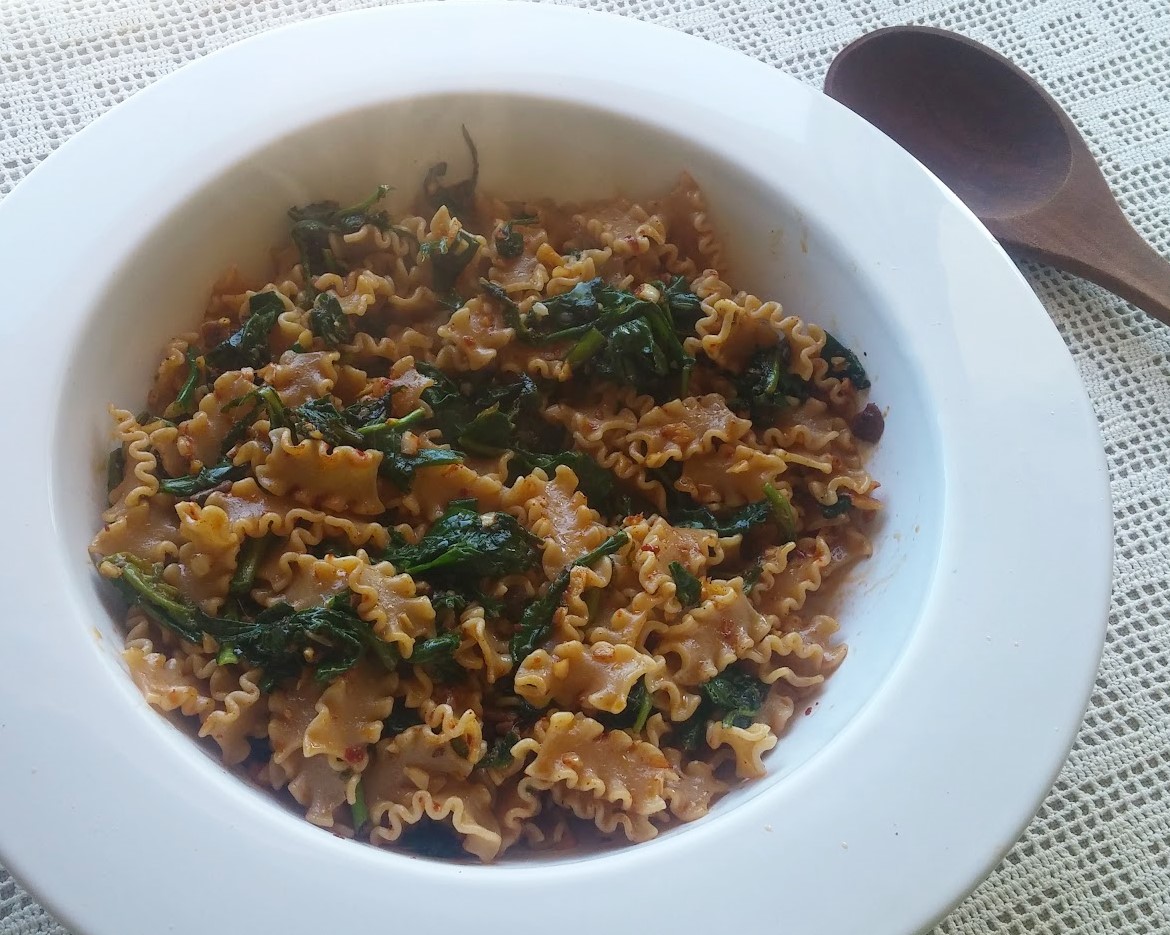
Pasta with Rutabaga Greens, Anchovies, Garlic & Chile

300 grams (10 ounces) rutabaga greens
6 to 10 cloves of garlic
1/4 to 1/2 teaspoon chile flakes
freshly ground black pepper to taste
25 grams (1 ounce; 1/2 small tin) anchovies
225 grams (1/2 pound) pasta
1/4 cup olive oil
 
Put a large pot of salted water on to boil for the pasta.

Wash and trim the greens, and chop them. Peel and mince the garlic, and put them in a small bowl with the chile flakes and pepper. Drain and mince the anchovies. 

When the water boils, add the pasta and set the timer for 1 minute longer than the recommended cooking time. When the pasta has 6 minutes left to cook, add the green, mixing them in well. 

Meanwhile, heat the olive oil over medium-low heat in a smallish skillet. When it is hot, mix in the garlic with the spices, and the anchovies. Allow them to sizzle gently in the oil until very fragrant, then remove from the heat and set aside. 

When the pasta and greens are cooked, drain them well and return them to the pot. Toss them with the hot seasoned oil and toss well to combine. Serve at once.


Last year at this time I made Cipollata.

Wednesday, 26 January 2022

Shalgam ki Sabzi

There isn't a lot to say about this; it's a nice tart and sprightly but not particularly hot dish of curried turnips. (I saved the blast of heat for this weeks final dish.) You could use rutabaga if you prefer, but in that case I suspect it would be a good idea to boil it for 20 minutes before you add it to the pan with the spices to finish cooking, as it takes so much longer to cook through. 
 
4 serving
45 minutes - 25 minutes prep time

Shalgam ki Sabzi - Curried Turnips

Prepare the Vegetables & Seasonings:
3 cups diced (3 medium) white turnips
2 pods of green cardamom
1/4 teaspoon fennel seeds, ground
1/4 teaspoon salt
1/4 teaspoon ground turmeric
1/4 teaspoon red chile powder
1/8 teaspoon ground cinnamon
a good grind of black pepper
1 good grate of nutmeg
1" piece of ginger
2 cloves of garlic
 
Peel and dice the turnips. 
 
Crush the cardamom pods and remove and discard the green papery husk. Grind the seeds with the fennel seeds and salt. Mix them with the remaining spices in a small bowl. Peel and mince the ginger and garlic, and add them to the bowl.

Finish the Dish:
1 tablespoon mild vegetable oil
1 teaspoon cumin seeds
1 teaspoon coriander seeds
1 cup of water
the juice of 1/2 lemon

Heat the oil in a good-sized shallow saucepan or a skillet over medium-high heat. Add the cumin and coriander seeds, and cook for a few minutes until they begin to sizzle and pop. Add the bowl of seasonings and mix in well, cooking for another minute or so. 

Add the turnips and the water, mixing well. Cover and cook until the turnips are tender when pierced with a fork, about 15 to 20 minutes. Add the lemon juice for the last few minutes of cooking. 


Last year at this time I made Chicken, Leek & Mushroom Pie.

Monday, 17 January 2022

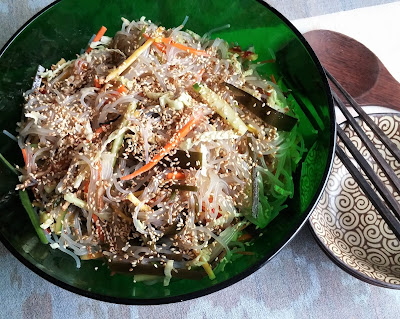
Korean Sweet Potato Noodle Salad

This is a perfect salad for the summer, being cool and refreshing yet relatively substantial without being heavy. But it is also a perfect salad for the winter, since it can be made with readily available winter vegetables. Carrots and cucumbers make a good foundation, then add such things and green onions, celery or celeriac, turnip or winter radish, bean sprouts or cabbage. I used a little cabbage; I had been thinking bean sprouts but whottasurprise, my local grocery store had none. 

If you can't find sweet potato noodles (which generally seem to come in bundles of about 200 grams) then you could use mung bean thread noodles. They tend to come in bundles of about 50 grams, so you will need 3 or 4 of them. The treatment is similar, but do check the cooking time - I think they might need a little less. 

I did not get around to making this as quickly as I intended (so just as well there were no bean sprouts) and my shiitakes got a little dried out. Therefore, I fried them briefly in a smidge of oil before adding them.
 
4 to 8 servings

Korean Sweet Potato Noodle Salad

Make the Dressing:
1/4 cup rice vinegar
1/4 cup soy sauce
1 to 2 teaspoons sugar
1 to 2 teaspoons gochujang OR chile-garlic sauce
1 tablespoon toasted sesame oil
2 tablespoons sesame seeds 

Put the rice vinegar, soy sauce, sugar, hot sauce, and sesame oil in a small bowl or jam jar and stir until the sugar is dissolved. 

The sesame seeds don't go directly in the dressing, but now is the time to toast them - a few minutes in a dry skillet over medium-high heat. Stir them as they toast and be prepared to scrape them out at once onto a plate to cool - they will go from perfect to scorched very quickly.
 
Make the Salad: 
150 grams to 200 grams sweet potato noodles (dangmyeon)
10 to 20 grams (1/2 ounce) dried wakame
8 to 10 shiitake mushrooms
1 medium carrot
1 or 2 small greenhouse cucumbers
1 cup other prepared vegetables (see introductory notes)
 
Put a fairly large pot of water on to boil. Boil the noodles as instructed on the package (probably for 5 minutes). LIFT them out of the water, keeping the water. Put the noodle in a strainer and rinse under cold water until cool. Drain well. Chop slightly to make them more manageable, if you like.
 
Meanwhile, put the wakame into the boiling water and boil for 3 minutes. Turn it over as it cooks several times, to allow it to re-hydrate evenly. You will need about a 3" x 8" sheet. Drain the wakame well, shred it into long thin "noodles", then cut it into bits about 2" or 3" long. 
 
Mix the noodles and wakame in a serving bowl. 
 
Remove and discard the shiitake mushroom stems, and shred the caps into thin julienne strips. Peel and slice the carrot very thinly, then slice the other way thinly to form fine julienne strips. Wash and trim the ends from the cucumber(s), and slice in the same way. Any other vegetables used should also be cut in fine julienne pieces. Toss them all with the noodles. 
 
Toss the dressing into the salad. Let it rest for 10 minutes before serving (it can be kept for longer in the fridge) then sprinkle the toasted sesame seeds over it and serve. 


Last year at this time I made Jerk Sweet Potatoes.

Wednesday, 5 January 2022

Side-Dish Cabbage Rolls

Cabbage rolls are a bit fiddly to put together, but there is something delightful about receiving your food in a neat little package. It's a present! Usually they are the main course, and contain meat or at least some kind of substantial protein or grain, but I thought I would do something a little different, and make them a vegetable side-dish. I have to say, I really loved them! 
 
The fiddly-ness is mostly chopping vegetables, and once you've made enough cabbage rolls to have the stem-shaving down, they are really quite quick and straightforward to put together. All the work also happens at the front end, so you have lots of time to work on the rest of dinner while these are in the oven. Mind you, I think something relatively simple is a good plan for serving with these - chops, steak, plain baked chicken (thighs could go in at the same time as the cabbage rolls), broiled fish, grilled tofu - they are going to be agreeable with a lot of different things. 

The dill pickle brine and paprika make these piquant, and I have to say the sour cream or yogurt really finished them - I don't know that I would describe it as optional. I didn't actually use a turnip, as I had a kohlrabi in the fridge that won't last as long. You could use some rutabaga or celery instead if you preferred. You could make them more substantial with about a cup of cooked rice, quinoa, or other grain added, but in that case you will need a few more cabbage leaves and should be prepared to apply the pickle brine and tomato sauce with a slightly heavier hand.
 
3 to 4 servings
1 hour 45 minutes - 45 minutes prep time
 
All-Vegetable Side-Dish Cabbage Rolls

6 to 8 large whole Savoy cabbage leaves
1 medium carrot
1 medium-small turnip (or similar)
1 medium onion
1 cup chopped mushrooms
2 cloves of garlic
2 tablespoons mild vegetable oil
freshly ground black pepper to taste, possibly salt
1 teaspoon rubbed savory
1 teaspoon sweet Hungarian paprika
1/2 cup dill pickle brine
3/4 to 1 cup tomato sauce
thick yogurt OR sour cream to serve

Put a large pot of water on to boil. Carefully remove outer leaves in good condition from a large cabbage. Shave the stems down to as close to the thickness of the rest of the leaf as you can. Once the water boils and you have your leaves ready, blanch them in batches until just softened, then rinse them in cold water to stop them cooking any further. Drain well. This can be done up to a day ahead. 

Peel and grate the carrot. Peel and grate the turnip. Peel and chop the onion. Clean and chop the mushrooms. Peel and mince the garlic. Other than the garlic, this too can be done up to a day ahead. 

Preheat the oven to 350°F. Lightly oil a shallow baking (lasagne) pan which will hold the cabbage rolls snugly. (Should be 1.5 litre/quart, or 8" x 10"). 

Put the oil in a large skillet and heat over medium-high heat. Add the prepared vegetables and cook until softened and reduced in volume by half. Stir frequently. Season with pepper, savory, and paprika when close to done. You may wish to add a little salt, but it will depend on how salty the dill pickle brine is. 

Remove the vegetables from the heat, and allow them to cool enough to handle. Divide them amongst the prepared cabbage leaves, rolling them up and placing them in the oiled pan. Pour the dill pickle brine and tomato sauce over them evenly, and bake for 1 hour. Check them half way through the cooking time, and if they look like they are drying out, cover them with some foil. 

Best served with a dollop of thick yogurt or sour cream. 


Last year at this time I made Buck-"Meat" Balls (or Patties).

Friday, 26 November 2021

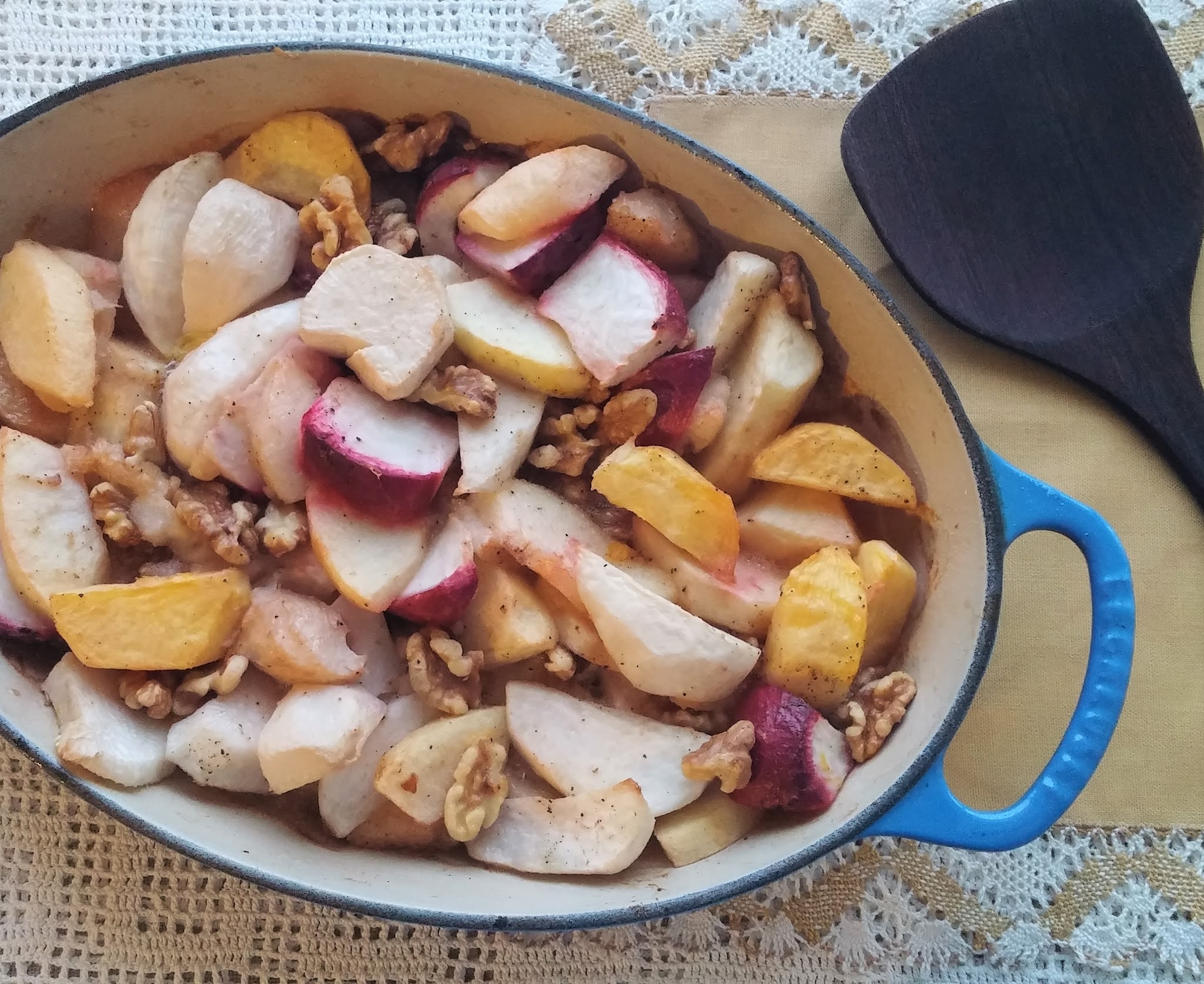
Roasted Turnips with Walnuts, Pears & Apples

Apparently, it's not just salads that I think are improved by fruit and nuts. (Look, ma! No cheese!) I realized last spring just how good turnips are with nuts, and the sweetness of a little fruit also balances out their zingy sharpness very well. At this time of year Mr. Ferdzy generally has a box of clementines on the go, so one of them went in too. I have to admit it got a little lost; if you don't have one put in 1/4 cup apple juice or water. 
 
4 to 6 servings
1 hour 30 minutes - 20 minutes prep time

Roasted Turnips with Walnuts, Pears & Apples

6 to 8 small (500 grams; 1 pound)  turnips
3 tablespoons unsalted butter
1 large apple
1 large pear
1/3 cup chopped walnuts
the juice of 1 clementine
salt & freshly ground black pepper to taste

Preheat the oven to 350°F. Put the butter into a shallow 2-quart/litre baking pan, and put it in the oven to melt. Wash, trim, and peel the turnips, and cut them into wedges. Toss them into the melted butter and roast them for 30 minutes, until beginning to be easily pierced with a fork. (Give them a little longer if necessary.) Ideally, they will fit the pan snugly but in a single layer. (Yes, mine were a bit too crowded.)
 
Peel and core the apple and pear, and cut them into similar to slightly larger wedges than the turnips. Toss them in with the turnips with the chopped walnuts. Squeeze the juice from the clementine, and pour it over them. Season with salt and pepper. Give everything another toss to blend well, and return to the oven for another 20 to 30 minutes, until everything (well, not the walnuts) is soft and perhaps browning slightly at the edges. Serve at once.


Last year at this time I made Squash & Brussels Sprouts Parmigiano

Wednesday, 17 November 2021

Time for Turnips


We did a bit of a turnip grow-out this year. It's a well-known fact (if you read this blog) that I am taken with occasional fits of inexplicable enthusiasm, and for some reason last year, during seed-catalogue season, I was taken with a fit of enthusiasm for turnips. For one thing, there was a good selection of some unusual varieties. 
 
The prominent long black ones in the front left are Noir Long du Pardailhan. Next to them, in the lower right are Scarlet Ohno Revival. The top right are Aprovecho Hardy, and to the left of them are Goldana and Goldette, which not too surprisingly got a bit confused during harvest. I don't recall ever seeing green shoulders on Goldana, though, so maybe those are the Goldettes; however even if that's the case I'm pretty sure not all the Goldettes had them. 

Noir Long du Pardailhan is a rare survivor of  a very old form of turnip, from the village of Pardailhan in France. The slightly larger size, elongated carrot shape, and rough, grey-black skin make them almost unrecognizable as turnips today. You are looking at pretty much all the harvest we got of them, other than a smaller one which we have already eaten. I think they are certainly capable of doing better; we threw in the seeds mid-summer and left them to their own devices subsequently. We should have at least thinned them. It is fortunate that the voles do not seem too interested in turnips. 

In spite of their seeming coarseness, the flesh was as white, smooth, sweet, and tender as any other, and better than some. Thus far I am not inclined to quite such effusions as the Slow Food page linked above, but it perhaps depends some on soil (ours is about as different from the native clay as possible) and perhaps once we eat the better specimens we will be even more impressed. Already, I think these are very good turnips, and I would certainly grow them again.
 
The Scarlet Ohno Revival is one I have had my eye on since we first started gardening here, but it has been hard to find. Few people carried it, and those who did we ended up not ordering from for lack of other desired choices. However, last year it was suddenly available at a few Canadian seed houses. These are by far the most attractive of the turnips we grew this year, with a rich beety magenta colour to skins, stems, and leaves. Inside they are white, perhaps blushed with pink. They also produced as many good specimens as any of the types we planted. I put one into the stew I made to test out all these turnips (Spanish Beef & Turnip Stew) and it was tasty and smooth, but definitely firmer and slower to cook than any of the others. I'm not sure it was an ideal specimen to test, though; it was a good 4" in diameter and had a certain amount of insect damage, which is why we wanted to eat it and not store it. But size tends to bring toughness to turnips - although even at that size I wouldn't say this was tough - and insect damage doesn't tend to improve flavour, at all. I left the skins on because I wanted to see how it did cooked, and it kept a nice colour and was perfectly edible. Excellent! This is another one I'll want to grow again. 

Scarlet Ohno Revival comes to us through the good work of Frank Morton of Wild Garden Seeds and OSSI. The original Scarlet Ohno was a Japanese variety, apparently once but no longer available in North America, and recreated by Frank Morton from similar and other-named but likely the same turnips. We're glad he did! I'm going to grow THESE again too. Are you detecting a theme yet? 
 
We got Aprovecho Hardy from Adaptive Seeds, and it is another OSSI registered variety. We found these to be one of the slower growing of the turnips this year, but overall their performance was fairly similar to the others. There are a couple of big ones, but most of them stayed fairly small. In spite of their (untested by us yet) hardiness, they were thin-skinned and very tender with a fine flavour. There were a few oddly shaped, off-type ones, but most of them were charming little white-skinned balls, with or without purple or green collars. Same old story! Happy to have them; will grow them again. 
 
These came out of breeding work by Alan Kapuler in Oregon; and it should perhaps be noted that when they say hardy, they mean Oregon hardy and maybe not Ontario hardy. I was about to say I would find out, but I think we've dug them all, so not this year I guess.  

Finally, we have the Goldana and the Goldette. We have been getting Goldana from William Dam for a few years now, and it has been (and maybe continues... don't know... must try a few more...) to be my favourite turnip. I've written about it already. We got Goldette from Annapolis Seeds even though it sounded very similar, and it is. We weren't careful during harvest and they got mixed up, and I can't really tell which are which, apart from the above-mentioned green shoulders, although perhaps it will be clearer if we eat some. But I doubt it. I don't think you can go wrong with either one; golden turnips are truly unique and excellent. They really don't taste as sharp as the white fleshed ones, and if you are not mad about the white ones, give one of the golden ones a try. 

As for me, it will not surprise anyone to hear that I would really like to try crossing the Scarlet Ohno Revival and perhaps Goldette (or Goldana) next year, to see what happens. I may not be able to; we only planted a row or so of each, which we then did not thin, and so most of the harvest is in the photo above. I'm not sure how well they will keep overwinter, always assuming we don't just eat them anyway. But it's something to think about. Perhaps if I started some in a pot indoors, and planted them out while it was still fairly cold in the spring, I could trick them into thinking it was time to go to seed. Hmmm.

Monday, 10 May 2021

Chicken Pozharski

Way back many years ago I found a little cook book published by MIR, the official publishing arm of the Russian Communist government (yep, that long ago) at the library. I copied out quite a few recipes from it; this was one of them. 
 
Unlike a lot of the most famous Russian recipes, this one is not a creation by French chefs then named for Russian aristocrats; it has a fairly well-known origin in the 19th century, at an inn in Torzhok run by a family named Pozharski.  

Generally, these are fairly typical of the large family of Russian "cutlets", the defining features here being ground chicken enriched with butter and fried in a coating of breadcrumbs, then served with a creamy sauce enriched with vegetables. 

It occurs to me that these are the direct ancestor of the ubiquitous "chicken nugget". How the mighty are fallen.
 
4 servings - 8 to 12 cutlets
45 minutes prep time

Russian Chicken Cutlets with Vegetable Cream Sauce
 
Form the Chicken Cutlets:
2 slices of bread (about 2/3 cup of crumbs)
2 tablespoons milk or light cream 
500 grams lean ground chicken
2 tablespoons unsalted butter, softened
1 large egg
1/2 teaspoon salt
freshly ground black pepper to taste
2 tablespoons minced fresh dill OR 2 teaspoons dry dillweed
1 large egg white
1/2 cup fine breadcrumbs
3 to 4 tablespoons oil to fry 

The bread should be stale but not dessicated; crumble it up in a mixing bowl and pour the milk on it, mixing it to moisten it completely. Once it is, add the ground chicken and butter and mix well. Add the egg, salt, pepper, and dill, and mix again. 
 
Separate the second egg, putting the egg white in a shallow bowl and the yolk aside to go into the sauce. Whisk the egg white well. Put the fine breadcrumbs into another shallow bowl. Divide the meat into 8 to 12 equal portions and roll them into neat balls. Roll each one in the egg white, then in the bread crumbs. Flatten them into patties and set them on a plate as they are done. Set them aside (in the fridge, if necessary) until the sauce is on the way to being made. They will fry up quite quickly.

Make the Sauce & Cook the Patties:
1 medium turnip
1 medium carrot
1 medium onion
1 or 2 cloves of garlic 
2 tablespoons minced parsley
1 tablespoon barley or wheat flour
1/4 teaspoon salt
freshly ground black pepper to taste
1 tablespoon unsalted butter
1 cup unsalted chicken stock
1/2 cup 10% cream
1 large egg yolk
1 to 2 tablespoons sherry or madeira

Peel and finely dice or coarsely grate the turnip and the carrot. Peel and finely chop the onion. Peel and mince the garlic. Mince the parsley and set it aside in a small bowl with the garlic, the flour, and all the remaining seasonings. 

Heat the butter in a shallow saucepan or medium sized skillet. Once it is melted and foaming, add the turnip, carrot, and onion. Cook gently over medium heat, stirring regularly, for about 10 minutes until the vegetables are softened and reduced in volume but not much browned.

At this point, you should heat a couple tablespoons of oil in another large skillet over medium-high heat in which to cook the chicken cutlets. They will take 3 or 4 minutes per side, and you will likely need to do them in 2 batches, and add a bit more oil to the pan when you start the second batch. Keep them warm in the oven at 200°F until they are all done.
 
While the cutlets cook, finish the sauce. Add the little bowl of seasonings and mix in well. Once there is no visible flour remaining, mix the chicken stock in slowly, stirring constantly. Whisk the egg yolk and sherry into the cream. When the chicken cutlets are all cooked, whisk the cream into the sauce and let it cook for another minute or so until the sauce is thickened. Serve the cutlets with the sauce at once.  


Last year at this time I made Spinach-Spelt Spaetzle or Gnocchi.

Monday, 1 March 2021

Nutty Turnips

No harder to make than boiled turnips, possibly because it is boiled turnips. The hazelnut and almond butter treatment, though, makes them really delicious. I'll be doing this with turnips quite often, and I'm going to try it with rutabaga as well. 
 
There isn't much to say about this recipe; it came about when I went to cook some turnips, stuck my head in various cupboards and appliances, and asked myself, "What goes with turnips?" 
 
Nuts. Nuts go with turnips, quite amazingly well. Hazelnuts in particular, I think. 
 
4 servings
30 minutes - 15 minutes prep time

Turnips with Hazelnuts and Nut Butter

500 grams (1 pound) white turnips
2 tablespoons unsalted butter
1/3 cup chopped hazelnuts
salt & freshly ground black pepper to taste
2 tablespoons almond butter

Peel the turnips and cut them into bite-sized chunks. Put them in a pot with water to cover them, and boil them for 10 to 15 minutes, until tender when pierced with a fork. Drain them, and return them to the heat. 

Add the butter and hazelnuts, and cook for a minute or two until the butter is absorbed and the nuts are lightly toasted. Season with salt and pepper. Add the almond butter, mix in well and let cook a minute to heat through, and serve at once. Watch you don't leave it for long once the almond butter goes in; it is inclined to stick to the pot and scorch.


Last year at this time I made Celeriac & Mushrooms au gratin.

Wednesday, 27 January 2021

Honey Braised Turnips

We had a very small crop of late-planted turnips this fall. We planted quite a lot of seed at the beginning of August, and it all came up very nicely, and I was excited. After about a week or so, though, I noticed the greenery was not advancing, but retreating. It soon became clear that they were being eaten by bugs faster than they could grow. Only a handful survived and thrived enough to produce a usable root. We are going to have to find some way to deal with this next year; it seems the longer we garden the worse the bug situation gets. 
 
I was also surprised to see that about half of the survivors, or even a bit more, were white turnips even though we had saved seeds from Goldana. Recessive genes? Cross contamination in the previous generation? No idea. 
 
I saw the trick for cutting the turnips on Pinterest somewhere, but I can I find it now? I cannot. But cutting your turnips while they are held in the cup of a wooden spoons keeps them in a nice shape as they cook. I'll be doing it again. 
 
4 servings
1 hour 10 minutes - 10 minutes prep time
 
Honey Braised Turnips

6 to 8 medium-small (450 grams; 1 pound) turnips
2 tablespoons unsalted butter
salt & freshly ground black pepper to taste
1 teaspoon rubbed thyme
1 tablespoon honey
1 teaspoon Dijon mustard
1/2 cup chicken OR vegetable broth
 
Preheat the oven to 350°F. 

Peel and trim the turnips. Cut them into wedges, leaving them attached at the bottom. (A wooden spoon to hold them will make this easy.) Slice the butter into bits and strew it around a baking dish that will hold the turnips fairly snugly. Put them in, cut sides up. 

Measure the salt, pepper, thyme, honey, and mustard into a small bowl, and mix well. Slowly mix in the broth until everything is dissolved. Pour this evenly over the turnips. 

Bake the turnips at 350°F for 20 minutes. Turn the turnips over carefully (cut sides now down) and bake for a further 20 minutes. Turn the turnips back to cut sides up again, and bake for a final 20 minutes. Serve at once. 


Last year at this time I made Perfect Fluffy Scrambled Eggs.

Friday, 20 November 2020

Braised Daikon & Carrots

On one of our numerous trips to Mississauga to deal with Mom's ongoing eye problems, we decided to branch out from our usual shopping haunts and check out an Asian (mostly Chinese) grocery store. I was very happy to see that they are labeling the origin of their fresh vegetables clearly, and promoting local produce. Not a lot at this time of year, but I was able to get a lovely big green radish! 
 
You can use any kind of winter radish (aka lo-bak, mooli, daikon, etc) for this. This is often translated as Braised Turnips, and in fact they are similar enough that you could use turnips if that's what you can get. Likely they will need a few minutes longer simmering but otherwise the recipe would be the same. 

This is often served as a soup, and you could do that easily enough simply by putting in about 2 or 3 cups more of whatever kind of stock you use. Some of the meat that made the stock, too.
 
4 servings
30 minutes - 10 minutes prep time
 
Braised Daikon & Carrots
 
Make the Sauce:
1 teaspoon arrowroot OR corn starch
1 tablespoon soy sauce
2 tablespoons chicken, pork, OR vegetable stock
1 teaspoon toasted sesame oil
2 green onions
 
Mix the starch, soy sauce, stock, and sesame oil in a small bowl. Wash, trim, and chop the onions finely, and mix them in. Set aside. 

Cook the Daikon & Carrots
225 grams (1/2 pound; 1 small or 1/2 large) daikon, lo-bak, OR green radish
225 grams (1 large or 2 small) carrots
2 cloves of garlic
4 slices of fresh ginger
1 tablespoon mild vegetable oil 
1 cup chicken, pork, OR vegetable stock
1/2 teaspoon sugar

Trim and peel the radish(es). Cut them in halves or quarters lengthwise, then into slices to make bite-sized pieces. Peel and slice the carrot. Peel and mince the garlic and ginger. 

Heat the oil in a mid-sized (2 quart) heavy-bottomed pot over medium heat. Cook the ginger and garlic in it for minute, then add the stock and sugar. Add the prepared radish and carrot. Simmer for about 20 minutes, until the vegetables are tender. 

Stir up the bowl of sauce, and mix it in until the sauce has thickened (less than a minute) then serve.


Friday, 6 November 2020

Duck Pasties

If you thought cabbage rolls stretched a little bit of duck pretty far, how about these pasties? Again, if you are shy on the amount of duck meat needed, you can fry up a few slices of bacon with the onion. However, you should also be sure not to make too much filling - don't go over the quantities listed - as this amount will make 6 very stuffed pasties. Each one is a meal with just a bit of salad to keep it company. We ate some of the leftovers cold and re-heated some in a hot oven; they were delicious both ways. Just don't microwave them, as the pastry will go soggy, as it always does.

This is a real left-over busting meal. Or to put it another way, you need to cook your potatoes and rutabaga in advance. It's all in the perspective, I suppose. If you have a little good thick gravy left over a spoonful will help keep them moist, but it's not traditional to add it, as far as I know, and if you have any holes in the finished pasties, it will leak out. 

I actually used the buttermilk instead of cream to thin my egg yolk, since it was already out. It seemed to work just fine. We thought these were delightful, and I will likely make them again with leftover turkey, because I can see that working really well too. Or the traditional roast or braised beef, for that matter.

In the end, that one 6 pound duck fed the 3 of us as a roast dinner, followed by 2 meals of cabbage rolls for 2 of us, the 3 of for lunch, and it looks like Mr. Ferdzy and I will have one more round of pasties. I did throw in about a quarter pound of bacon to make it stretch, but still, FIVE* meals (12 servings), plus there is still a fair bit of duck stock in the fridge. I'd say we squeezed our money's worth out of that bird.

6 pasties
1 hour 15 minutes - 40 minutes prep time 
NOT including time to cool
 
 
Make the Pastry:
2 1/4 cups whole spelt flour
1/2 teaspoon salt
1/4 cup cold unsalted butter
1/4 cup mild vegetable oil
1/4 cup buttermilk
the white of 1 large egg
 
Measure the flour and salt into a mixing bowl and mix. Grate in the butter, turning it to coat it in the flour. Add the oil, buttermilk, and egg white, and mix everything well, cutting it together with a pastry cutter or the side of a spoon. Once it is well blended but still with lumps of butter, pull it together to form a ball (by hand). Let rest for 20 minutes while you make the filling. 

Make the Filling & Finish:
1 small onion
1 teaspoon duck fat or other oil
1 1/2 cups diced cooked duck meat
3/4 cup diced cooked potato
3/4 cup diced cooked rutabaga
salt & freshly ground black pepper to taste
extra whole spelt flour for rolling
up to 6 tablespoons leftover duck gravy OPTIONAL
1 large egg yolk
2 tablespoons light cream

Peel and dice the onion, and cook it in the fat or oil over medium heat until softened and translucent. Put it into a mixing bowl with the diced cooked duck, potato, and rutabaga. Season carefully with salt and generously with pepper. 

Preheat the oven to 400°F. 

Divide the dough evenly into 6 pieces. Dust a sheet of parchment paper with a little flour, and roll the first piece of dough out into a circle. Be sure that it is large enough to hold the filling. Put 1/6th of the filling on it, along with up to a tablespoon of leftover gravy, if you have it, and fold it over to close. Press sealed along the edges, then roll the edge up and press again to be sure to have a good seal. Lift the pasty onto a baking tray lined with another piece of parchment paper, leaving space for the rest.

Repeat with the remaining pieces of dough and filling. 

Bake the pasties for 15 minutes. Whisk the egg yolk and cream together. Brush the pasties with this mixture, then return them to the oven for a further 15 minutes of baking. Serve warm or at room temperature. If kept in the refrigerator, bring them out 20 minutes before serving to take the chill off them. They will also reheat well in the oven. 


*The mathematically astute will conclude, correctly, that Mr. Ferdzy and I were piggies with the pasties.
Last year at this time I made the tasty but perplexing Turkish Lentil & Potato Salad.

Wednesday, 8 July 2020

White Beans with Bacon, Turnip Greens & Onion

As threatened, I got out there and thinned the rutabagas. The result was enough "turnip" greens to make 2 packets of frozen greens and a dish to be eaten at once. This was the dish. Turnip - rutabaga - greens are astringent enough that I think them best with something to balance them out; both the mild and creamy beans and the rich and smoky bacon being classic choices for doing that.

I did not add the vinegar; I enjoyed the rather sweet and mellow vibe of the stew without it, but if you feel the flavours are a bit flat otherwise, put it in. Likewise, I considered putting in some hot chile flakes but that was really not my prevailing mood. You could add a few, or do as I did and simply pass some hot sauce so that it can be spiced to taste at the table.

This is a fairly substantial dish, and we ate it by itself - some bread and butter would be good with it, or toast. Hot stews don't seem very summery, but this was one that goes together quickly enough that the kitchen shouldn't be too over-heated. Of course, I cooked the beans in the Instant Pot which helps keep it down. A tin would be about the right amount of beans and would achieve the same results with even less effort.

2 servings
30 minutes, not including cooking the beans

White Beans with Bacon, Turnip Greens & Onion

2 cups cooked white beans
extra bean cooking liquid, ham broth, or chicken broth
225 grams (1/2 pound) bacon
1 medium onion, with its greens if possible
300 grams (10 ounces) turnip OR rutabaga greens
salt & freshly ground black pepper to taste
1/2 to 1 teaspoon sweet smoked Spanish paprika
2 teaspoons vinegar (optional)

The beans should have their cooking liquid; otherwise you may need to supplement it with some ham or chicken broth.

Cut the bacon into pieces a little narrower than they are high, and put them in a large, heavy bottomed pot or skillet. Don't start cooking them, though, until the vegetables are more or less ready to go.

Trim and peel the onion, and chop it. Chop the green onion top too, if it is there and in good condition, but set the green tops aside separately.

Wash the turnip greens well in cold salted water; it they can soak a bit so much the better. Then strip the leaves from the stems, discarding the stems and any badly damaged or yellowed leaves. Chop the remaining leaves coarsely.

Begin cooking the bacon over medium heat. Once it is about half-cooked, assess the amount of fat being rendered and drain off some if it looks like there is too much. A certain amount is good though, to cook and flavour the remaining ingredients.

Add the onion and cook with the bacon until soft and translucent, stirring occasionally. Add the chopped green onion tops and seasonings - the amount of salt to depend very much on how much is in the bacon, and perhaps also the beans and broth (if being used). Once they are well combined, add the beans with the cooking liquid. Simmer for a few minutes until hot through, and add a little more broth if required to give the mixture a stewy but not too liquid texture.

Add the drained chopped greens, mixing them in until well wilted down. Continue simmering the mixture until the greens are done to your liking; likely somewhere between 5 and 10 minutes. Again, a little more stock may be added if needed.

This is a rather sweet and mellow dish; you could sharpen it up with a dash of vinegar if you like. Once it goes in, let the strong scent of vinegar cook off before you serve it.


Last year at this time I made Herby Feta, Quinoa, & Snow Pea Salad.

Friday, 10 April 2020

Rutabaga & Apple Soup

There isn't too much to say about this; it's a winter vegetable purée soup, with some sweet and slightly zingy flavours and a lovely colour. (And brrr, it seems to be a winter week.)

At two servings, it will be a big bowl of soup to go with salad or bread and cheese; four servings would be fairly small portions as a starter to a meal.

Anise seed is an under-used spice, I think. I keep meaning to use it more often. This is a start.

This was quite a thick soup; you might want to add a bit more broth to make it soupier.

2 to 4 servings
1 hour - 30 minutes prep time

Rutabaga & Apple Soup

2 cups diced peeled rutabaga
4 cups unsalted chicken OR vegetable broth
1 bay leaf
1/2 teaspoon salt
1 medium carrot
2 large apples
2 tablespoons unsalted butter
1/2 teaspoon anise seed, ground
1 teaspoon ground ginger
the juice of 1/2 small lemon
1 tablespoon sherry
1/3 cup light cream

Peel and dice the rutabaga, and put it in a soup pot with the broth and bay leaf and salt. Bring to a boil and boil steadily for 40 minutes, until tender. As soon as it is in, peel the carrot and cut it into dice. Add it to the pot of rutabaga to cook along with it.

When the rutabaga and carrots have about 15 minutes left to cook, peel, core, and slice the apples. Heat the butter in a medium-sized skillet over medium heat. Cook the apples gently until quite soft and slightly browned. A few minutes before they are done, sprinkle them with the ground anise seed and ginger. Mix in well.

Transfer the cooked carrots and rutabaga to a blender or food processor. Add the apples and process until smooth. Return the soup to the pot, add the lemon juice, sherry, and cream and re-heat just up to the point of being steaming hot, but do not allow it to boil. Serve at once.


Last year at this time I made Chick Pea Choux Pastry


Wednesday, 1 April 2020

Clapshot Roasties

Clapshot is a traditional dish from the Orkney Islands of Scotland, and versions of it abound in Ontario too now. Usually Clapshot is made with boiled and mashed potatoes, rutabaga, and carrots, and I love it that way, but it occurred to me to take the same ingredients and roast them instead. Yes! Very good. And since I let the vegetables cool overnight before roasting them, I figure much better for the blood sugar.

4 servings
1 hour 45 minutes - 20 minutes prep time

Roasted Potatoes, Carrots & Rutabaga

225 grams (1/2 pound) rutabaga
225 grams (1/2 pound) carrots
450 grams (1 pound) potatoes
2 to 3 tablespoons mild vegetable oil
salt & freshly ground black pepper to taste
freshly grated nutmeg to taste

Peel the rutabaga and cut it into fairly small dice. Peel and trim the carrots and cut them into similar dice. You can peel and cut the potatoes into just slightly larger dice now, or wait until after they have been cooked.

Put the rutabaga and carrots into a pot of water to cover. Add the potatoes now (they still should be covered with water) if they are whole or in larger chunks. (You should cut them into approximately 1 x 2" chunks if they are large; leave them if that is close to their natural size.)

Bring the vegetables to a boil and boil for 10 minutes. If you have cut the potatoes into dice already, don't add them until the others have cooked for 5 minutes.

Drain the partially cooked vegetables well. You can let them cool completely or finish cooking them now. If the potatoes are still in large pieces, they should be cut into dice slightly larger than the others.

Preheat the oven to 375°. Toss the vegetables with the oil in a 9" x 13" or similar shallow roasting (lasagne) pan. Season with the salt, pepper, and nutmeg and toss again. They should be just lightly coated in oil.

Roast at 375°F for 1 hour to 1 hour and 20 minutes, until the vegetables are cooked and looking a little browned around the edges. Serve at once.


Last year at this time I made Claypot Chicken - in the Romertopf

Monday, 9 March 2020

Rutabaga Gnocchi

I have now made these with both spelt and barley flour, and they both work well so feel free to use whichever you prefer. The spelt flour will certainly be easier to find. Our impression is that the spelt ones had a stronger and more robust flavour than the barley ones did, so that may be a factor in your decision as well. I found the texture of the dough when using barley flour improved with sitting for 10 minutes before being formed, so you should allow for that if you go that route. You can see one of the barley flour gnocchi sitting in the middle of the plate (paler and slightly grooved). It was a pretty subtle distinction.

This is a nice variation on the theme of gnocchi, but I found the flavour of the rutabaga less pronounced than I expected. You may or may not consider that a good thing. 

72 (6 dozen pieces); 4 to 8 servings
1 hour to boil and mash the rutabaga
20 minutes to make and cook the gnocchi

Rutabaga Gnocchi

2 cups mashed cooked rutabaga
about 2 1/2 cups whole spelt OR barley flour
1/2 teaspoon salt
a few gratings of nutmeg
1 large egg
1/2 cup potato starch OR more flour as used

Peel the rutabaga and cut it into cubes. You will need a scant 4 cups of cubes to achieve 2 cups of mashed cooked rutabaga. Put the cubes into a pot and cover them generously with water. Bring them to a boil and boil them for 40 to 45 minutes, until tender. Drain them very well and mash thoroughly. Let them cool for a few minutes (or completely) before proceeding.

Put a large pot of salted water on to boil to cook the gnocchi - not as much salt as for cooking pasta, but a sprinkle. If you are using barley flour to make these, however, hold off until the dough has been mixed and has sat for 10 minutes.

Measure 2 cups of flour and add it to the mashed rutabaga (back in the pot, or in a mixing bowl). Add the salt and nutmeg, and mix well. Break in the egg, whisk it up, then mix it in thoroughly. At this point, add a little more flour, mixing well between each addition, until you have a sticky but cohesive dough. I added about another 1/2 cup in total to achieve this.

Divide the dough into 4 or 6 even parts, and roll each part into a long, even roll about 1" in diameter. Cut each roll into 16 or 12 even pieces, roll each piece into a flattish rectangle and put them on a plate on which the potato starch or remaining flour has been sprinkled. Shake to coat them, then shake off any excess starch or flour.

When the water boils and the gnocchi are made, add them to the pot. Boil until they all are floating high in the water; unless you have made them much larger than I did, that will be about 5 minutes at most. Skim them out or drain them, and dress them with the sauce of your choice. Serve at once.


Last year at this time I made Scottish Oatcakes

Wednesday, 19 February 2020

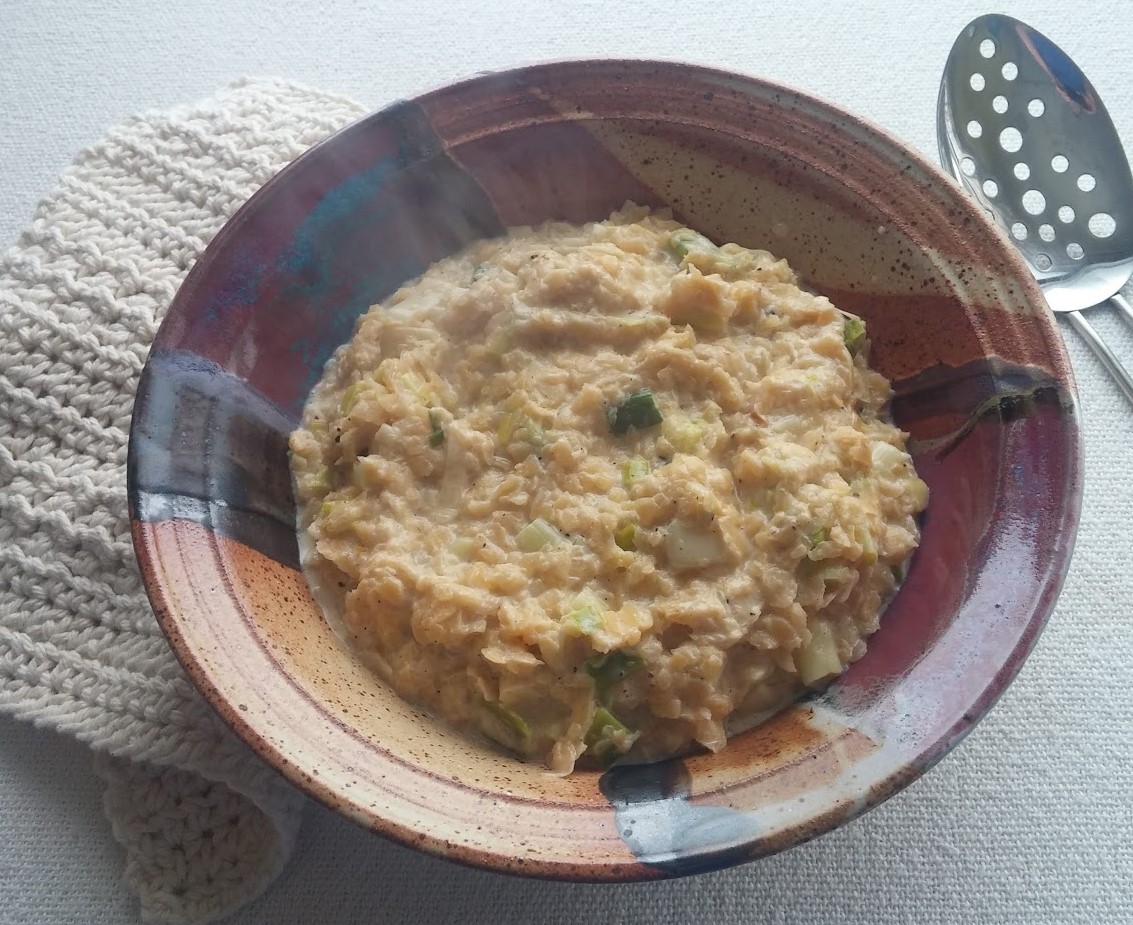
Creamy Rutabaga & Leeks

Ontario leeks seem to be available for much longer than they used to be, right through the winter if we are lucky. I also seem to be doing a series of vegetable dishes consisting of a changing array of vegetables cooked with leeks and butter. Now I'm doing rutabaga, and like almost everything else it goes beautifully with leeks and butter. How could it not? And then I upped the ante and added cream. Wow! Yes, this is very rich and commensurately delicious with it.

I'm proud to say I grew both the rutabaga and the leeks that went into this dish.

4 servings
1 hour - 20 minutes prep time

Creamy Rutabaga & Leeks

4 cups rutabaga, peeled and grated
2 cups (2 medium leeks) finely chopped leeks
3 tablespoons unsalted butter
2 cups unsalted chicken OR vegetable stock
1/4 teaspoon salt
freshly ground black pepper to taste
freshly grated nutmeg to taste
3/4 cup 10% cream
1 teaspoon arrowroot OR cornstarch

Peel and grate the rutabaga. Wash, trim, and finely chop the leeks.

Heat the butter in a large heavy-bottomed soup pot over medium heat. Add the rutabaga and mix in well. As it begins to wilt down, mix in the stock. Cover and let simmer for 25 to 30 minutes. Stir frequently. Add some water if the stock looks like boiling off - the liquid can and should be getting fairly low by the end, but don't let it disappear.

Season with the salt, pepper, and nutmeg. 

Add the leeks, and continue simmering for another 10 to 15 minutes, stirring regularly and watching the level of the liquid. By the time they are tender, the liquid should be about gone. Mix the starch into the cream and add them to the pot. Stir in well. Reduce the heat to a very slow simmer and let cook for another 5 to 7 minutes, until the cream has thickened and coated the vegetables. Serve at once.


Last year at this time, apparently, a new obsession was born as I made Spaetzle - Quick Austrian Egg Noodles (Dumplings).

Wednesday, 8 January 2020

Braised Pork Belly with Turnips

Usually this is made with radishes, of the long white variety. Winter radishes, as they are sometimes called, and when we grow them they do indeed do best planted in mid to late summer and harvested just before frost, when they will then keep in the cold room for a month or two.

Unfortunately, we didn't grow any this year and although they should theoretically be available around now, if they are it isn't in this little hotbed of completely non-Asian food. Turnips, though, are very similar and replace them quite well. I suspect they might have taken a little longer to cook than radishes would have, so if you do manage to use radishes, start checking them a bit earlier on in the cooking process.

This is a tasty and complete dish - you may want to serve it with some rice - but it does lack in colour. A little chopped parsley, cilantro, or green onion, if you have any of those, sprinkled over the top, will perk it up considerably.

2 to 4 servings
1 hour 15 minutes - 30 minutes prep time

 Braised Pork Belly with Turnips

Start the Dish:
250 grams (1/2 pound) fresh pork belly
500 grams (1 pound) white turnips
1 tablespoon finely minced or grated fresh ginger
4 to 6 cloves of garlic

Cut the pork belly into bite-sized chunks. Put them in a large skillet or heavy-bottomed soup pot, and cook them over medium heat quite gently for about 30 minutes. Stir occasionally.

Meanwhile, peel and cut the turnips into bite-sized pieces. Peel and grate or mince the garlic and ginger.

Make the Sauce & Finish the Dish:
2 tablespoons rice vinegar
2 tablespoons soy sauce
2 tablespoons sherry
1 teaspoon 5-spice powder
1 to 2 teaspoon chile-garlic sauce
1/2 to 3/4 cup water

Mix the sauce ingredients together in a small bowl.

When the meat has cooked for about 20 minutes, long enough to have rendered a fair amount of fat, lift the meat out of the pan with a slotted spoon. Drain off most of the fat, leaving just enough to keep the turnips from sticking, when added. Return the meat to the pan, and add the ginger and garlic. Cook for several minutes, stirring them into the meat until well distributed and fragrant.

Add the turnips and the sauce, with the smaller amount of water. Mix in well. Cover the pan and simmer gently for about 20 minutes more. Stir every 5 minutes or so. If the sauce evaporates before the end of the cooking time, add a little more water, but the sauce should be reduced to thicken and coat the pork and turnips just around the end of the cooking time.

Serve with steamed rice.


Last year at this time I made Baked Apples Stuffed with Mincemeat

Wednesday, 4 December 2019

Rutabaga, Carrot, & Leek Soup

This cheerfully orange soup is basically a thick vegetable purée with seasonings. In other words, it's easy, healthy, substantial, and delicious. Just the thing for what looks like being an old-fashioned winter, and a good choice to balance out some of the richer fare floating around at this time of year.

4 to 6 servings
1 hour 30 minutes prep time


 Rutabaga, Carrot, & Leek Soup

2 cups peeled, diced rutabaga
2 cups peeled, diced carrots
1/4 cup unsalted butter
1 bay leaf
2 medium-large leeks (4 cups when chopped)
1 teaspoon salt
freshly ground black pepper to taste
1/4 teaspoon dried rosemary leaves
1/2 teaspoon rubbed sage
2 tablespoons barley flour, toasted
4 cups chicken OR vegetable stock, or a little more
1/4 cup apple cider vinegar
a dollop of sour cream to serve, optional

Peel and dice the rutabaga. Peel and dice the carrots. Melt the butter over medium heat in a heavy-bottomed soup pot. Add the rutabaga and carrots, and mix in to coat them in the butter. Let them cook slowly, stirring regularly, for about 45 minutes.

Meanwhile clean, trim, and slice the leeks. Rinse them again and drain well. Add them to the vegetables in the pot as soon as they are ready - you want them to cook in the butter for about half an hour. Season with the salt, pepper, rosemary, and sage.

Toast the barley flour in a small skillet over medium heat, stirring regularly. When it has toasted to the shade of a brown paper bag, turn it out onto a plate to cool. When the vegetables have cooked for 45 minutes, sprinkle it over them and stir it in until it disappears. Pour over the chicken stock and vinegar. Simmer for a further 30 to 40 minutes until the rutabaga is tender, stirring occasionally. Keep the pot covered and try not to let it evaporate too much, but if it does add a bit more stock.

Purée the soup (after removing the bay leaf) until smooth. Reheat to serve. Be careful! The thick soup is prone to splattering.  A dollop of sour cream makes a nice garnish, if you are so inclined.


Last year at this time I made Fondant Potatoes & Turnips.

Wednesday, 24 April 2019

Roasted Rutabaga Fries

By this time of year there isn't much that's still available in the way of storage vegetables, at least not ones that aren't very, very tired. Rutabaga is one of the few. I haven't quite figured out where it stands in the new diet, but I've been eating a lot of it lately anyway. It doesn't make me feel off-kilter the way the last potato dish I made did, so there's that. 

I'd certainly had the idea of roasting rutabaga as fries, but had never quite gotten around to doing it. Fortunately, Molly Watson at The Spruce Eats has done it already and I just did what she told me, although I did turn down the heat a little and I'm glad I did. Yummy!

You do have to like rutabaga - the roasting really intensifies their flavour a lot. One cup (and all these measurements are highly approximate, it's that kind of thing) is probably closer to what most people will eat, but keep in mind they will shrink by about 1/3 in the roasting.

per serving
1 hour - 20 minutes prep time

Roasted Rutabaga Fries

1 to 2 cups rutabaga, when peeled and cut
2 teaspoons mild vegetable oil, about
salt & freshly ground black pepper to taste
other seasonings, such as paprika, savory, etc

Preheat the oven to 425°F.

Peel the rutabaga, whatever quantity you believe will be eaten, and cut it into thin French-fry shapes of about 1/4" across. I found it easiest to cut 3 slices at a time, then stack and cut them in the other direction.

Put all the fries into a mixing bowl and toss with just enough oil to coat them lightly. Spread them out on a large baking tray and sprinkle with whatever seasonings you like; I used the ones mentioned above.

Roast the fries at 425°F for 20 minutes, then turn them over and roast them for another 15 to 20 minutes. Watch them towards the end, as they will darken and burn fairly rapidly. Brown is fine, desirable even, but crunchy, in this case, is not good.


Last year at this time I made Oatmeal Scones.

Monday, 3 December 2018

Fondant Potatoes & Turnips

Well, this was my very first attempt at Fondant Potatoes, and I can't say I did a lovely job. I know exactly what happened - wrong potatoes, unclarified butter, and did not cook long enough - and let those things happen anyway. They were delicious anyway, so no few regrets.

First off I didn't use waxy potatoes - I used German Butterballs -  and rather than get brown they wanted to let off a lot of starch which welded itself to the pan and did the getting of the brown. I also could not be arsed to clarify the butter and knew from the start that that would mean I should be prepared to pull them off the stove earlier than I would otherwise to avoid burnt butter flavour. I pulled them off when  the smell was so delectable I could wait no longer and also everything else had been sitting and waiting for 5 minutes already. 

Before I made these I carefully read through Felicity Cloake's article How to make the perfect fondant potatoes, from the Guardian, and followed her directions insofar as I am capable of following anyone's directions. (Floury potatoes, unclarified butter; see.) Since under-cooking seems to be a hazard of this dish I did not hesitate to cook them in a more generous amount of water for a few minutes before draining much of it off and proceeding in the more usual way.

If you are cooking both potatoes and turnips, you will need fewer of each, obviously, and there is also a definite upper limit to the amount you can get in the pan. It will be so much easier to turn the pieces when the time comes if they are not jammed in like bus riders in rush-hour.  If you want to serve more than 3 or 4 people you will need to break out a second pan.

In spite of all the flaws with this attempt, the resulting potatoes were delicious and distinctive. I will definitely want to work on making these a part of my potato (and turnip) repertoire.

In fact, after I had made these and written up the post, I found a small stash of Pink Fir Apple potatoes and tried them again. I had expected them to be better, but in some ways they were worse. The results were still very tasty, but really more like plain old fried potatoes. I am inclined to suspect that success here rests very much on having the right potato, and that I don't have it. If anyone else has made these - with potatoes available in Ontario - I'd love to hear how it worked out for you and what kind of potatoes you used.

4 servings
1 hour prep time

Fondant Potatoes & Turnips

4 to 6 smallish (2"diameter) waxy potatoes
AND/OR 6 to 12 very small (1 1/2" diameter) Goldana turnips
2 cups (about) water
3 tablespoons clarified butter OR unsalted butter
1/2 teaspoon salt
1 teaspoon rubbed thyme or savory
1 large clove of garlic
freshly ground black pepper to taste

Peel the potatoes and/or turnips and cut each one in half, aiming for as flat a profile as possible.

Put the pieces in a single layer into a sufficiently large skillet with the rounded sides down. Add the water - enough to just come up to the tops - and bring them to a boil. Boil them for 5 to 10 minutes; 5 minutes for potatoes and 10 minutes for turnips. If using both, start the turnips then add the potatoes when the turnips have boiled for 5 minutes.

Ladle off much of the water, leaving about enough to fill the pan to 1/4". Add the butter, salt, and thyme and let the vegetables boil gently until the water is evaporated; about 10 or 15 minutes. Peel and mince the garlic while they cook. Add it to the pan as the water goes.

Continue cooking the potatoes and/or turnips for another 20 to 30 minutes until they have browned nicely on the underside. You can turn them and cook them some more on the top as well if you are that dedicated to hanging over a hot pan. They were quite lovely one-sided.


Last year at this time I made Brussels Sprouts with Sour Cream & Horseradish.