Monday, 28 February 2022

Stir-Fried Tofu "Noodles"

It's a basic dish of stir fried noodles and vegetables... without any noodles. I found tofu sheets in the cooler of an Asian market last time we were in Windsor. It's a big pity I cannot get anything like it around here. The local grocery has a few slabs of basic tofu; take it or leave it, and misses out on the huge range of shapes and textures available. This particular iteration is a large, thin, and rather dense sheet that cuts nicely into strips that have about the texture of cooked noodles, hence this dish. Ideal for anyone trying to avoid carbohydrates, like (*checks notes*) me. There are also dried sheets of tofu, but that's not what you need here. The refrigerated tofu sheets freeze really well, so next time we're in Windsor or some other civilized spot I intend to stock up.

Having said that, next time I might replace half the tofu with a square of ramen noodles; I do miss them even though this was really good. Unlike real noodle dishes, it would also be quite appropriate to serve this with some rice.
 
2 to 4 servings
30 minutes prep time
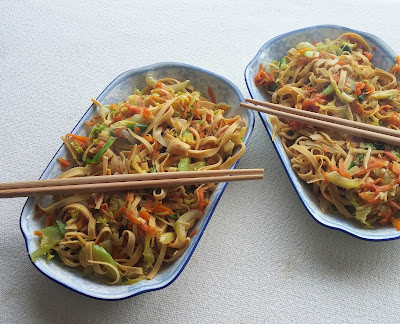
Stir-Fried Tofu Noodles & Vegetables

300 grams (10 ounces) fresh tofu sheet
3 cups shredded savoy cabbage (or other cabbage or greens)
1 large carrot
1 large onion
1 or 2 stalks of celery
1 or 2 cloves of garlic
2 slices fresh ginger optional
2 tablespoons mild vegetable oil
1/4 soy sauce (light helps keep the salt down)
2 teaspoons toasted sesame oil

While the tofu sheet is folded as it came in the package, cut it into 1/8" strips. Cut them in half again across the middle. This will leave you with a pile of noodle-like tofu shreds.

Prepare the vegetables; shred the cabbage, peel and grate the carrot, peel and cut the onion into slivers, wash and thinly slice the celery, and chop the garlic and ginger fairly finely.

Heat 1 tablespoon of the oil in a large skillet or wok. Sauté the onion until it begins to soften, then add the remaining vegetables including the garlic and ginger. Drizzle a couple tablespoons of water over them, and cook at high temperature, stirring and tossing constantly until the veggies are softened and the water is evaporated. Remove the veggies from the pan and set them aside.

Heat the remaining tablespoon of oil in the skillet. Put in the tofu "noodles", and drizzle the soy sauce over them. Cook them, stirring constantly and turning until they are well mixed and heated, then add the vegetables back in. Continue to mix and toss until well blended and hot through, and all the liquid has evaporated. Drizzle with the sesame oil, mix well and serve. 


Last year at this time I made Tomato, Macaroni, & Cheese Soup.

Friday, 25 February 2022

Bulgarian Princesses

This traditional Bulgarian dish was commonly made when making sausages; leftover filling was spread on bread and broiled. It then went on to became a popular snack whether sausages were being made or not. You can season the meat however you like, really, although this was a pleasant combination.
 
Why are they called Princesses? No idea. It sounds a bit cannibalistic, but I hope the actual implication is that they are good enough for a princess. Not one of your sits-in-a-tower-embroidering princesses, but an I'm-also-a-general-in-the-army type princess, with a hearty appetite. 

My beef (and given the relatively small amount needed, it was only beef) is grass-fed and therefore very lean. This is a dish that needs a little fat in it, to melt into the bread and give it the perfect texture. Not too much though; I added a scant tablespoon of bacon fat to my mixture (before the egg, so I could get it well-distributed) and it worked perfectly. 

Why yes, these really are a lot like an open-faced hamburger. More fun, but I think some pickles and slice of tomato would do them nothing but good. Salad is a great accompaniment for them. I say nothing of French fries.
 
4 servings
20 minutes prep time
 
Bulgarian Princesses - Open-Faced Grilled Meat Sandwiches

3/4 teaspoon cumin seeds
1/4 teaspoon black peppercorns
1/2 teaspoon salt
1 teaspoon rubbed savory
1 teaspoon sweet smoked paprika
1 or 2 cloves of garlic
1 tablespoon minced parsley, OPTIONAL
250 grams (1/2 pound) slightly fatty ground beef
  OR beef and pork mix
1 large egg
1 medium baguette
  OR 4 crusty buns
 
Grind the cumin and pepper with the salt, then mix all the spices in a mixing bowl. Peel and mince the garlic, (and mince the parsley) and add it along with the beef. Mix well, then mix in the egg. 

Preheat the oven broiler. 

Slice the bread or buns. Toast them lightly under the broiler, then turn the oven heat to 400°F. Spread the buns with the beef mixture while the oven heats, then bake them for 8 to 10 minutes until the meat is done. If the meat is done but you think it could have a better colour, put the princesses under the broiler for a couple of minutes. Serve hot, garnished with a sprinkle of parsley, if possible.


Last year at this time I made Bachelor's Baked Hash. Huh. Do I want meaty, carby comfort food all the time at the end of February? Apparently.

Wednesday, 23 February 2022

Bulgur Mujadarra

Mujadarra is usually made with rice, not bulgur, but bulgur works very well too, and is a better choice for me nowadays. 
 
Mr. Ferdzy and I both grew up eating brown rice and lentils as it was a popular food with the hippie-health food crowds in which we both ran. It was healthy and very cheap and filling - still is. It wasn't until much later I discovered that the best part of the combination was the caramelized onions. Of course, unlike the base they take a fair bit of time and attention, generally lacking on the part of frazzled parents. I find I can get a lot of other things done in the kitchen while they cook, though; emptying or loading the dishwasher, wiping the counters, checking the fridge for science experiments, or if all else fails I sit at the table with a book in between the stirrings of the onions.
 
4 servings
1 hour prep time
 
Bulgur Mujadarra
 
Cook the Lentils & Bulgur:
2/3 cup green or brown lentils
2/3 cup coarse bulgur
1 or 2 bay leaves
1/2 teaspoon salt
3 cups water
 
Rinse the lentils and bulgur; drain well. Put them in a rice cooker with the bay leaves, salt, and water. Turn on and let them cook until done. If done before the onions, keep them warm. 

Cook the Onions & Finish:
3 medium-large onions
3 tablespoons mild vegetable oil
a little salt
freshly ground black pepper
1/4 to 1 teaspoon Aleppo pepper
a little parsley to garnish 

Peel the onions and cut them in half from pole to pole. Cut them in half again, if the onions are large, then slice them into half or quarter moon pieces, thin but not in shavings. 

Heat the oil in a large skillet over medium heat. Add the onions and cook, stirring regularly, until the onions soften and reduce in volume, and take on a golden colour. This cannot be hurried, and will take 30 to 40 minutes, more likely 40 minutes. If they are browning too quickly, reduce the heat. Season with a little salt early in the process to help draw out the liquid from them. Add the other seasonings close to the end. 

When the onions are ready, remove about 1/3 or 1/2 of them to a small plate. Mix the cooked lentils and bulgur into the remaining onions in the pan, and let it all heat through and get well amalgamated. Serve with the remaining onions spread over the top, and a sprinkling of chopped parsley. 


Last year at this time I made Green Beans in Savory Sauce.

Monday, 21 February 2022

Beef Adobo

I think this is particularly good with bone-in beef, but it is not required.  

It's funny how one's taste evolves over the years; I think I'm getting to the point where if I am served a meat dish with no vinegar in it I feel like something vital is missing. Well, it's not missing here. It's also interesting to me to compare this dish, the result of Asian colonization by people from the Iberian peninsula, with the other such dish I made a little while ago. It's a Spanish-Filipino fusion, rather than a Portuguese-Indian one, and while there are points of similarity it's also pretty different. I don't think I could tell you which one I like better; they're different moods but I don't think I'd ever be sorry to see one of them on the table.
 
4 servings
2 hours to overnight marinade time
20 minutes prep time
2 hours cook time
 
Beef Adobo
 
2 tablespoons finely grated fresh ginger
3 or 4 cloves of garlic
2 bay leaves
1/3 cup apple cider vinegar
2 to 3 tablespoons maple syrup
2 tablespoons soy sauce
1 tablespoon fish sauce
freshly ground black pepper to taste
500 grams (1 pound) stewing beef
OR 900 grams (2 pounds) stewing beef with bones
2 or 3 medium onions
2 tablespoons mild vegetable oil

Peel and grate the ginger; peel and grate the garlic. Put them in a container which can be covered and which will hold the beef. Mix with the remaining marinade ingredients. Marinate the beef for 2 hours to overnight in the fridge. 

Peel, trim, and cut the onions in quarters, then in slices (quarter rings).
 
Heat the oil in a large heavy-bottomed soup pot over medium heat. Cook the onions in it until soft, stirring regularly. Add the beef, with the marinade. Cook gently for 1 1/2 to 2 hours until the marinade slowly evaporates and the beef fries and browns slightly in the residual oil. It's best to get it started with a lid on it, then let the liquid reduce faster towards the end of the cooking time. Let the adobo rest 5 minutes before serving. 


Friday, 18 February 2022

Patatas al Ajillo

There are a lot of Spanish potato dishes made with this technique but somewhat varying seasonings, with a wide variety of names, often reflecting the locale where the variant is typical. The technique in question is to fry the potatoes first, then stew them in a sauce. The sauce will almost always contain paprika, and I have yet to see a version without garlic, so I am calling this Potatoes in Garlic Sauce. 
 
I put some chorizo in this, because the first version I saw had it, and I got a little fixated on it. Many recipes don't call for it, and I don't think it is at all required, especially since good chorizo can be hard to find. (I got President's Choice, because it was all I could get, but I'm here to tell you that it is best described as bad chorizo.) 
 
Tasty food is described in Spanish as "rico", that is to say; rich. High calorie foods, preferably in the form of meat, have traditionally been regarded as what food should be; perhaps not surprising in an impoverished place with more grazing than arable land, and a lot of labour to be done. In reality though, a dish like this would have been vegetarian much more often than not. The oil and potatoes still keep it plenty "rico". 

I've seen this technique in Hungarian dishes as well; if you want to go in that direction, omit the saffron, go a little lighter on the garlic, and use Hungarian paprika. If you want to put in sausage, use a dry smoked Hungarian sausage instead of the chorizo, and there you are. 

To my amusement, this reminds me of a favourite dish from my high school days, when I would order French fries with gravy from the school cafeteria, then douse them generously with vinegar and ketchup. I haven't seen leftover French fries in, uh, two years at least, but should such a thing ever reappear, I think toasting them up in a skillet and finishing them in a sauce like this would be a very reasonable way to have them.
 
I forgot to toast my flour; it should be done before you get started. I don't think it was a dire omission. 
 
2 to 4 servings
1 hour - all working time
 
Spanish Potatoes Cooked in Garlic Sauce

Prepare & Fry the Potatoes:
600 grams (3 or 4 large) potatoes
2 to 6 cloves of garlic 
1 medium onion
125 grams (1/4 pound) good dry chorizo
1/4 to 1/3 cup mild vegetable OR olive oil 

Wash and trim the potatoes; peel them if you like. Cut them into thick (1/4"/1/2 cm) slices, placing them in a large bowl of cold water as you work. Let them stay there until you are ready to start cooking. 

Peel and trim the garlic, and cut each clove into 3 slices. Peel and chop the onion - set it aside. If using chorizo, chop it into medium dice. 

Heat the oil - enough to cover the bottom of the pan by the thickness of the potatoes - in a large skillet over medium-high heat. Add the garlic cloves and let them fry until a pale straw gold, stirring to keep them cooking evenly. This won't take more than a minute or two. Remove them with a slotted spoon to a food processor or (more traditionally) a mortar. 

Lift the amount of potatoes you can fry at once from the water, and pat them dry. Fry them in the oil until a good golden brown on both sides; turn them as needed. Transfer them with the spoon to a plate as they cook, adding more dried potato slices to take their place, until they are all done. This is a slow process; allow 30 to 40 minutes depending on the size of your skillet and how brown you want them. Even if you like them fairly pale, they do need to come out of this process about half cooked so don't rush them - turn down the heat instead.
 
Make the Sauce & Finish:
3 tablespoons chopped parsley
1/4 to 3/4 teaspoon salt
1 teaspoon Spanish paprika (de la Vera)
1/4 teaspoon saffron threads
1 teaspoon toasted barley OR wheat flour
3 tablespoons apple cider vinegar OR white wine vinegar
1/2 cup water OR broth
1 tablespoon chopped parsley, again
 
While the potatoes fry, chip away at making the sauce. To the garlic add the washed, dried, and roughly chopped parsley, the salt, paprika, and saffron. Grind to a relatively smooth paste. Then add the flour, mix, and stir in the vinegar. 
 
Once all the potatoes are cooked and removed to a plate, drain the oil out of the pan. Don't wash it; in fact leave just enough oil to now put in the onion and cook it until softened and lightly browned. Add the seasoning purée to the pan. Use the water to swish out whatever utensil you made the paste in, and add that to the pan as well. Gently return the potatoes to the pan. Simmer for a further 15 or 20 minutes until the sauce has thickened to coat the potatoes. Serve at once, with the remaining chopped parsley sprinkled over the top. 


Last year at this time I made Balsamic Carrots.

Wednesday, 16 February 2022

Curried Rutabaga Soup

Here's a quick and simple soup to make, and it can be eaten at once or it will keep well for a couple of days in the fridge - in that case you might not want to add the cream until you are re-heating it. I'm calling fairly softly for both the curry powder and chile-garlic sauce; taste it and add more if you like, but I'm mindful that it's far easier to add more than to fix it once you've added too much, and both of those are subject to a high degree of personal taste modifications.

I didn't put any in, but it occurs to me that a tablespoon or 2 of maple syrup would be very good in this.
 
4 servings
1 hour - 20 minutes prep time
 
Curried Rutabaga Soup

450 grams (1 pound) rutabaga
2 bay leaves 
3 cups unsalted chicken or vegetable stock
2 tablespoons butter
1 teaspoon chile-garlic sauce 
1/2 teaspoon salt
1/2 cup 10% cream

Peel the rutabaga and cut it into dice. Put it into a heavy-bottomed 2 litre (quart) pot with water to cover it by an inch. Add the bay leaves. Bring to a boil, and boil steadily for 40 to 45 minutes until tender. There should be about a cup of cooking water left once they are done, but check the pot several times during the cooking period to ensure it does not run dry - add a little more water if necessary. 

Remove and discard the bay leaves. Purée the rutabaga with the cooking water, then leave it in the blender while you melt the butter in the cooking pot. Add the curry powder and let it sizzle in it for a minute or so. Add the puréed rutabaga. Swish out the blender with some of the stock, then add it to the pot as well. Taste, and season with chile-garlic sauce and salt to taste; adjust the amount of curry powder now too if you think it needs a little more. 
 
Bring the soup up to a simmer, then add the cream. Continue heating the soup until it is on the edge of simmering again, then serve at once. As always with cream soups, don't let it boil again for fear of curdling.


Monday, 14 February 2022

Carrot Halwa

Here's a last-minute treat for Valentine's day, which you can possibly make with things already around the house, at least if you are in the habit of keeping a can or 2 of evaporated milk at hand, as I do.
 
This traditional Indian sweet is somewhere between a thick pudding and soft fudge in texture. I could probably have improved mine by grating the carrots more finely or even putting them through the food processor, but, oh well. It was still delicious. As usual I cut the sugar way back and replaced some of it with sweetener. Or, don't add sugar at all and instead of condensed (unsweetened) milk, use evaporated (sweetened) milk; that's quite a common way to make it, actually. 

I made mine thick enough to mold, but cook it to a thickness that looks good to you, keeping in mind that it will set a little more as it cools.
 
8 servings
1 hour to 1 hour 30 minutes prep time
 
Carrot Halwa

450 grams (1 pound) carrots
2 tablespoons unsalted butter 
354 ml (1 tin) condensed milk
12 pods (1/2 teaspoon) green cardamom
1/8 teaspoon salt 
1/4 cup ground almonds or other nuts
1 teaspoon chick pea flour
1/4 cup coconut sugar OR Sucanat
1/4 cup sugar OR erythritol-monkfruit sweetener
1/4 cup chopped nuts, raisins, dessicated coconut, 
   chopped dried apricots, preserved ginger, etc - OPTIONAL

Wash, peel, and grate the carrots finely. 

Heat the butter in a heavy-bottomed soup pot over medium heat and add the carrots. Cook gently, stirring regulary, until softened and reduced in volume, about 10 minutes. 

Add the evaporated milk and mix well. Let it simmer gently while you grind the cardamom pods with the salt. (Remove the green husks as they are broken.)

Add the cardamom and salt. Mix the nuts, chick pea flour, and sweeteners, and mix them in. Continue to cook gently, stirring regularly, for another 30 to 40 minutes until thickened.  Add any of the possible add-ins that appeal to you, appropriately chopped if they require it. Mix in well, and simmer for a few more minutes. 

You can serve this as a warm pudding, or press it into a mold and cut it (serve at room temperature) according to how you would like it and how thick you let it get. I am told it is very good with vanilla ice cream. I can  also picture some thin custard.


Last year at this time I made Kimmel Beef Stew.

Friday, 11 February 2022

French Onion Strata

I'm calling this a strata, but it's basically French onion soup that has solidified into an equally delicious main dish. Serve it with a salad, and that's a meal. 
 
It's a little amazing to me how long long it takes onions to cook down, and also how many of them you will need. You can't wander off and leave them, either. It does make this feel a little luxurious. However, once it's in the oven all the work is done, so this is a good dish for casual entertaining, or just for days when you are pottering around the kitchen anyway.
 
4 to 6 servings
2 hours - 1 hour prep time

French Onion Casserole

6 medium-large (8 cups sliced) pink or yellow onions
2 tablespoons chicken or bacon fat, or mild vegetable oil
3 or 4 cloves of garlic
1 teaspoon rubbed savory
1 teaspoon rubbed thyme
1/4 teaspoon rubbed rosemary
salt & freshly ground black pepper to taste
300 grams (10 ounces) stale but good quality bread
2 tablespoons chicken or bacon fat, or mild vegetable oil
2 large eggs
1 1/2 to 2 cups chicken, beef, or vegetable stock
250 grams (1/2 pound) Gruyere, Gouda, Comte, or Havarti cheese 

Peel the onions, and cut them in half from pole to pole. Slice them into thin half-moons. Heat the fat or oil in a large skillet over medium heat, and cook the onions for 40 to 45 minutes, until golden brown. Stir regularly; towards the end you will need to stir them frequently. They should be a fairly even golden brown. 

Meanwhile, peel and mince the garlic, and when the onions are about done, mix the garlic into them with the seasonings, and let it cook for another minute or two. Transfer the onions to a plate and set aside. 

Also meanwhile, preheat the oven to 400°F. Slice the bread into moderately thin slices, and drizzle them with the remaining fat (melted) or oil, in a shallow 8" x 10" baking (lasagne) pan. Toss them to distribute the fat and to allow them to stand as separately as possible. Bake them for 15 minutes until crisp and lightly browned. Reduce the oven to 375°F.
 
Whisk the eggs, then whisk in 1 cup of the stock. Dice one half of the cheese and slice the other half thinly.
 
Toss the caramelized onions into the toasted bread. Mix in the diced cheese. Drizzle the eggs and stock evenly over the bread and mix again. Let rest for 5 minutes, then drizzle with more stock if necessary. The mixture should be moist, but all the broth should be absorbed and the bread should not be soggy. Spread it all out with the additions evenly distributed, and top with the remaining sliced cheese. Bake for 30 to 35 minutes until lightly browned and bubbling. Let rest for 10 minutes before serving. 


Last year at this time I made Chocolate-Sweet Potato Mousse or Frosting.

Wednesday, 9 February 2022

Sauerbraten

I've made this a few times over the winter; I think it is one of my favourite pot roasts - this is one of the tastiest marinades for beef out there. Since I made it several times, I used a few different roasts. I thought the sirloin tip was noticeably the best, and the chuck roast was... chewy. Tasty, but chewy.
 
You will notice I don't brown the roast. I can't stand the smoke and spatter of doing so, and now I only brown meat that is going into the Instant Pot. Same would apply to using a slow cooker. The initial bake at 400°F is enough to make it reasonably brown on top; at least, I think so. 

I found the cooking time somewhat variable with the different roasts. This is also probably not the best roast to make if you are planning for a very specific start time for your meal, as I suspect the time may vary a bit in any case. It could be reheated in some of its own juices if made in advance and sliced, but in that case be sure to keep it a bit on the rare side in the first cooking.

6 to 8 servings
15 minutes to make marinade 
2 to 4 days to marinate
2 hours prep & finish plus N hours per pound to roast
including warm-up from fridge

Sauerbraten; sweet and sour pot roast
 
Make the Marinade:
1 medium onion 
2 or 3 cloves of garlic
2 or 3 bay leaves
2 teaspoons salt
1 teaspoon black peppercorns
1 teaspoon juniper berries
10 to 12 whole cloves
a 2" stick of cinnamon OR 1/2 teaspoon ground cinnamon
2 teaspoons ground ginger
a good grate of nutmeg
2/3 cup red wine
2/3 cup red wine vinegar
2 tablespoons apple butter 
1.5 to 2 kilos (3 to 4 pound) rump, blade, round, or cross-cut roast;
   -  sirloin tip is particularly recommended

Put everything but the roast into a pot, and bring it to a boil. Allow it to cool slightly, then immerse your roast in it. Keep refrigerated for 2 to 4 days, turning the roast a couple of times to be sure it is evenly marinated. 

I have found the best container to brine or marinate roasts and small poultry is a stainless steel compost bucket. You can keep one for the purpose, or just run the regular one through the dishwasher first.

To Cook:
2 carrots 
2 onions
2/3 cup beef or chicken stock

Bring the roast out and clean off the marinade (discard). Leave the roast out for an hour to bring it up to room temperature. This is important, or the cooking times will be off. 
 
Preheat the oven to 400°F. 

Peel and cut the carrots into small chunks. Peel and chunk the onions. Lay them in the bottom of a roasting pan, and pour the broth over them. Lay the roast over the top. 

Roast at 400°F for 30 minutes. Reduce the heat to 225°F and continue roasting for approximately 1 hour per pound. Internal temperature should be 160°F to 180°F for medium to well-done beef, which I recommend for this recipe. Cover loosely and let rest for 10 to 15 minutes before carving.
 
I used a deep roasting pot with a lid, and covered the roast during the cooler roasting time, and just left it on while it rested. 


Last year at this time I made Turkey & Wild Rice Porcupines

Monday, 7 February 2022

Potage Albert

I found this simple little soup in an old Canadian cook book. Most of them contain recipes which now fall somewhere between thoroughly obsolete and utterly boring, so it's always a bit of an exciting moment when I find something that looks serviceable. However, a little while later I found the same recipe in a just slightly older cook book called French Household Cooking, put out by Country Life in 1908. Tsk, tsk.
 
The first recipe was much simplified in transition, and it changed again in my hands. I thought it needed some goosing up in the way of seasonings and some acid to sharpen it. The original made use of late summer produce, and I'm sure it's delicious fresh from the garden, but it makes a quick, easy and tasty winter soup with frozen beans and canned tomatoes.
 
4 to 8 servings
30 minutes prep time NOT including cooking the beans
 
Potage Albert with white beans, green beans, potatoes and tomatoes

3/4 cup of white beans, cooked
     (about 2 cups cooked white beans)
2 cups bean cooking water OR chicken stock
2 cups diced potatoes
2 cups diced canned tomatoes
2 cups diced frozen green beans
1 medium onion
3 or 4 cloves of garlic
2 tablespoons bacon fat OR butter
salt & freshly ground black pepper to taste
1 1/2 teaspoons rubbed basil
2 tablespoons vinegar OR lemon juice 

The beans need to be cooked in advance; or you can use a tin. Save the bean cooking water for the soup, unless you are using chicken stock. 

Scrub and trim  the potatoes, and peel them if necessary. Cut them into large dice and put them in a heavy-bottomed soup pot with 2 cups bean cooking water or chicken stock. Bring to a boil and simmer for about 10 minutes, until tender. Mash coarsely right in the broth. 

Add the white beans, the tomatoes, and the green beans chopped into short lengths. Set the soup to simmer. Meanwhile, peel and chop the onion finely. Peel and mince the garlic. 

Heat the fat or butter in a skillet and cook the onion over medium heat for 5 to 7 minutes until softened and reduced in volume. Add the garlic and basil, and cook for another minute or so. Add these to the soup, and deglaze the pan with a little of the broth, adding it back in when you are done.

Season the soup with salt and pepper as needed, and add the vinegar or lemon juice. Let it simmer for a few minutes until the raw scent of the vinegar (if that's what you used) is gone. Serve hot.


Last year at this time I made Lentil, Buckwheat & Walnut Loaf

Friday, 4 February 2022

Panini Press Grilled Tofu

This is a pretty standard, even stripped-down, tofu marinade. I've decided I don't like to add herbs, or spices, or in particular garlic, because mostly they are inclined to scorch, however cooked. More flavour comes in with a sauce that gets served over the tofu. In this case I used Ginger-Peanut Sauce, but there are quite a number that will be suitable. I've been making the Ginger-Peanut Sauce with less water and adding a bit of chile-garlic sauce to it.

I've tried baking marinated tofu, and I've tried pan-frying marinated tofu, and those both work perfectly well. It turns out, though, that this is the easiest to do and to clean up. It will take longer than you think, particularly if you want some nice dark grill marks on your tofu - I certainly do - and it will remove quite a bit of moisture from the tofu making it particularly dense and chewy, which I also really like. On the other hand, 20 minutes isn't long and you will need that time in most cases to assemble whatever you are going to serve with it, if not longer.

A waffle iron would achieve the same results as the panini press, only with cross-hatches. Eight slices cut in the same orientation as a loaf of bread is what fits into my fairly small one, but next time I think I would cut each slice into 2 to 4 pieces as well. It depends how you want to serve it. If I had put it into sandwiches for instance, the larger slices would have been ideal.
 
2 to 3 servings
1 hour plus to marinate
about 20 minutes to grill
 
Panini Press Grilled Tofu

400 grams (14 ounces) extra-firm tofu
3 tablespoons strong soy sauce (tamari)
3 tablespoons apple cider OR rice vinegar
1 tablespoon honey, maple syrup, OR very dark brown sugar, OPTIONAL
1 to 2 tablespoons mild vegetable oil
 
Drain and blot the tofu quite dry. Cut it into 8 to 12 slices (keeping in mind how they will fit in your panini press). Put them in a zip-lock bag, or snug, flat bottomed bowl, and add the soy sauce and vinegar, and the sweetener if you are so inclined. Marinate for at least one hour, up to overnight. 

Brush the panini grill with oil, and pre-heat it. Drain and gently blot the tofu slices, and arrange them in the press in a single layer. Cook for about 20 minutes. Serve with rice or noodles, vegetables, and a sauce of your choice. 


Lasts year at this time I made Peanut Butter & Jam Crisp.

Wednesday, 2 February 2022

Patatnik - A Cheesy Potato Cake

Potato pancakes are popular all through Eastern Europe. This version is from Bulgaria, and it's pretty similar to most, although the addition of cheese is a little different. Normally, it would be sirene cheese but good luck finding that around here - feta is pretty close. The result is quite substantial, and we made it our lunch with a salad on the side. If you want to serve it with more dishes, you might want to cut back on the feta.

Feta is quite salty so be careful with adding more salt. It will need a little, but only a little. If you decide to omit the cheese you should add about 3/4 of a teaspoon of salt. You could replace the mint with basil in a pinch, but dried mint is actually an underused herb, in my opinion. It's worth getting it and seeing what you think of it. It's good with cheese dishes generally.

As with any dish made with grated raw potatoes, the difference between complete success and a soggy yet crumbly mess is *squeezing* those potatoes to remove as much liquid as possible. It makes all the difference. 

I actually broiled my Patatnik for 6 minutes at the end, and it looked like it. As a lover of dark crunchy potatoes I regret nothing; but I am recommending a somewhat shorter time.
 
4 servings
1 hour 20 minutes - 20 minutes prep time

Patatnik - A Cheesy Potato Cake

1 tablespoon unsalted butter
600 grams (1 1/4 pounds) baking potatoes
2 tablespoons potato starch
1/4 to 1/2 teaspoon salt (consult the feta)
freshly ground black pepper
1 teaspoon rubbed savory
1 to 2 teaspoons rubbed dried mint
1/2 to 1 teaspoon Aleppo pepper
1/2 cup feta or sirene cheese, crumbled
1 large OR 2 small eggs
1 tablespoon unsalted butter, again

Generously butter a 9" pie plate or similar shallow baking pan. Preheat the oven to 400°F. 

Wash, trim, and grate the potatoes coarsely. Squeeze them hard over the sink by handfuls, to remove as much water from them as you possibly can. Put the handfuls of dried potato shreds into a mixing bowl. When the potatoes are all squeezed, add the potato starch and seasonings. Toss well to combine. 

Crumble in the feta cheese and mix. Break in the egg(s) and mix thoroughly. The potatoes should be coated enough to stick together, but not noticeably eggy. Scrape them into the prepared pan, and press them gently but evenly into a layer. Dot with the remaining butter. 

Bake the Patatnik for 45 to 50 minutes, until golden brown. If you feel it is done, but not quite as brown as you would like, put it under the broiler for 3 or 4 minutes. Let it rest for 10 minutes before serving. 

This can be cooked on a griddle as pancakes as well; oil it well then ladle in thin pancakes. Cook until well-browned on both sides, adding more oil as needed. Expect to get 6 to 8 fair sized pancakes. I have not tried this as I tend to think that the oven is both easier and not much slower given that you are unlikely to be able to cook all your pancakes at once, but I'm putting it out there.


Last year at this time I made Almost Whole Stuffed Cabbage