Friday, 13 July 2007

"French" Dressing

Not a lot that's French about this - it's a traditional American recipe. Actually, it does start with a fairly classic vinaigrette, but adds ketchup. Yup, ketchup is where French dressing gets that mysterious glowing orange tint. It's a nice sharp dressing with a touch of richness that goes very well with a salad of mixed greens or cold snap beans; at least when you make it yourself. It's easy, and way better than any of the commercial versions.

About 1 cup dressing
45 minutes - 15 minutes prep time

1/2 cup sunflower or other vegetable oil
1/3 cup cider or white vinegar
3 tablespoons tomato ketchup
2 teaspoons sugar
1/2 teaspoon salt
1/2 teaspoon ground mustard seed (I often use a bit more)
1/2 teaspoon sweet Hungarian paprika
1/4 teaspoon freshly ground black pepper
1/2 teaspoon Worcestershire sauce

1 tablespoon minced parsley or chives (optional)

Put all the ingredients in a 250 ml - 500 ml glass jar, cap tightly and shake well until emulsified.

Let the dressing sit for half an hour to allow the flavours to blend. Give it another shake before using.

This will keep, covered in the fridge, for at least a week although if you expect to keep it that long, leave out the parsley or chives.

Thursday, 12 July 2007

Butter-Cooked Peas & Spinach

Nothing fancy here, just three ingredients. Needless to say, this is all about the complete freshness and quality of all of them...

2 servings
40 minutes - 30 minutes prep time

4 cups spinach
2 cups freshly shelled peas (1 litre/quart with the pods)
1-1/2 tablespoons unsalted butter

Wash and pick over the spinach, discarding coarse stems and any damaged leaves. Wash again and drain very well; in fact it is best to dry it with a salad spinner.

Shell the peas.

Melt the butter in a large sauce pan over medium-low heat, then add the dry peas and the spinach. Turn over once or twice to mix as well you can at this point.

Let cook slowly, stirring every minute or two to keep the spinach wilting evenly. After about 10 minutes, the spinach should be completely wilted and the peas cooked. Serve with whatever buttery juices have accumulated. Salt and pepper if you like; but to me these just taste so perfectly of themselves they're not needed.

Saturday, 7 July 2007

Cauliflower & Celeriac Soup with Cheddar Cheese

It occurs to me that this might be good cold, without the cheese. Mind you, I like to use an orange cheddar for this as otherwise the colour is a bit wallpaper-pasty. The flavour, however, is excellent. I served it garnished with a bit of sour cream with a little smoked sweet paparika and salt mixed in.

6 to 8 servings
40 minutes - 10 minutes prep time

Cauliflower and Celeriac (Celery Root) Soup with Cheddar Cheese
Soup:
4 cups (1 litre or 1 quart) chicken stock
1 small celeriac, peeled and cut in 1 cm slices
1 small cauliflower, washed, trimmed and cut in chunks
4-5 small shallots, peeled and halved

1 1/2 cups (6 oz/175 gms) grated old or extra-old cheddar
salt as required

Put the chicken stock in a large pot. Add the peeled and cut up celeriac. Bring to a boil and simmer for 10 minutes.

Add the prepared cauliflower and shallots. Simmer until tender, about 20 minutes.

Purée the soup until very smooth.

Check for salt – it should be just slightly under-salted, as the cheese will add salt. Add the grated cheese, and re-heat gently, stirring constantly, until the cheese is melted and the soup is hot.

Sour Cream Topping (Optional):
1/3 cup sour cream
3/4 teaspoon smoked sweet paprika
1/4 teaspoon salt

Mix well, and add a dollop of cream to each bowl of soup as they are served.

Potato Madeleines

When I made my potato gnocchi, I baked all my remaining old potatoes. I only used half of them for the gnocchi; here's where the other half ended up. I do think that these also benefited from being made with starchy old potatoes.

These would be excellent to have at a party - they look very elegant, and much of the prep work can be done in advance. I am already speculating about adding different herbs to them.

18 madeleines
1 hour 15 minutes - 15 minutes prep time; cooking time divided over two sessions

Potato Madeleines450 grams (1 pound) old baking potatoes (3 large)
1/4 cup potato starch
1/2 teaspoon salt
1 teaspoon baking powder
1/4 cup butter plus 2 tablespoons butter
2 large eggs

Bake the potatoes ahead of time, for 40 to 45 minutes at 375°F. Use old potatoes (potatoes that have been stored for some time.) When cool enough to handle, peel and press through a ricer, food mill or mash with a hand masher. Keep in the fridge until you are ready to make the madeleines. This can be done several days ahead.

When ready to proceed, preheat the oven to 450°F. Melt the 1/4 cup of butter, and let it cool slightly.

Mix the potato starch, salt and baking powder in a small bowl, and mix gently into the potatoes, fluffing them a bit as you go.

Beat the eggs (you might as well use the same small bowl as for the flour) with the melted butter, and mix gently into the potatoes.

Melt the remaining butter, and use half of it to brush the madeleine pans. Put a spoonful of the potato mixture into each one, and press gently to fill the forms. Level the tops. (They should be just barely rounded.) Brush the tops with the remaining butter.

Bake at 450°F for 17 to 20 minutes, or until golden brown.

A Visit to the Kitchener Market

This week, we got up and headed off to the Kitchener Market for our Saturday morning outing and food-stocking-up adventure. It's housed in a modern building that for the most part works fairly well, although it has a few odd quirks to it. There is a large square outside the front, which always seems a bit underpopulated. There's a radio station on one side of it and they always seem to be blasting out bad music, so we scurry in as quick as we can.
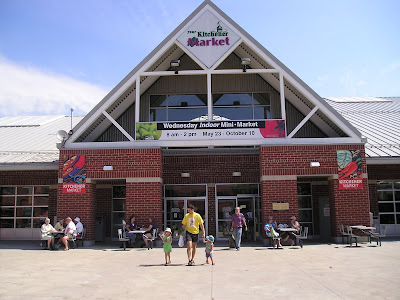
The front square. Hmm, I see they have a Wednesday market in the summer as well.
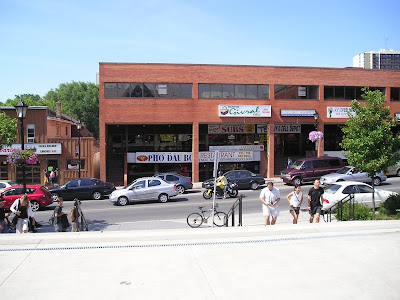
One of the nice things about the Kitchener Market is that it is in an area with a lot of other interesting shops and restaurants. Try the Pho Dau Bo for Vietnamese soups and noodles, or go for a banh mi or two from the Givral Deli upstairs. At $2 for each banh mi (or Vietnamese-style submarine sandwich) they are a real deal and delicious. Yes, I know, you can get them even cheaper in Toronto. We're not in Toronto. There are also several bakeries, a Vietnamese grocery store, a German deli, an Indian bulk store, and the Korean Barbeque Restaurant (yum) all in the same block.
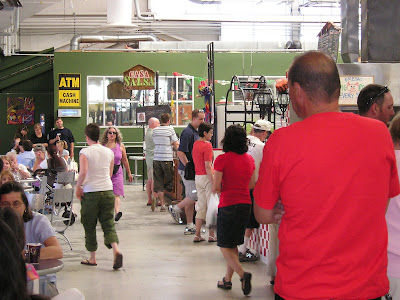
There are also a number of little restaurant booths right inside the market, although I find them a bit pricey. However, the food has been good whenever I have tried one and there is quite a selection.
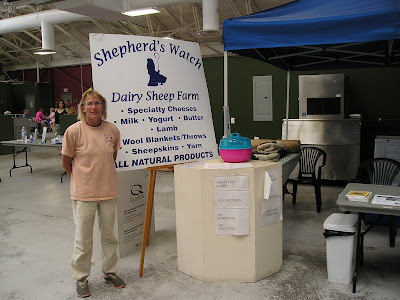

We stopped and chatted for a bit with this lady from Shepherd's Watch Dairy Sheep Farm, and ate some samples of the cheese made with sheeps' milk from their own farm only, without the use of pesticides or hormones. They had the usual feta, as well as blue cheese, camembert and a firm cheese with a bit of a bite. They also have meat, sheepskins, yarn and textiles. It's your one-stop sheep product shopping. You can contact them through Foodlink.
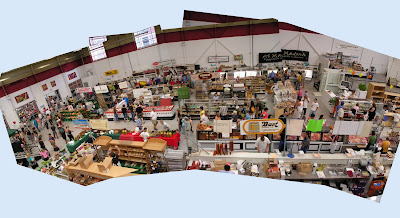
Inside, the upper level has the food court, and a few full-time vendors. But most of the action is downstairs in the main hall. Here is a cobbled-together overview of the shopping madness. Click the picture for a larger view.
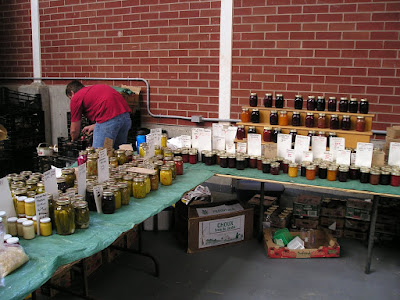
As soon as we get downstairs we usually head out the side door to a covered outside area, which is where almost all the fruits and veggies are during the summer. The first stand on the right as soon as we get out is a favourite stop. They have home-made preserves as well as a large selection of high quality locally grown produce at very reasonable prices. We got some fabulous cherries from them this trip, but we timed it perfectly - this is a one-shot deal; they don't have a lot and they harvest them all at once.
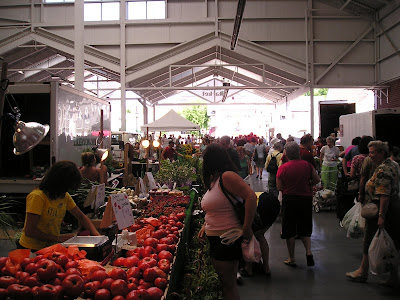
An overview of the "outside" vegetable market. Once things really get swinging, the market spills out into the street beyond as well.
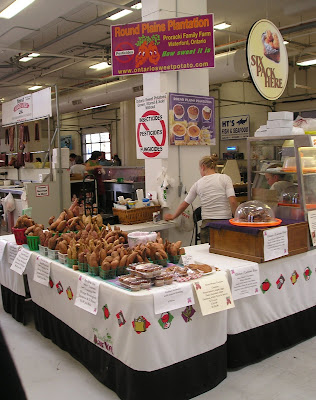
Inside, there is a large selection of bakeries and butchers, along with flower merchants, honey sellers, etc, and this stand from Round Plains Plantation. Yes, if you go to the Kitchener Market you can get several varieties of sweet potatoes pretty much all year round, as well as sweet potato based baked goods.

One of the honey sellers.
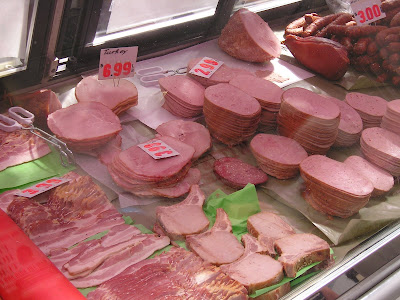
Kitchener's Germanic heritage means that there are still a lot of independant butchers producing high quality meats. Here is a typical sampling - sausages, cold cuts, bacon and a local specialty, smoked pork chops. Pork is king, but there's also lots of beef and poultry. I've even seen rabbit.
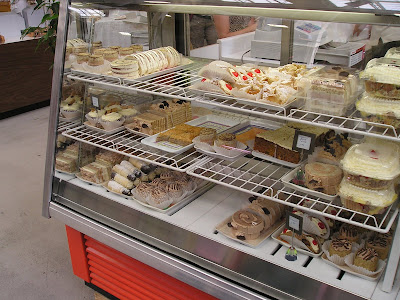
The only ones that compete with the butchers in terms of volume are the bakeries. This one has particularly elegant offerings, although there is also a large assortment of more prosaic breads and cakes, and several of them offer excellent poppyseed strudel, which is a personal favourite.

The high barn-like ceiling is adorned with multi-lingual welcome banners, reflecting the increasing diversity of the Kitchener-Waterloo area.

Thursday, 5 July 2007

Adobo Chicken

More or less adobo chicken, anyway - I eyeballed a couple different recipes, added a few things on my own and came up with this.

4 servings
40 minutes - 10 minutes prep

8 to 10 skinless, boneless chicken thighs
1/2 cup water
1/3 cup low sodium soy sauce (I used tamari; okay but on the edge of over-saltiness)
2/3 cup white vinegar
2 garlic-ginger cubes
2 bay leaves
1 1/2 teaspoons black peppercorns, crushed
2 tablespoons ketchup

Put the chicken, water, and well, everything into a good-sized pot, and simmer for 20 to 30 minutes, until the chicken is tender.

Remove the chicken, and boil the sauce over high heat for 10 minutes or so, until much reduced and thickened - there should be about 1 cup. Let the sauce cool, remove the bay leaves and skim the fat off.

To serve, sauté the chicken pieces in a little oil until nicely browned. Heat the sauce and serve over the chicken, with steamed rice. This is a good dish to make in advance, as it will keep overnight in the fridge, and just requires a little last minute attention.

Roasted Asparagus with Anise Seeds

Oop-la! Found a pound of asparagus in the fridge that I forgot I had bought, almost a week ago. But here's the advantage to buying the freshest local produce: it was still in fine condition. And this was a lovely way to say farewell to the asparagus season. The recipe came from Epicurious.

Roasted Asparagus with Anise Seeds - from Epicurious450 grams (1 pound) asparagus
1 tablespoon olive oil
1/2 teaspoon anise seeds
1/2 teaspoon sea salt

Preheat the oven to 450°F. Wash the asparagus and snap off the tough ends. Cut the asparagus into thirds, and toss the pieces in the olive oil in a shallow roasting pan. They should fit in in a single layer.

Grind the anise seed and mix with the salt. Sprinkle the salt and anise seed over the asparagus. Roast for 12 minutes*, until tender.


*They said 5-8 minutes. I said, uh-uh. But, like, watch the stuff.

Strawberry Lemonade Concentrate

This is not a lot of work to make although squeezing the lemons can get tedious. I'm not sure it really qualifies as seasonal Ontario food, given all that lemon juice and sugar, but I think I will give it the benefit of the doubt. And oh boy, is it ever good a little later in the summer on a hot, hot day.


24 servings (6 500 ml jars)
1 hour - 45 minutes prep time

12 cups (3 litres or quarts) strawberries
4 cups fresh lemon juice, lime juice or a combination
5 cups sugar

Rinse and drain the strawberries, and hull them.

Squeeze the juice from the lemons and/or limes and measure. You will likely need about 16 lemons or 24 limes, but it does not hurt to have a few extra on hand; they do vary quite a bit in juiciness.

Meanwhile, put the jars on to boil in a large canning kettle, with the water coming up at least an inch over the tops. Boil for 10 minutes before removing them to be filled.

Purée the strawberries. Heat them with the lemon or lime juice and sugar in a large pot, until the sugar is completely dissolved. Bring up to the point where it is about to boil, but do not allow it to boil.

Pour the concentrate into the hot sterilized jars to within 1 cm (1/2") of the tops.

Seal with lids prepared according to the manufacturers directions. (Generally, this means boil them for 5 minutes.) Return the jars to the boiling water bath, and boil for 15 minutes before removing and allowing to cool. Store in a cool, dark spot.

To serve, mix with cold water to taste; about one part concentrate to two parts water, with a few pieces of ice added.

Berry Vinegars

Fruit flavoured vinegars are very easy to make and add an elusive taste of summer to salads and other dishes all year long. I plan to make a few different ones this year. I started 2 weeks ago with strawberry vinegar.

Berry Vinegars - maceratingHere is sherry vinegar, with strawberries macerating in it. This is a bit of an experiment. In the past, I have found I prefer cheap ol' plain white vinegar to more expensive wine vinegars as it allows the unobstructed berry flavour to shine through the best. However, I thought strawberries and sherry vinegar would go together well so we shall see.

Straining the Berry Vinegar
The finished vinegar being strained for bottling. In addition to the strainer, I used about 6 layers of cheesecloth which seemed to do a pretty good job at keeping any residue out of the final product. Below; the finished vinegar bottled up and ready for use. There are two kinds; the strawberry-sherry vinegar and plain strawberry vinegar.

3 cups vinegar
2 weeks - 40 minutes prep time

Berry Vinegars - Finished
2 cups strawberries, raspberries or blueberries
2 cups plain white vinegar

Put a quart or litre bottle into a pot with enough water to cover by an inch or so, and bring to a boil. Boil ten minutes.

Meanwhile, wash the berries and hull them, and mash them in non-reactive bowl. Pour over the vinegar. When the jar is sterilized, drain it and put in the strawberry-vinegar mixture. Cap with a lid and ring which have been put in the boiling water for 5 minutes. At this stage it can be a used lid. (Be sure it is in good condition.)

Set in a cool, dark place for 2 weeks.

Strain the vinegar, preferably through several layers of cheesecloth. Put three 250 ml (1 cup/1/2 pint) jars in a pot and cover with water to an inch above the tops. Bring to a boil and boil them for 10 minutes. Remove and drain well. Ladle in the strained vinegar, and cap with new lids and rings. Pop the jars back into the boiling water, and boil for 5 minutes. Let cool and store.

I suspect these little jars of vinegar are acidic enough to be left out once opened, but I keep them in the fridge to be on the safe side.

Wednesday, 4 July 2007

Basic Basil Pesto

These lumpy little objects are my leftover gnocchi. Watch the garlic; at this time of year it is freshly harvested and will be stronger than if it had been stored.

8-10 servings
20 minutes

Basic Basil Pesto made with sunflower seeds1/4 cup sunflower seeds
1/2 teaspoon salt
2-6 cloves of garlic
2 cups packed basil leaves
1/2 cup extra-virgin olive oil

Prepare the basil by pulling the leaves from the stems, measuring them by packing them firmly into the measuring cup, then washing and draining them well.

Toast the sunflower seeds lightly, if you like, in a dry skillet over medium heat. Put them in the food processor with the salt and garlic, and process until finely chopped. Add the basil and process again until the basil is finely chopped. Process in the oil, until the pesto starts looking creamy.

To use the pesto, toss with hot cooked pasta or gnocchi and grated Parmesan or other hard, highly-flavoured cheese to taste. Or use to top baked potatoes, or fish or chicken, or... well, there are all kinds of ways to use pesto. Go forth and do so.

Whenever I make pesto in the summer when fresh basil is available, I make a full recipe and freeze whatever I don't use at once. I have coloured ice-cube trays that I use for the purpose; that way I know not to use the trays for ice cubes and so avoid having pesto-flavoured drinks. Once the pesto is frozen, pop it out of the trays and put it in a zipper-closure freezer bag. Double bag it, or the flavour of pesto will be all through your freezer.

I figure 1 to 2 pesto cubes equals 1 serving. I think it works better not to freeze the pesto with cheese mixed in, but to mix in freshly grated cheese when you use it. The cubes should be taken out of the freezer at least an hour before they are wanted; you can help them along a little with brief zaps in the microwave, but don't overdo it.

Strawberries with Maple Jellies

Well. This was highly experimental - the second time I have tried using agar-agar - and not entirely a roaring success. Not a roaring failure by any means, but it needs some work. The jellies were very firm, and I couldn't quite decide if I liked that or not. I did like the little bursts of maple flavour interspersed with the strawberries though, and I can see doing something like this with other flavours; mint for example, as a way to perk up fruit salads.

If anyone has more familiarity with agar-agar, I'd like some comments and suggestions.

4 servings
1 hour 15 minutes - 15 minutes prep time

Strawberries with Maple Agar-Agar JelliesMaple Jellies:
1/4 ounce (7 grams) agar-agar
1 cup water
pinch salt
1/2 cup maple syrup

4 cups (1 quart or 1 litre) strawberries

Put the agar, water, salt and maple syrup in a small pot and bring to a boil. Simmer hard for 5 minutes. Pour into a loaf pan or other mold and refrigerate until set, about 1 hour.

Wash, hull and cut the berries in half. Cut the jelly in small cubes, and mix with the berries. Serve with a dab of whipped cream, if desired.

Sunday, 1 July 2007

Gumbo 'Z'erbes

Gumbo 'z'erbes (aux herbes) is a kind of stone soup; something good made from scraps of this 'n' that, in this case a mixture of greens. Consequently, it's a very flexible recipe. Traditionally in Louisiana it was served as a meat-free dish (although it's not clear to me whether that would exclude the bacon fat or not) during Lent. However, there is no chance of making this dish during Lent in Ontario, so you might as well throw in some bacon and/or sausage if you can. A little pork does wonders for such dark and rather overwhelming greens. If you don't eat pork, consider using smoked turkey pieces cooked in advance to provide the broth as well as the meat.

You can use familiar greens like spinach, kale, beet-greens and chard, or less familiar greens like radish or turnip tops and the leaves from cauliflower and broccoli. They are really quite edible.

Gumbo ZerbesThe finished dish.

Greens used to make Gumbo ZerbesFor this batch I used a handful of spinach, the leaves from a cauliflower, the leaves from a head of broccoli, about half the tops from the radishes, the tops from two onions, a stalk of celery, and some chopped up raw veggies left-over from another meal.

Preparing brassica leaves such as chard, broccoli, kale or cabbageAs is usually the case with brassicas, the thin dark leafy parts of the leaves are the best; the wide tough mid-ribs are not appetizing and are discarded. It's easiest to just start pulling up the ribs from the bottom, ripping off the leafy parts until you reach a part of the mid-rib that is tender enough that it snaps in your hand.

4 servings
1 hour 15 minutes - 30 minutes prep time

6 to 8 cups chopped greens (use a mixture of at least 4 kinds)

1 large onion (I used 2 smaller ones)
1/4 teaspoon black peppercorns
1/4 teaspoon allspice
1/4 teaspoon oregano
1/4 teaspoon thyme
1/4 teaspoon cayenne pepper

1/4 cup vegetable oil OR bacon fat
OR 200 grams lean bacon and 200 grams chorizo (optional)
1/4 cup flour (I used rice flour)
5 cups broth
2 bay leaves

4 cups cooked rice

Wash the greens, strip them of any coarse stems and damaged or yellowed parts, roll them up and shred them finely. Measure them and put them in a large pot. Steam them in the water that clings to them after washing. When well wilted, remove them from the heat and set them aside.

Peel and chop the onion, and set it aside in a bowl. Crush the pepper and allspice together, and add them to the onion along with the other spices.

Chop the bacon and sausage. Heat the bacon or fat in a skillet, and sprinkle the flour over. Cook over medium heat until the flour is well amalgamated and browned, stirring constantly.

Meanwhile, heat the broth with the sausage slices (if using) and bay leaves.

When the roux is cooked (the bacon/fat and flour) mix in some of the broth to loosen, then add it to the pot of broth. Add the cooked greens and heat through, stirring well.

Serve over freshly cooked rice, or if you have left-over cooked rice, break it up with wet hands into the gumbo and heat it with the greens.